Digital Time Tracking vs. Paper Timesheets: Understanding Ontario’s Legal Requirements

.avif)


Key Takeaways
- The ESA does not require a specific timekeeping format. Employers can use paper or digital records, but the information captured and retention periods are fixed by law.
- Most non-salaried construction employees require daily and weekly hours records, including overtime hours and rates, kept for three years.
- Paper timesheets are legal, but they carry a much higher risk of being incomplete, illegible, or lost, which puts the employer at a disadvantage in a dispute or audit.
- Ontario employers with 25 or more employees on January 1 of any year must have a written electronic monitoring policy in place by March 1, whether or not they use digital time tracking tools that include GPS or biometric features.
- Accurate time records directly affect WSIB premium calculations, since insurable earnings are based on actual hours and wages paid.
- Digital time-tracking software reduces manual-entry errors, supports multi-jobsite crews, and creates a defensible audit trail that paper records rarely provide.
- Employers who fail to keep proper hours records carry the burden of proof in a wage dispute, since an employment standards officer will rely on the best evidence available, which is often the employee’s account when the employer has nothing to counter it.
A Ministry of Labour inspector shows up at a jobsite trailer and asks for three years of hourly records for every worker on the crew. The general contractor pulls out a stack of handwritten timesheets, some smudged, a few missing signatures, and one week in which the foreman just estimated the hours because the sheet went missing. That is not a hypothetical situation. It is the kind of gap that turns a routine audit into an order to pay, and it happens more often than most Ontario contractors expect.
Time tracking sounds like an administrative afterthought until it becomes the deciding factor in a wage dispute, a WSIB audit, or a Ministry of Labour investigation. For construction employers running crews across multiple jobsites, with workers moving between projects and often clocking in before a supervisor even arrives, the stakes are higher than in a typical office environment.
This article explains what Ontario’s Employment Standards Act(ESA) actually requires when it comes to tracking employee hours, how paper timesheets stack up against digital time tracking, and where Ontario’s electronic monitoring rules come into play. You will also learn how digital time tracking software helps contractors reduce payroll errors, stay audit ready, and report accurate figures to the Workplace Safety and Insurance Board (WSIB).
What Ontario Construction Employers Must Track Under ESA Timekeeping Rules

The Employment Standards Act, 2000 sets out exactly what employers must record for each employee, but it does not tell employers how to record it. The employer can choose their own record format, as the ESA 2000 does not provide specific formatting requirements. Instead, the ESA 2000 sets out what information must be captured and the time periods during which it must be maintained and kept readily available for inspection. This is the core point that gets lost in the “digital versus paper” debate. Ontario law is format-neutral. What it is not neutral about is completeness.
For most hourly construction employees, section 15(1) of the ESA requires the employer to record:
- The employee’s name, address, and start date of employment.
- The number of hours worked each day and each week.
- The employee’s regular rate of pay and any overtime rate.
- Dates and times of any overtime hours worked, along with the rate paid.
- Copies of any written agreements to work excess hours or average overtime pay.
Some employees who are lawfully exempt from overtime and maximum‑hours provisions do not require daily and hourly hour records for ESA purposes, but these exemptions are narrowly defined and rarely apply in construction. Employers are not required to record the dates and times the employee worked or the hours of work for employees who are entitled to receive a fixed amount for each pay period, where the amount paid does not change, and who are exempt from overtime pay and the provisions for maximum hours of work. Very few construction trades workers fall into this category, since most are paid hourly and eligible for overtime; in practice, daily and weekly hours records apply to the vast majority of a construction payroll.
Retention periods matter as much as the content of the records. In Ontario, the Employment Standards Act, 2000 requires that payroll and other employment records be kept for at least three years after an employee ceases to be employed; other types of records have different retention periods. Vacation time and vacation pay records have a longer retention window and must be kept for five years from the date the record was created, so a payroll system that only holds three years of history can leave a gap on the vacation side.
If an employer cannot produce complete records, an employment standards officer will rely on the best evidence available and may make adverse determinations; this often disadvantages employers lacking records. Where an employer has not made and kept complete records, the employment standards officer will be required to make a determination with respect to issues such as the employee’s rate of pay and hours worked, based on the best evidence available. In practice, the best evidence is often the worker’s own recollection, since it is the only account left standing.
Paper Timesheets vs Digital Time Tracking for Construction Teams
Both paper timesheets and construction time tracking software can technically satisfy the ESA’s record-keeping requirements, since the law focuses on content and retention rather than medium. The practical differences show up in accuracy, defensibility, and day-to-day administration.
A key point construction employers often miss: paper timesheets are not automatically safer from a compliance standpoint just because they avoid electronic monitoring rules. A paper system with incomplete entries, missing signatures, or inconsistent daily logs is a direct violation of ESA recordkeeping obligations, regardless of the format used. The format does not create the risk. Incomplete data does.
Common Compliance Risks With Manual Timesheets
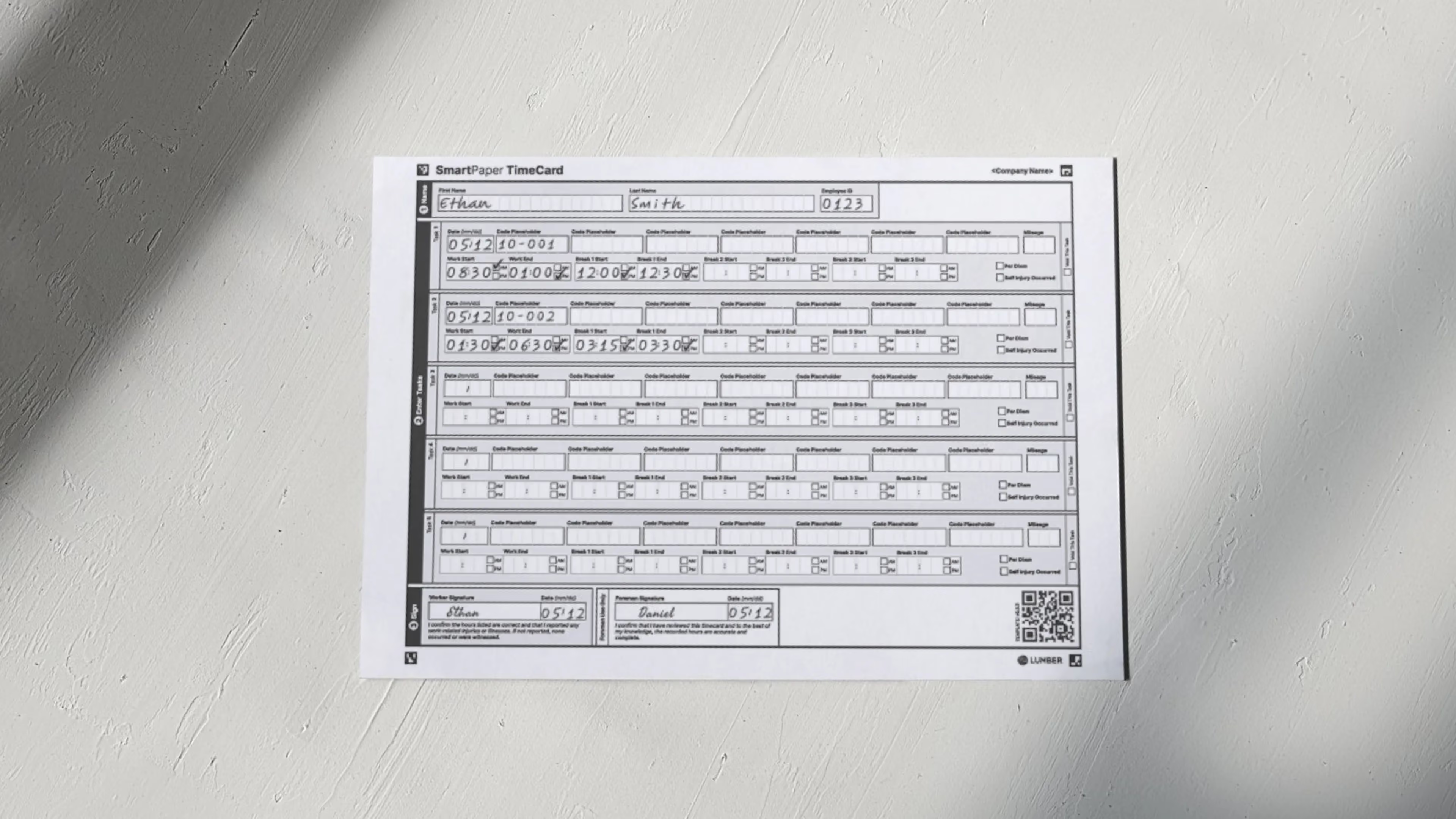
Manual timesheets create several recurring problems for Ontario construction employers, particularly on projects with multiple crews, subcontractors, and shifting jobsite locations.
Illegible or incomplete entries. Handwritten sheets filled out at the end of a long shift are prone to rounding, guesswork, and missing details such as break times or exact start and finish times.
Lost or damaged records. Paper stored in a jobsite trailer or a truck cab is exposed to weather, spills, and simple misplacement. Once a sheet is gone, so is the evidence needed to support payroll figures in a dispute.
Inconsistent recordkeeping across crews. When each foreman uses their own timesheet, the information captured can vary from one crew to another, making it harder to produce a consistent, ESA-compliant record set across the workforce.
Delayed payroll processing. Manual timesheets require someone to collect, interpret, and enter data before payroll can run, increasing the risk of transcription errors and delays that can affect deduction remittances.
Weak audit trail. As one legal recordkeeping case illustrates, an employer’s inability to produce hours worked records directly undermined its position in a wage dispute. The employer’s failure to keep records of hours worked, contrary to the Act, was a critical factor in the Tribunal finding in favour of the employee. The Tribunal stated that the employer has a statutory obligation to maintain a record of an employee’s hours of work pursuant to the ESA, and that it did not meet that obligation. Without records, the employer could not counter the employee’s version of events.
Ministry of Labour exposure. Employment standards officers can request three years of records during an inspection. A contractor without organized, complete records faces a slower, more difficult inspection process and a greater risk of an order to pay.
Electronic Monitoring Requirements Under Ontario Law

Digital time tracking often involves features beyond a simple clock-in and clock-out, such as GPS location stamps, geofencing, photo verification, or device tracking. This is where Ontario’s electronic monitoring policy requirement becomes relevant for construction employers.
Since April 2022, Part XI.1 of the ESA requires certain employers to disclose their monitoring practices in writing. Employers with 25 or more employees on January 1 of any year are required to have a written policy on the electronic monitoring of employees. The policy must state whether or not the employer electronically monitors employees. If monitoring does occur, the policy must describe how and under what circumstances it occurs, the purposes for which the collected information may be used, and the date it was prepared.
The count applies province-wide, not per jobsite. Where an employer has multiple locations, all employees employed at each location in Ontario must be included when determining whether the 25-employee threshold has been met. A contractor with several small crews spread across job sites can easily hit the 25-employee mark even if no single site employs that many workers.
Once the threshold is met, the deadline for having a policy in place is fixed. Beginning in 2023, employers with 25 or more employees on January 1 of each year must have the policy in place by March 1 of that year. The policy must then be distributed to employees, and copies must be retained. Guidance from industry sources states that policies should be retained for 3 years after they cease to be in effect, and any updated version must be redistributed within 30 days of a revision.
It is worth being clear about what this rule does and does not do. The ESA requires employers meeting the threshold to disclose monitoring practices; it does not itself prohibit monitoring or create new statutory privacy rights, but failure to comply with the disclosure and distribution requirements can result in administrative enforcement action.
It does not create any new privacy rights for employees. In other words, Ontario law does not restrict GPS tracking or device monitoring on a jobsite. It requires transparency about it. A construction time tracking software rollout that includes location stamps or geofencing is fully permitted, provided the employer discloses this in a compliant written policy when the 25-employee threshold applies.
Non-compliance carries a real cost. Employers who fail to have the required policy in place or to distribute it within the mandated timeframe can face administrative penalties, and repeated violations increase their exposure.
How Digital Time Tracking Improves Payroll and WSIB Accuracy
Accurate time records are not just an ESA issue. They directly affect two other areas where Ontario construction employers face regular scrutiny: payroll remittances and WSIB premium reporting.
WSIB premiums are calculated based on actual insurable payroll, and construction is a Schedule 1 industry where coverage is mandatory. Maintaining proper records means keeping accurate payroll and incident records and making them available to the WSIB upon request. Good recordkeeping supports effective claims management and helps ensure that premium assessments are accurate. If recorded hours and wages do not match what is reported to WSIB, the discrepancy can trigger a reconciliation issue or an audit.
WSIB does not rely solely on what a contractor self-reports. WSIB can and does cross-reference your payroll reports with CRA T4 summaries. If the numbers don’t match, expect a call. Back assessments can go back up to four years, with interest and penalties. When hours worked are tracked accurately at the point of work, rather than reconstructed later from memory or handwritten notes, the payroll figures that feed into both CRA remittances and WSIB reporting are far more likely to align.
Digital time tracking also reduces the administrative lag between hours worked and hours paid. Automated calculation of overtime thresholds, break deductions, and daily totals reduces the arithmetic errors that creep into manual payroll processing, particularly on jobs with varying shift lengths or multiple pay rates for employees working across different trade classifications.
How Digital Time Tracking Software Helps Ontario Contractors Stay Compliant
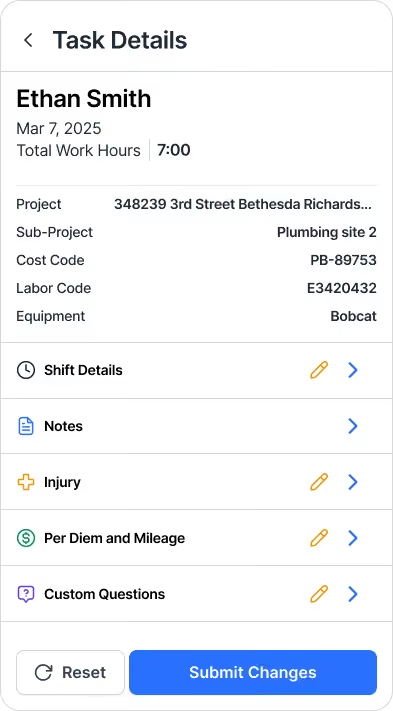
For a construction business managing crews across several active job sites, a digital time-tracking system built for the industry addresses several compliance pressure points at once.
Consolidated hours records. Instead of collecting paper sheets from multiple foremen, hours worked at every jobsite feed into a single system, satisfying the ESA’s requirement to record daily and weekly hours for each employee.
Automatic retention. A digital system retains records electronically, reducing the risk of losing the three-year history the ESA requires or the five-year vacation pay record.
Overtime and rate accuracy. Systems built for construction payroll can apply the correct overtime threshold and rate automatically, reducing manual calculation errors on multi-rate crews.
Audit readiness. When a Ministry of Labour officer or a WSIB auditor requests records, a digital system can produce the requested history quickly, rather than requiring a search through boxes of paper.
Job costing accuracy. Because hours are tied to specific jobsites and cost codes as they are recorded, job costing and payroll stay aligned, which also supports more accurate WSIB classification reporting across different types of work.
Electronic monitoring disclosure support. For contractors who meet the 25-employee threshold, using a system with GPS or verification features means the written electronic monitoring policy needs to accurately describe those specific features, since the policy content must match what is actually being used.
This is where Lumber’s approach to Canadian construction payroll fits in. Lumber is built around the realities of multi-jobsite crews, union payroll rules, and the recordkeeping obligations that come with the ESA, giving contractors a system that keeps time records, job costing, and payroll data aligned rather than scattered across paper sheets and spreadsheets.
Ontario’s Employment Standards Act does not force construction employers to switch to digital time tracking. It requires accurate, complete hours records retained for the correct period, and it holds employers responsible when those records fall short. Paper timesheets can meet that bar in theory, but in practice, they are far more likely to produce gaps that cost a contractor in a wage dispute, a Ministry of Labour inspection, or a WSIB audit.
Contractors running crews across multiple jobsites should review three things without delay: whether their current timekeeping method actually captures everything section 15(1) of the ESA requires, whether their business has crossed the 25-employee threshold that triggers the electronic monitoring policy requirement, and whether their recorded hours match what is being reported to WSIB and CRA. Getting ahead of these questions now is far less costly than answering them for the first time during an audit.
Frequently Asked Questions
Is digital time tracking legal in Ontario?
Yes. The Employment Standards Act does not specify a required format for time records, so digital time tracking is fully legal, provided it captures the information the ESA requires, such as daily and weekly hours worked, overtime hours, and pay rates. If the digital system includes features like GPS location tracking, biometric verification, or device monitoring, and the employer has 25 or more employees on January 1 of a given year, the employer must also have a written electronic monitoring policy in place by March 1 of that year describing how the monitoring works and how the collected information is used.
What employee time records are Ontario employers required to keep?
Under section 15(1) of the ESA, employers must record each employee’s name, address, and start date, along with the hours worked each day and each week, the regular pay rate, and any overtime hours and rates. Salaried employees who are exempt from overtime and maximum hours provisions only require records of hours worked beyond their regular work week, or no hours records at all if overtime rules do not apply to them. Employers must also retain copies of any excess hours or averaging agreements and vacation time and pay records, which have a longer five year retention period.
How long must construction companies keep timesheet records in Ontario?
Most employment records, including hours worked, overtime, and pay rate information, must be kept for three years after the employee stops working for the employer. Vacation time and vacation pay records must be kept for five years from the date the record was made. Copies of excess hours or averaging agreements must be kept for three years after the last day worked under that agreement. Electronic monitoring policies should be retained for three years after the policy is no longer in effect. Since retention periods vary by record type, contractors should track each category separately rather than applying a single blanket rule.
Are paper timesheets compliant with Ontario labour laws?
Paper timesheets can be fully compliant, since the ESA does not mandate a specific recordkeeping format. What matters is whether the paper records capture all required information, remain legible and complete, and are retained for the correct period and made available for inspection on request. In practice, paper systems carry a higher operational risk of incomplete entries, illegible handwriting, and lost sheets, particularly across multiple jobsites. If those records are ever challenged in a Ministry of Labour investigation or a wage dispute, missing or incomplete paper records leave the employer with limited evidence to support its position.
What are the risks of using paper timesheets in construction?
The main risks are incomplete or illegible entries, lost or damaged sheets, inconsistent recordkeeping across different foremen or crews, delayed payroll processing due to manual data entry, and a weak audit trail if hours are ever disputed. Since employment standards officers rely on the best available evidence when records are incomplete, a contractor without solid documentation is often at a disadvantage against an employee’s own account of hours worked. Paper systems also make it harder to reconcile hours across multiple jobsites quickly, which can delay payroll and increase the chance of WSIB reporting discrepancies.
Lorem ipsum dolor sit amet, consectetur adipiscing elit. Donec ullamcorper mattis lorem non. Ultrices praesent amet ipsum justo massa. Eu dolor aliquet risus gravida nunc at feugiat consequat purus. Non massa enim vitae duis mattis. Vel in ultricies vel fringilla.
Introduction
Mi tincidunt elit, id quisque ligula ac diam, amet. Vel etiam suspendisse morbi eleifend faucibus eget vestibulum felis. Dictum quis montes, sit sit. Tellus aliquam enim urna, etiam. Mauris posuere vulputate arcu amet, vitae nisi, tellus tincidunt. At feugiat sapien varius id.
Eget quis mi enim, leo lacinia pharetra, semper. Eget in volutpat mollis at volutpat lectus velit, sed auctor. Porttitor fames arcu quis fusce augue enim. Quis at habitant diam at. Suscipit tristique risus, at donec. In turpis vel et quam imperdiet. Ipsum molestie aliquet sodales id est ac volutpat.


Ipsum sit mattis nulla quam nulla. Gravida id gravida ac enim mauris id. Non pellentesque congue eget consectetur turpis. Sapien, dictum molestie sem tempor. Diam elit, orci, tincidunt aenean tempus. Quis velit eget ut tortor tellus. Sed vel, congue felis elit erat nam nibh orci.

Dolor enim eu tortor urna sed duis nulla. Aliquam vestibulum, nulla odio nisl vitae. In aliquet pellentesque aenean hac vestibulum turpis mi bibendum diam. Tempor integer aliquam in vitae malesuada fringilla.
Elit nisi in eleifend sed nisi. Pulvinar at orci, proin imperdiet commodo consectetur convallis risus. Sed condimentum enim dignissim adipiscing faucibus consequat, urna. Viverra purus et erat auctor aliquam. Risus, volutpat vulputate posuere purus sit congue convallis aliquet. Arcu id augue ut feugiat donec porttitor neque. Mauris, neque ultricies eu vestibulum, bibendum quam lorem id. Dolor lacus, eget nunc lectus in tellus, pharetra, porttitor.
Ipsum sit mattis nulla quam nulla. Gravida id gravida ac enim mauris id. Non pellentesque congue eget consectetur turpis. Sapien, dictum molestie sem tempor. Diam elit, orci, tincidunt aenean tempus. Quis velit eget ut tortor tellus. Sed vel, congue felis elit erat nam nibh orci.
Mi tincidunt elit, id quisque ligula ac diam, amet. Vel etiam suspendisse morbi eleifend faucibus eget vestibulum felis. Dictum quis montes, sit sit. Tellus aliquam enim urna, etiam. Mauris posuere vulputate arcu amet, vitae nisi, tellus tincidunt. At feugiat sapien varius id.
Eget quis mi enim, leo lacinia pharetra, semper. Eget in volutpat mollis at volutpat lectus velit, sed auctor. Porttitor fames arcu quis fusce augue enim. Quis at habitant diam at. Suscipit tristique risus, at donec. In turpis vel et quam imperdiet. Ipsum molestie aliquet sodales id est ac volutpat.
Mi tincidunt elit, id quisque ligula ac diam, amet. Vel etiam suspendisse morbi eleifend faucibus eget vestibulum felis. Dictum quis montes, sit sit. Tellus aliquam enim urna, etiam. Mauris posuere vulputate arcu amet, vitae nisi, tellus tincidunt. At feugiat sapien varius id.
Eget quis mi enim, leo lacinia pharetra, semper. Eget in volutpat mollis at volutpat lectus velit, sed auctor. Porttitor fames arcu quis fusce augue enim. Quis at habitant diam at. Suscipit tristique risus, at donec. In turpis vel et quam imperdiet. Ipsum molestie aliquet sodales id est ac volutpat.
- Lectus id duis vitae porttitor enim gravida morbi.
- Eu turpis posuere semper feugiat volutpat elit, ultrices suspendisse. Auctor vel in vitae placerat.
- Suspendisse maecenas ac donec scelerisque diam sed est duis purus.
Lectus leo massa amet posuere. Malesuada mattis non convallis quisque. Libero sit et imperdiet bibendum quisque dictum vestibulum in non. Pretium ultricies tempor non est diam. Enim ut enim amet amet integer cursus. Sit ac commodo pretium sed etiam turpis suspendisse at.
Tristique odio senectus nam posuere ornare leo metus, ultricies. Blandit duis ultricies vulputate morbi feugiat cras placerat elit. Aliquam tellus lorem sed ac. Montes, sed mattis pellentesque suscipit accumsan. Cursus viverra aenean magna risus elementum faucibus molestie pellentesque. Arcu ultricies sed mauris vestibulum.

Critical Construction Compliance | Awareness Week
Mar 16, 2026
Apr 15, 2026
Nov 30, 2026
Dec 15, 2026
Essential resources for contractors