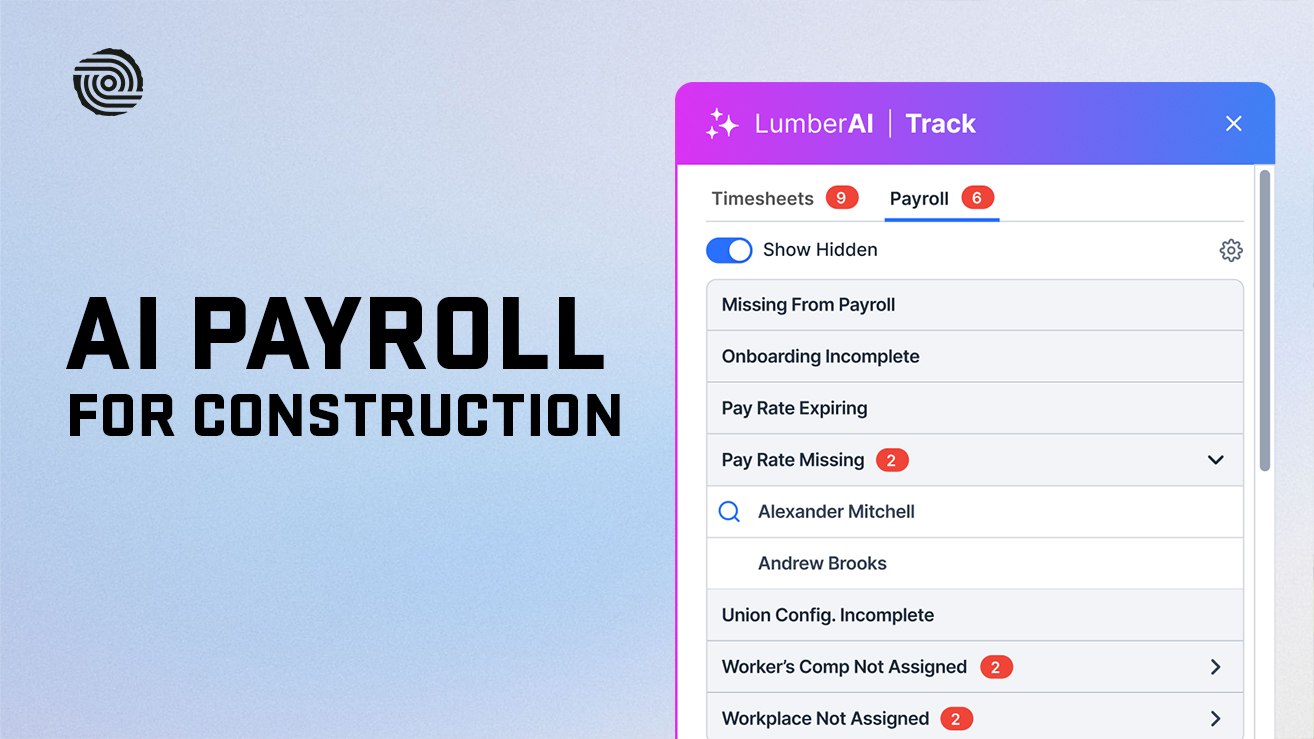
Scaling Union Crews? How AI Keeps Your Payroll Spot-On

.avif)


Managing union payroll for a small crew is straightforward when you are familiar with the collective bargaining agreement and the workers. However, as you add crews, projects, classifications, and jurisdictions, the process becomes increasingly complex. Rates may change by county, fringe contributions can differ by classification, and overtime rules often vary by agreement. Each mistake can result in financial loss, wasted time, and diminished trust.
AI for union payroll is transforming how construction contractors operate. Rather than relying on manual checks and institutional knowledge, AI tools can interpret CBAs, apply the correct rules automatically, and flag compliance issues before they become violations.
How Adding More Union Crews Makes Payroll More Complex

Union payroll involves more than simply paying workers for hours worked. Each CBA outlines detailed rules for compensation. With one crew on a single project, these rules are manageable. As operations scale, complexity increases rapidly.
As you add more union crews, the following factors change:
More CBAs to manage: Different contractors may be signatories to various agreements, each covering distinct trades, jurisdictions, or effective dates. A mid-sized contractor operating across multiple counties may manage dozens of agreements simultaneously, each with unique wage scales, benefit rates, and reporting requirements.
More worker classifications: A single project may include journeymen, apprentices at various progression steps, foremen, general foremen, and specialty roles. Each classification has a different base rate, fringe contribution rate, and potentially unique overtime thresholds. Misclassifying a worker can affect every paycheck for all impacted employees.
More jurisdictions: Prevailing wage rates vary by county and project type. For example, a contractor working across multiple California counties may encounter different rate requirements for the same classification based on project location. Maintaining current and accurate rates across all projects is a significant administrative challenge.
More fringe benefit tracking: Health, pension, annuity, and apprenticeship fund contributions are calculated hourly and submitted to separate funds. As crew size increases, so does the risk of miscalculation or missed contributions. These errors can lead to audits and penalties that far exceed the original underpayment.
The administrative workload increases exponentially, not linearly.
Manual Payroll Processes Can’t Handle Union Complexity at Scale
Many contractors continue to use spreadsheets, printed CBAs, and experienced payroll staff to manage union payroll. This approach is effective only until project volume increases or a key team member departs.
Manual processes often fail in predictable ways. Wage rate tables may become outdated and go unnoticed until a compliance audit. New payroll administrators may apply overtime rules from the wrong agreement. Fringe benefit contribution rates can be entered incorrectly when a CBA renews. Apprentices may be classified at the wrong progression step for an entire pay period.
Each of these errors requires significant time to investigate, correct, and resubmit. Beyond administrative costs, wage underpayments can lead to back pay obligations, penalties, and strained relationships with union representatives and workers.
The core issue is that manual processes rely on individuals consistently remembering and applying numerous rules for every payroll run. This expectation becomes increasingly unrealistic as the number of workers, projects, and agreements grows.
Certified payroll reporting adds further complexity. For prevailing wage projects, contractors must submit weekly reports documenting hours, classifications, wages paid, and fringe benefits. A single error can trigger a review, and this risk increases significantly across multiple projects and crews.
AI Can Read CBAs and Apply Payroll Rules Automatically
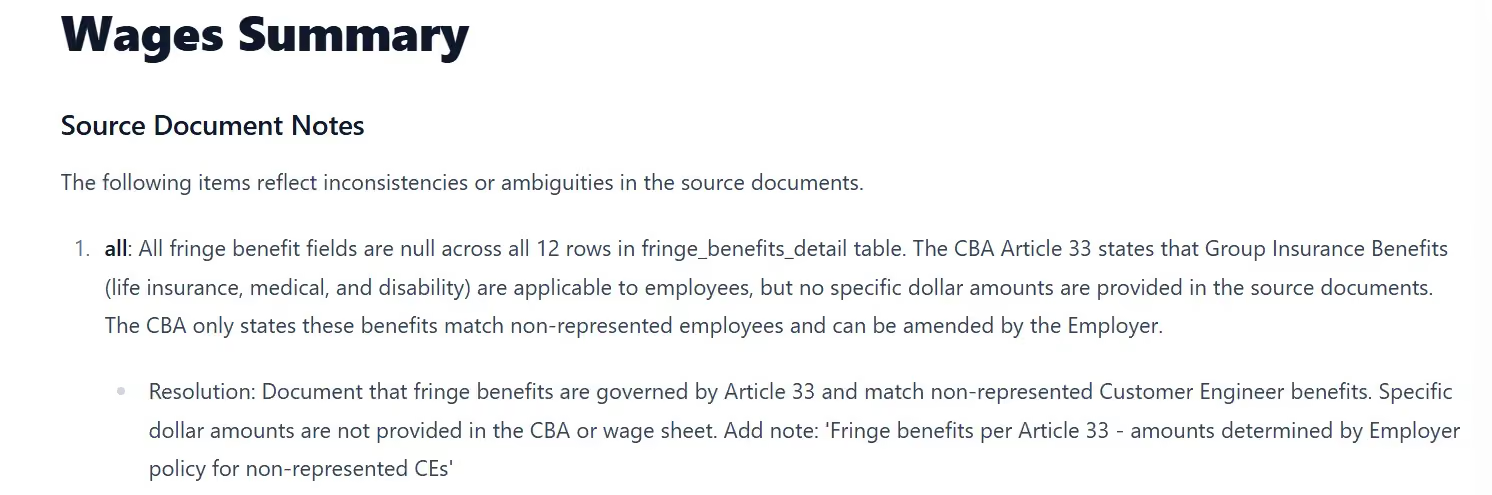
Technology is making a practical difference in this area. AI systems designed for construction payroll can process the text of collective bargaining agreements and extract the specific rules that govern payroll calculations.
Rather than requiring a payroll administrator to manually translate CBA language into spreadsheet formulas, AI reads the agreement and automatically applies the correct wage rates, fringe contributions, overtime rules, shift differentials, and reporting requirements. When a CBA renews and rates change, updating the system simply involves uploading the new agreement instead of manually editing multiple files.
The practical capabilities include:
Wage and classification accuracy: The AI identifies and applies the correct base rate for each worker classification, eliminating the need for payroll staff to manually reference rates. This is especially important when workers change classifications or when new apprentice progression steps take effect.
Fringe benefit calculation: Contribution rates for health, pension, annuity, and training funds are sourced directly from the agreement and calculated per hour worked. The system tracks total contributions and flags discrepancies before payroll is finalized.
Overtime rule application: Whether an agreement requires overtime after 8 hours daily, 40 hours weekly, or both, the AI applies the correct thresholds and calculates premium pay accordingly. For agreements with shift differentials or consecutive-day premiums, these rules are applied automatically.
Compliance checking: Before payroll is submitted, AI compares calculated amounts against prevailing wage requirements, CBA minimums, and fringe obligations to identify any shortfalls. This process catches errors that might otherwise be discovered during an audit.
For contractors working on prevailing wage projects in California, tools such as Lumber’s Prevailing Wage Agent further enhance compliance by checking certified payroll reports against federal and state wage requirements, flagging violations and missing data before submission.
How ILA Ensures Accurate Union Payroll Every Time
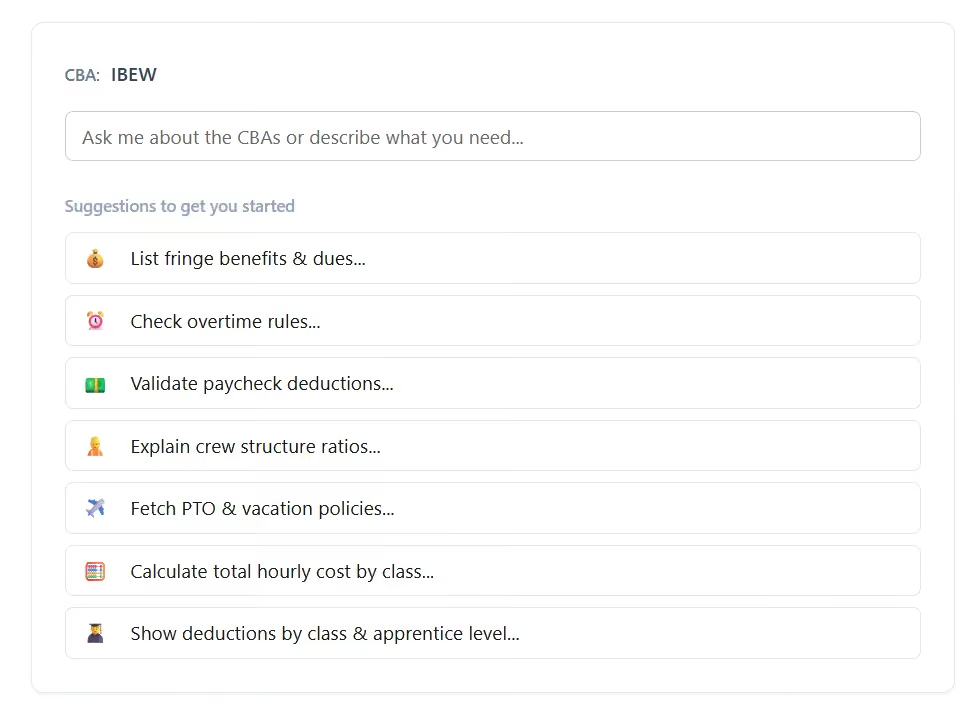
ILA (Intelligent Labor Assistant) by Lumber integrates the AI capabilities required to manage union payroll at scale. It operates across three key areas that directly impact payroll accuracy.
Union Agent manages the CBA aspect of payroll. Contractors and union administrators upload their collective bargaining agreements directly to the platform. The AI analyzes each document and extracts all payroll-relevant provisions, including base wage rates by classification, fringe benefit contribution rates, overtime rules, shift differentials, holiday pay, and reporting requirements. Business agents can ask direct questions about any agreement, including cross-agreement comparisons, and receive answers sourced from the actual document rather than relying on memory.
This is especially valuable when managing payroll for crews working under multiple agreements. Instead of maintaining separate reference documents and risking errors, the AI organizes all CBA provisions in a single, searchable location.
Prevailing Wage Agent manages compliance verification for certified payroll. Contractors upload their CPR documents, and the agent checks wage rates, overtime, and fringe benefits against both federal and California state requirements. It generates a compliance report identifying violations, missing information, and areas where compliance cannot be determined due to incomplete data. This replaces manual third-party reviews and provides contractors with a clear understanding of their compliance status before submitting reports.
Paper Timecard Agent addresses data entry challenges at the beginning of the payroll process. For crews using paper timecards, the agent extracts time data from a photo of the card and converts it into a digital timesheet. This eliminates manual data entry errors and accelerates the process of transferring field time data into the payroll system.
Together, these tools support the entire payroll process, from time capture to compliance verification, with AI managing rule application and addressing areas where manual processes are most prone to error.
Scale Union Payroll Without Increasing Compliance and Payroll Errors with ILA by Lumber
The goal for any growing contractor is to add crews and projects without increasing administrative headcount or compliance risk. AI for union payroll enables this by managing the rules-based tasks that previously required experienced payroll staff.
When AI processes payroll calculations based on the actual CBA, classification errors decrease. Automatic calculation of fringe contributions from agreement rates helps catch underpayments before submission. Certified payroll reports checked against current prevailing wage requirements allow violations to be identified and corrected before audits.
As a result, payroll scales more reliably. Both a contractor managing 5 union workers and one managing 50 can process accurate, compliant payroll without requiring a proportional increase in administrative staff.
ILA by Lumber is designed specifically for construction contractors facing these complexities. The Union Agent, Prevailing Wage Agent, and Paper Timecard Agent address the key points in the payroll process where union complexity most often leads to errors.
Frequently Asked Question
How do you manage payroll for union workers?
Union payroll requires applying the specific rules in the applicable collective bargaining agreement, including base wage rates by classification, fringe benefit contributions, overtime provisions, and shift differentials. Contractors can manage this manually or use AI-powered tools that read CBA documents and apply the correct rules automatically.
What makes union payroll more complex than regular payroll?
Union payroll is governed by detailed CBAs that specify exact wage rates, benefit contribution requirements, and overtime rules for each classification. These rules vary by agreement, jurisdiction, and trade. Managing multiple agreements across multiple projects requires tracking many variables that standard payroll software was not built to handle.
Can AI accurately process union payroll?
Yes. AI tools designed for union payroll can read CBA documents, extract payroll rules, and apply them to worker time data. They can also check calculated amounts against prevailing wage requirements and flag discrepancies before payroll is finalized. The accuracy depends on having current, correctly uploaded agreement documents in the system.
What is a CBA in payroll?
A collective bargaining agreement (CBA) is the contract between a union and an employer that defines employment terms, including wage rates, benefits, overtime rules, and working conditions. In payroll, the CBA is the authoritative source for what each worker is owed and what the employer must contribute to benefit funds.
Lorem ipsum dolor sit amet, consectetur adipiscing elit. Donec ullamcorper mattis lorem non. Ultrices praesent amet ipsum justo massa. Eu dolor aliquet risus gravida nunc at feugiat consequat purus. Non massa enim vitae duis mattis. Vel in ultricies vel fringilla.
Introduction
Mi tincidunt elit, id quisque ligula ac diam, amet. Vel etiam suspendisse morbi eleifend faucibus eget vestibulum felis. Dictum quis montes, sit sit. Tellus aliquam enim urna, etiam. Mauris posuere vulputate arcu amet, vitae nisi, tellus tincidunt. At feugiat sapien varius id.
Eget quis mi enim, leo lacinia pharetra, semper. Eget in volutpat mollis at volutpat lectus velit, sed auctor. Porttitor fames arcu quis fusce augue enim. Quis at habitant diam at. Suscipit tristique risus, at donec. In turpis vel et quam imperdiet. Ipsum molestie aliquet sodales id est ac volutpat.


Ipsum sit mattis nulla quam nulla. Gravida id gravida ac enim mauris id. Non pellentesque congue eget consectetur turpis. Sapien, dictum molestie sem tempor. Diam elit, orci, tincidunt aenean tempus. Quis velit eget ut tortor tellus. Sed vel, congue felis elit erat nam nibh orci.

Dolor enim eu tortor urna sed duis nulla. Aliquam vestibulum, nulla odio nisl vitae. In aliquet pellentesque aenean hac vestibulum turpis mi bibendum diam. Tempor integer aliquam in vitae malesuada fringilla.
Elit nisi in eleifend sed nisi. Pulvinar at orci, proin imperdiet commodo consectetur convallis risus. Sed condimentum enim dignissim adipiscing faucibus consequat, urna. Viverra purus et erat auctor aliquam. Risus, volutpat vulputate posuere purus sit congue convallis aliquet. Arcu id augue ut feugiat donec porttitor neque. Mauris, neque ultricies eu vestibulum, bibendum quam lorem id. Dolor lacus, eget nunc lectus in tellus, pharetra, porttitor.
Ipsum sit mattis nulla quam nulla. Gravida id gravida ac enim mauris id. Non pellentesque congue eget consectetur turpis. Sapien, dictum molestie sem tempor. Diam elit, orci, tincidunt aenean tempus. Quis velit eget ut tortor tellus. Sed vel, congue felis elit erat nam nibh orci.
Mi tincidunt elit, id quisque ligula ac diam, amet. Vel etiam suspendisse morbi eleifend faucibus eget vestibulum felis. Dictum quis montes, sit sit. Tellus aliquam enim urna, etiam. Mauris posuere vulputate arcu amet, vitae nisi, tellus tincidunt. At feugiat sapien varius id.
Eget quis mi enim, leo lacinia pharetra, semper. Eget in volutpat mollis at volutpat lectus velit, sed auctor. Porttitor fames arcu quis fusce augue enim. Quis at habitant diam at. Suscipit tristique risus, at donec. In turpis vel et quam imperdiet. Ipsum molestie aliquet sodales id est ac volutpat.
Mi tincidunt elit, id quisque ligula ac diam, amet. Vel etiam suspendisse morbi eleifend faucibus eget vestibulum felis. Dictum quis montes, sit sit. Tellus aliquam enim urna, etiam. Mauris posuere vulputate arcu amet, vitae nisi, tellus tincidunt. At feugiat sapien varius id.
Eget quis mi enim, leo lacinia pharetra, semper. Eget in volutpat mollis at volutpat lectus velit, sed auctor. Porttitor fames arcu quis fusce augue enim. Quis at habitant diam at. Suscipit tristique risus, at donec. In turpis vel et quam imperdiet. Ipsum molestie aliquet sodales id est ac volutpat.
- Lectus id duis vitae porttitor enim gravida morbi.
- Eu turpis posuere semper feugiat volutpat elit, ultrices suspendisse. Auctor vel in vitae placerat.
- Suspendisse maecenas ac donec scelerisque diam sed est duis purus.
Lectus leo massa amet posuere. Malesuada mattis non convallis quisque. Libero sit et imperdiet bibendum quisque dictum vestibulum in non. Pretium ultricies tempor non est diam. Enim ut enim amet amet integer cursus. Sit ac commodo pretium sed etiam turpis suspendisse at.
Tristique odio senectus nam posuere ornare leo metus, ultricies. Blandit duis ultricies vulputate morbi feugiat cras placerat elit. Aliquam tellus lorem sed ac. Montes, sed mattis pellentesque suscipit accumsan. Cursus viverra aenean magna risus elementum faucibus molestie pellentesque. Arcu ultricies sed mauris vestibulum.

Critical Construction Compliance | Awareness Week
Mar 16, 2026
Apr 15, 2026
Nov 30, 2026
Dec 15, 2026
Essential resources for contractors