



Construction Labor Costs in 2027: What the Latest Federal Data Means for Your Budget


Construction job openings rose 45% in a year. Over roughly the same period, total construction spending fell 2.7%. When labor gets more expensive and work volume shrinks, the difference comes out of margin.
That gap is the focus of The 2027 Margin Squeeze, a new benchmark report from Lumber Benefits and Risk built on 339 federal data points from the Bureau of Labor Statistics (BLS), the Census Bureau, the Agency for Healthcare Research and Quality (AHRQ), and OSHA. If you set bid rates, renew a health plan, or approve field wage increases, these numbers belong in your 2027 budget.
This article covers what an hour of construction labor costs today, where costs are rising fastest, which trades face the most pressure, and five practical moves to protect margin next year.
Key Takeaways
- An hour of construction labor costs employers $51.96, which is 11% above the private-sector average. About 30 cents of every dollar goes to benefits and legally required costs.
- Employer health insurance cost per hour rose 8.2% year over year, faster than wages (5.8%).
- Construction workers already pay 27.3% of a single-coverage health premium, a higher share than workers in manufacturing or transportation.
- Workers' compensation costs construction $1.10 per hour, 2.56 times the private-industry rate. Framing, plumbing and HVAC, drywall, concrete, and structural steel carry the highest injury rates.
- Construction quits rose from 1.5% to 2.4% of workers per month, a 60% jump, while layoffs fell. Workers are leaving for better offers.
- Budgets built on 2025 assumptions will understate 2027 labor costs. Contractors control benefits funding, workers' comp management, and retention design.
Why 2025 Cost Assumptions Will Understate 2027 Labor Costs
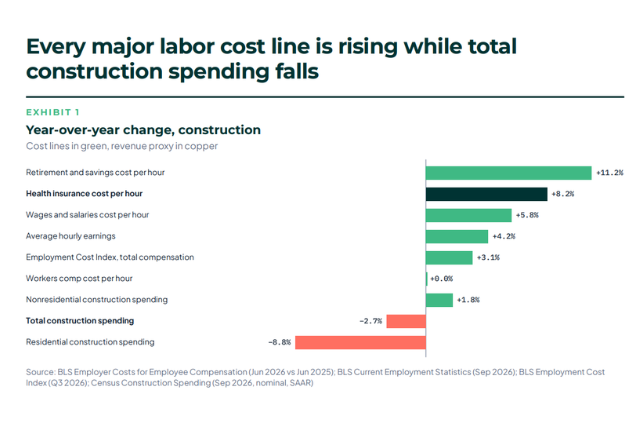
Every major labor cost line moved up over the past year. According to BLS Employer Costs for Employee Compensation (ECEC), comparing June 2026 to June 2025:
- Retirement and savings cost per hour rose 11.2%.
- Health insurance cost per hour rose 8.2%.
- Wages and salaries cost per hour rose 5.8%.
- Workers' comp cost per hour was flat at $1.10.
Revenue did not keep pace. Census data shows total construction spending down 2.7% year over year through September 2026, with residential down 8.8% and private manufacturing down 17.9%. Nonresidential spending grew 1.8%.
For budgeting, the Employment Cost Index (ECI) is the more reliable trend line. The ECI holds the mix of jobs constant, so it measures how much the same workforce costs over time. Construction total compensation on the ECI rose 3.1% through Q3 2026. ECEC figures, by contrast, can shift when the mix of occupations changes.
Compliance note: The October to November 2025 federal shutdown delayed several BLS releases. Recent monthly figures are preliminary and will be revised, so verify current data before locking budgets.
Construction Labor Is Harder to Find and Harder to Keep
Construction employment grew 1.3% year over year, 2.5 times the private-sector rate of 0.5%. Growth was uneven. Electrical contractors added 4.1% to payrolls and nonresidential building added 3.4%, while roofing shed 4.7% and structural steel and precast fell 2.0%.
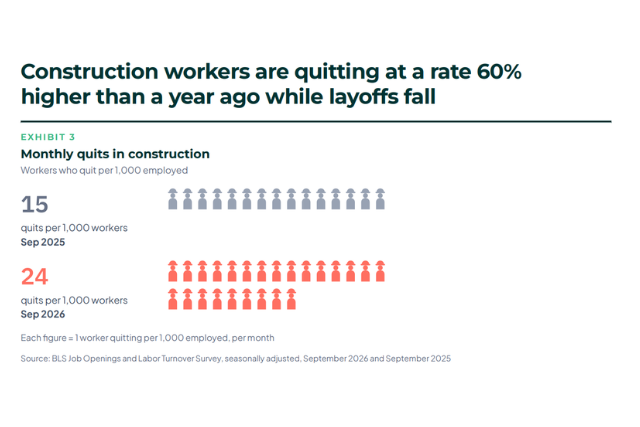
Turnover data from the BLS Job Openings and Labor Turnover Survey (JOLTS) tells the bigger story. In September 2026, construction workers quit at 2.4% per month, up from 1.5% a year earlier. Layoffs fell at the same time.
Rising quits with falling layoffs means workers are leaving voluntarily, usually for higher pay or better benefits. In that market, your benefits package and the share of premium employees pay become retention tools, not just line items.
Shrinking trades face a different problem. Headcount swings make Affordable Care Act (ACA) tracking harder. Employers with 50 or more full-time employees, including full-time equivalents, are Applicable Large Employers and must offer qualifying coverage to employees averaging 30 or more hours per week. Seasonal and variable-hour crews require careful measurement to stay compliant.
What an Hour of Construction Labor Actually Costs
Wages make up $36.13 of the $51.96 hourly total, or about 70%. The remaining $15.84 covers benefits and statutory costs:
- Legally required benefits, including workers' comp: $4.42
- Health insurance: $3.71
- Paid leave: $2.63
- Supplemental pay: $2.49
- Retirement: $2.39
- Other insurance: $0.19
The table below compares construction to private industry on the cost lines that matter most for 2027 planning.
Workers' comp is only 2.1% of the hour, but it shows the widest gap with other industries. It is also the statutory cost a contractor can influence most directly.
Health Insurance Is the Fastest-Growing Benefit Cost
Health insurance cost per hour rose 8.2% in a year. AHRQ data shows private-sector family premiums grew 7.1% in 2025, with a mean family premium of $26,281 and a mean single premium of $9,025.
The obvious response is to shift more cost to employees. The data suggests caution. In March 2026, construction workers paid 27.3% of a $746.06 monthly single-coverage premium, compared with 21.1% in manufacturing and 23.5% in trade, transportation, and utilities. With quits up 60%, a bigger paycheck deduction can push a skilled worker to a competitor.
Union membership in construction rose to 11.1% in 2025, up from 10.3% in 2024. For union crews, the collective bargaining agreement sets health and welfare contributions. For most of the field workforce, employers set benefit design.
Instead of raising employee contributions, contractors can look at:
- Funding arrangement. Level-funded, self-funded, or captive arrangements give claims visibility and can return surplus to the employer.
- Plan design. Network, deductible, and copay structure affect cost without changing the premium split.
- Pharmacy management. Prescription drugs are often a fast-growing share of claims.
Workers' Comp: Small Share, Widest Gap
The construction-wide injury rate of 2.2 cases per 100 full-time workers looks close to the private-industry rate of 2.3. That average hides the risk. According to the BLS Survey of Occupational Injuries and Illnesses for 2024, five trades sit well above the private rate: framing (4.6), plumbing and HVAC (3.0), drywall and insulation (2.9), poured concrete (2.8), and structural steel and precast (2.8).
Construction also accounted for 1,034 of 5,070 U.S. workplace deaths in 2024, about 1 in 5, according to the BLS Census of Fatal Occupational Injuries. OSHA's maximum penalty for a serious violation is $16,550 in 2026.
Workers' comp premiums are priced by class code (the code that describes the work performed) and adjusted by your experience modifier, or EMR. The EMR compares your claims history to similar employers. A mod below 1.0 lowers premium; above 1.0 raises it. Many owners and GCs also use EMR to prequalify bidders, so a high mod can cost you work as well as money.
Practical steps:
- Benchmark against your own trade and class code, not construction averages.
- Tie safety spending to the claims that drive your mod.
- Build a return-to-work program that brings injured workers back on modified duty.
- Audit class code assignments so payroll is not reported under higher-rated codes.
Which Construction Trades Face the Most Cost Pressure
The table below compares labor demand, wage pressure, and injury exposure for selected trades.
*Earnings growth measured at the parent industry group. Median wages are from BLS Occupational Employment and Wage Statistics, May 2025.
Plumbing and HVAC contractors face the highest combined pressure: rising demand, fast wage growth, and an above-average injury rate. They need both a wage strategy and a workers' comp strategy. Electrical contractors face the tightest labor market but lower injury exposure. Roofing contractors should expect more seasonal and contract labor and closer ACA eligibility tracking.
When setting pay scales, use the 25th to 75th percentile wage range for your trade and region rather than the average. A rate below the 25th percentile in a tight market is an early warning sign of turnover.
Five Moves for 2027 Construction Budgets
- Budget wages at or above the ECI. Set 2027 wage assumptions by trade, not by company average. Electrical and mechanical trades are running above the 3.1% construction ECI.
- Plan medical renewals above wage growth. Review your funding arrangement before renewal season, not after the quote arrives.
- Hold the line on employee cost share. Measure any contribution increase against the cost of replacing a skilled worker, not only the premium savings.
- Treat workers' comp as a managed cost. Benchmark by class code and track how safety investments move your EMR.
- Manage to cost per productive hour. Combine payroll, benefits, and time tracking data to see your fully burdened cost per hour worked each month, by job and trade.
That last step is where many contractors struggle, because payroll, timesheets, and benefits often live in separate systems. When payroll, time tracking, and job costing run on one integrated platform, as they do in Lumber, you can pull that number monthly instead of reconstructing it at year-end.
Get the full trade-by-trade benchmarks behind these numbers. Download the 2027 Hard Hat Workforce Economics Report
Frequently Asked Questions
How much does an hour of construction labor cost employers?
According to BLS Employer Costs for Employee Compensation, construction employers paid an average of $51.96 per hour worked in June 2026. Wages accounted for $36.13, or about 70%. The remaining $15.84 covered benefits and legally required costs, including health insurance ($3.71), legally required benefits such as Social Security, Medicare, unemployment insurance, and workers' comp ($4.42), paid leave, supplemental pay, and retirement. Construction's total is 11% higher than the private-industry average of $46.89. These are national averages. Your actual cost depends on trade, region, union status, and benefit design, so calculate your own fully burdened rate from payroll data.
Why are construction health insurance costs rising faster than wages?
Employer health insurance cost per hour in construction rose 8.2% year over year, compared with 5.8% for wages. Medical premiums are driven by claims costs, provider pricing, and prescription drug spending, all of which have risen faster than general wage growth. AHRQ data shows private-sector family premiums grew 7.1% in 2025. Because construction workers already pay 27.3% of single-coverage premiums, shifting more cost to them is risky in a high-turnover market. Many contractors are instead reviewing funding arrangements, plan design, and pharmacy management to slow cost growth.
How can contractors reduce workers' compensation costs?
Workers' comp premiums are based on payroll, class codes, and your experience modifier (EMR), which compares your claims history with similar employers. To lower costs, start by confirming that each worker's payroll is reported under the correct class code. Then focus safety programs on the injuries that drive your claims, such as falls, strains, or struck-by incidents. A return-to-work program that offers modified duty can shorten claim duration and reduce claim costs. Over time, fewer and smaller claims lower your EMR, which reduces premiums and can improve your eligibility to bid on projects that prequalify contractors by safety record. Rating rules vary by state, so confirm details with your carrier or broker.
Should contractors raise employee health premium contributions in 2027?
Proceed carefully. Construction workers already pay a larger share of single-coverage premiums than workers in manufacturing or transportation, and construction quits rose 60% year over year. A higher payroll deduction can be the deciding factor when a skilled worker weighs a competing offer. Before raising contributions, estimate what it costs to replace a worker in that trade, including recruiting, onboarding, and lost productivity, and compare it with the premium savings. In many cases, changes to funding arrangements or plan design can control costs with less retention risk.
Which construction trades face the most labor cost pressure in 2027?
Based on BLS employment, earnings, and injury data, plumbing and HVAC contractors face the highest combined pressure, with 1.8% employment growth, 5.1% earnings growth at the parent industry level, and an injury rate 1.30 times the private average. Drywall and insulation also carry elevated injury exposure. Electrical contractors face the tightest labor market, with employment up 4.1%. Roofing is shrinking, creating headcount volatility and making ACA eligibility tracking more complex. Trade pressure also varies by region, so compare these national figures with local market data.
Final Thoughts
Construction enters 2027 with labor and benefit costs rising between 3% and 8% while total spending declines. Health insurance is the fastest-growing cost line, workers' comp is the widest gap with other industries, and workers are quitting at a much higher rate than a year ago.
Contractors cannot control the labor market or construction spending. They can control how they fund benefits, manage workers' comp, and design pay and benefits to keep skilled crews.
Practical next steps:
- Rebuild 2027 labor cost assumptions by trade using current ECI data.
- Start medical renewal planning early and evaluate funding alternatives.
- Review class code assignments and your current EMR.
- Calculate your fully burdened cost per productive hour and track it monthly.
To see how your cost per hour, workers' comp load, and employee premium share compare with these benchmarks, Lumber Benefits and Risk offers a review using the payroll and time data already in Lumber. The full benchmark, The 2027 Margin Squeeze, is available from Lumber.
Build your 2027 budget on current federal data, not 2025 assumptions. Download the full report
Lorem ipsum dolor sit amet, consectetur adipiscing elit. Donec ullamcorper mattis lorem non. Ultrices praesent amet ipsum justo massa. Eu dolor aliquet risus gravida nunc at feugiat consequat purus. Non massa enim vitae duis mattis. Vel in ultricies vel fringilla.
Introduction
Mi tincidunt elit, id quisque ligula ac diam, amet. Vel etiam suspendisse morbi eleifend faucibus eget vestibulum felis. Dictum quis montes, sit sit. Tellus aliquam enim urna, etiam. Mauris posuere vulputate arcu amet, vitae nisi, tellus tincidunt. At feugiat sapien varius id.
Eget quis mi enim, leo lacinia pharetra, semper. Eget in volutpat mollis at volutpat lectus velit, sed auctor. Porttitor fames arcu quis fusce augue enim. Quis at habitant diam at. Suscipit tristique risus, at donec. In turpis vel et quam imperdiet. Ipsum molestie aliquet sodales id est ac volutpat.


Ipsum sit mattis nulla quam nulla. Gravida id gravida ac enim mauris id. Non pellentesque congue eget consectetur turpis. Sapien, dictum molestie sem tempor. Diam elit, orci, tincidunt aenean tempus. Quis velit eget ut tortor tellus. Sed vel, congue felis elit erat nam nibh orci.

Dolor enim eu tortor urna sed duis nulla. Aliquam vestibulum, nulla odio nisl vitae. In aliquet pellentesque aenean hac vestibulum turpis mi bibendum diam. Tempor integer aliquam in vitae malesuada fringilla.
Elit nisi in eleifend sed nisi. Pulvinar at orci, proin imperdiet commodo consectetur convallis risus. Sed condimentum enim dignissim adipiscing faucibus consequat, urna. Viverra purus et erat auctor aliquam. Risus, volutpat vulputate posuere purus sit congue convallis aliquet. Arcu id augue ut feugiat donec porttitor neque. Mauris, neque ultricies eu vestibulum, bibendum quam lorem id. Dolor lacus, eget nunc lectus in tellus, pharetra, porttitor.
Ipsum sit mattis nulla quam nulla. Gravida id gravida ac enim mauris id. Non pellentesque congue eget consectetur turpis. Sapien, dictum molestie sem tempor. Diam elit, orci, tincidunt aenean tempus. Quis velit eget ut tortor tellus. Sed vel, congue felis elit erat nam nibh orci.
Mi tincidunt elit, id quisque ligula ac diam, amet. Vel etiam suspendisse morbi eleifend faucibus eget vestibulum felis. Dictum quis montes, sit sit. Tellus aliquam enim urna, etiam. Mauris posuere vulputate arcu amet, vitae nisi, tellus tincidunt. At feugiat sapien varius id.
Eget quis mi enim, leo lacinia pharetra, semper. Eget in volutpat mollis at volutpat lectus velit, sed auctor. Porttitor fames arcu quis fusce augue enim. Quis at habitant diam at. Suscipit tristique risus, at donec. In turpis vel et quam imperdiet. Ipsum molestie aliquet sodales id est ac volutpat.
- Lectus id duis vitae porttitor enim gravida morbi.
- Eu turpis posuere semper feugiat volutpat elit, ultrices suspendisse. Auctor vel in vitae placerat.
- Suspendisse maecenas ac donec scelerisque diam sed est duis purus.
Lectus leo massa amet posuere. Malesuada mattis non convallis quisque. Libero sit et imperdiet bibendum quisque dictum vestibulum in non. Pretium ultricies tempor non est diam. Enim ut enim amet amet integer cursus. Sit ac commodo pretium sed etiam turpis suspendisse at.
Tristique odio senectus nam posuere ornare leo metus, ultricies. Blandit duis ultricies vulputate morbi feugiat cras placerat elit. Aliquam tellus lorem sed ac. Montes, sed mattis pellentesque suscipit accumsan. Cursus viverra aenean magna risus elementum faucibus molestie pellentesque. Arcu ultricies sed mauris vestibulum.

Critical Construction Compliance | Awareness Week
Mar 16, 2026
Apr 15, 2026
Nov 30, 2026
Dec 15, 2026
Essential resources for contractors