Union Payroll Complexity in the GTA: A Guide for Electrical Contractors Copy link

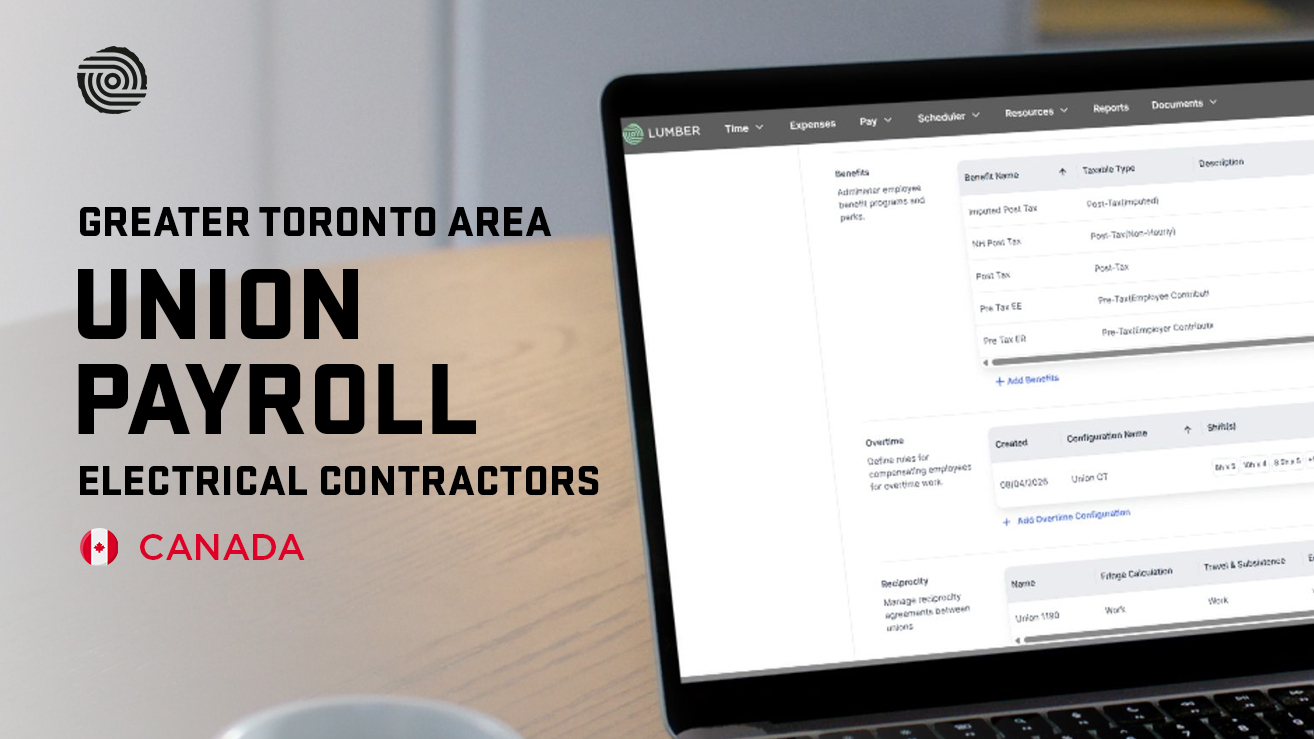



A single electrician on a GTA job can trigger numerous separate payroll calculations and remittances before their cheque is even cut. Base wage, pension and benefit contributions, training and other industry funds, union dues, association dues, and, depending on the applicable agreement, market recovery or stabilization amounts, all layered on top of standard CRA remittances. Get one line wrong, and it is not just an unhappy worker. It is a grievance, a fund reconciliation problem, or a call from the local's business manager.
For electrical contractors working across Toronto and the Greater Toronto Area, this isn't hypothetical. It is Friday, every week.
This guide breaks down what makes union electrical payroll in the GTA genuinely complex, who the key players are, where contractors most often go wrong, and what a compliant payroll process actually looks like.
It is written for GTA-based electrical contractors, payroll administrators, and construction accountants who need to understand the mechanics, not just the theory.
Key Takeaways
- Electrical contractors in the GTA typically bargain through the Electrical Contractors Association of Ontario (ECAO) with IBEW Local 353, which represents electricians, apprentices, and control technicians across Toronto and the surrounding region.
- Union electrical payroll involves multiple simultaneous remittances beyond wages: pension, welfare, training, union dues, association dues, and trade-specific funds such as the Joint Electrical Promotion Plan (JEPP).
- Electrician (Construction and Maintenance) is a compulsory trade in Ontario, regulated by Skilled Trades Ontario under the Building Opportunities in the Skilled Trades Act, 2021.
- Ontario's statutory ratio for Electrician – Construction and Maintenance is one apprentice for each journeyperson, subject to prescribed exclusions and rules. OYAP participants and certain other approved programs are excluded from the calculation.
- A full electrical apprenticeship requires 9,000 hours of combined on-the-job and in-school training, roughly five years, for the Construction and Maintenance stream.
- GTA contractors working across multiple IBEW local jurisdictions in Ontario (Toronto, London, Niagara, Thunder Bay, Sarnia, Ottawa, Windsor, Central Ontario, and others) must track different local appendices, not a single flat provincial standard.
- Union payroll creates multiple employee- and employer-side remittances that must reconcile to hours, classifications, and the applicable collective agreement.
- Accurate union payroll helps contractors meet collective-agreement remittance obligations, pay workers correctly, and keep records that can withstand payroll and trust fund review.
Why Union Electrical Payroll Is Harder Than It Looks
Non-union construction payroll is already demanding. Union electrical payroll adds a second layer of collective-agreement and trust-fund requirements on top of Ontario employment standards and CRA payroll obligations.
For accurate payroll and remittances, map each hour worked to the correct classification, local jurisdiction, and collective agreement, then split it across multiple funds before producing a net cheque. Because remittances are reported by employee and by fund, discrepancies between payroll records, hours worked, and remittance reports can create reconciliation and audit problems.
For a payroll administrator running this by spreadsheet, one wrong classification or missed fund on a new hire's setup can create errors that carry into subsequent pay runs before anyone identifies them.
The Union Landscape: Who Contractors Are Actually Dealing With
In the GTA, electrical contractors most commonly bargain with IBEW Local 353, which represents electricians, apprentices, and control technicians across Toronto and an expanded jurisdiction served through its South, West, East, and North operations, including Mississauga, Oshawa, and Barrie.
On the employer side, contractors deal with two distinct organizations that are easy to conflate. ECAO (Electrical Contractors Association of Ontario) is the provincial association, with area chapters across the province, including ECA Greater Toronto. The Greater Toronto Electrical Contractors Association (GTECA) is the local area association tied specifically to the Local 353 agreement, and under that agreement, association dues are remitted to GTECA.
Local 353 participates in the provincial bargaining structure alongside other Ontario locals under the IBEW Construction Council of Ontario (IBEW CCO), most recently under a Principal Agreement running to 2028. Under this structure, the province-wide Principal Agreement is supplemented by local appendices specific to each participating local. This matters for GTA contractors because a project that spans jurisdictions, or a workforce pulled from more than one local, isn't covered by a single set of terms. Local appendices establish jurisdiction-specific wage rates, fund contributions, and other local conditions that operate alongside the Principal Agreement.
Contractors bidding work outside their home jurisdiction, which is common for larger GTA firms taking on projects in neighbouring regions, need to confirm which local's terms apply before payroll is even set up.
The Fund Structure: What Gets Deducted and Remitted
A union electrician's pay package includes more than an hourly rate. The IBEW CCO Principal Agreement and Local 353's appendix identify several distinct funds and remittances that contractors are responsible for, including:
- Pension contributions, paid into the applicable pension fund
- Welfare contributions for health and related coverage, and in some cases an RRSP component
- Supplemental Unemployment Benefit (SUB) fund payments
- Education and Training Fund contributions
- Union dues, deducted from the worker's pay and remitted to the local.
- Association dues, a separate employer-side payment remitted to GTECA.
- Joint Electrical Promotion Plan (JEPP) contributions, an industry-funded initiative that promotes the trade, currently set at $0.10 per hour earned.
- A Market Recovery or Stabilization Fund contribution and, for Local 353, additional local funds such as the Promotional Fund and IBEW Sports Fund.
The applicable collective agreement and fund rules determine which contributions and deductions apply, how each is calculated, and when it must be remitted, along with a report identifying which employee each contribution belongs to.
Not every fund is a per-hour employee deduction; some are employer-side contributions on top of wages. Rates and fund structures are renegotiated with each new agreement term, so contractors must use the current, signed agreement rather than assumptions carried over from a previous contract cycle.
Apprenticeship Ratios and Compliance
Electrician (Construction and Maintenance), sometimes referred to by its licence code 309A, is one of Ontario's compulsory trades. Because it is compulsory, individuals performing work within its regulated scope generally must hold the required Certificate of Qualification, be registered as an apprentice, or qualify for an applicable statutory exemption. The Building Opportunities in the Skilled Trades Act, 2021, sets out this framework, and Skilled Trades Ontario administers it.
A full Construction and Maintenance apprenticeship requires 9,000 hours of training, made up of 8,160 hours of on-the-job experience and 840 hours of in-school instruction, roughly a five-year path to certification. The related Domestic and Rural electrician stream requires 7,200 hours.
The journeyperson-to-apprentice ratio matters directly for payroll and workforce planning. Ontario’s current statutory framework limits apprentices in ratio trades, including electrician, to one apprentice for each journeyperson, subject to prescribed exclusions. The ratio is calculated based on the apprentices and journeypersons employed or otherwise engaged by a given employer, not on a per-site basis. Individuals participating in the Ontario Youth Apprenticeship Program (OYAP), a similar Minister-approved program, or a pre-apprenticeship program are excluded from that ratio calculation under regulation, which gives contractors additional flexibility when working with co-op or pre-apprenticeship placements.
Getting the ratio wrong is not just a training issue. It affects who can legally be assigned to a task, which in turn affects how hours are classified and costed on the job.
Common Payroll Mistakes GTA Electrical Contractors Make
- Misclassifying apprentices by level. Fund contributions and wage rates typically scale with apprenticeship progression, so a worker advancing a level mid-project needs an immediate payroll update.
- Applying the wrong local's rates on cross-jurisdiction work. Contractors moving crews between GTA-adjacent regions sometimes default to their home local's terms without confirming the applicable agreement.
- Manually reconciling fund remittances. Spreadsheet-based tracking of multiple employee deductions and employer-side fund contributions can create reconciliation errors and missed remittances.
- Falling behind on agreement renewals. Fund contribution rates change with each new collective agreement. Payroll systems set up once and left alone quietly drift out of compliance.
- Losing track of ratio compliance as headcount changes. As journeypersons and apprentices move between projects, contractors need to keep their overall ratio calculation current rather than treating it as a one-time setup step.
A Practical Compliance Checklist
- Confirm which local's collective agreement governs each project before mobilizing crew.
- Verify every worker's classification and apprenticeship level at project start and after any progression.
- Map each required fund remittance (pension, welfare, SUB, training, dues, JEPP, and any market recovery contribution) against the current agreement rates.
- Track journeyperson-to-apprentice ratios across the workforce in line with the applicable Ontario requirements, and separately verify any collective-agreement or project-specific requirements.
- Cross-check CRA remittances (CPP, EI, income tax) alongside union fund deductions on every pay run.
- Keep signed copies of the current agreement and local appendices on file for audit readiness.
Frequently Asked Questions
Do all electrical contractors in the GTA have to use IBEW Local 353?
No. Contractors are only bound by IBEW Local 353's collective agreement if they are signatory to it, typically through membership or affiliation with the Electrical Contractors Association of Ontario or a direct agreement with the local. Non-union electrical contractors and those affiliated with other trade unions operate under entirely different terms. Contractors should confirm their own bargaining status rather than assume based on project type or location.
What is the difference between union dues and association dues in this context?
Union dues are deducted from the worker's pay and remitted to the IBEW local on the employee's behalf. Association dues are a separate, employer-side payment remitted to the relevant employer association, such as GTECA for Local 353's agreement, to fund the association's representation and administrative work. Both may appear in the contractor's remittance reporting, but they are different obligations: one comes off the worker's pay, and the contractor pays the other.
How does the apprenticeship ratio actually work in practice?
Ontario's statutory framework limits a contractor to one apprentice electrician for each journeyperson it employs or otherwise engages in the trade, subject to prescribed exclusions, and the calculation is made across the employer rather than site by site. Individuals participating in OYAP, a similar approved program, or a pre-apprenticeship program are excluded from that calculation under regulation. Contractors should confirm current ratio rules directly with Skilled Trades Ontario, since the regulatory framework has changed several times in recent years.
What happens if a contractor misses a trust fund remittance?
Missed or late remittances can prompt a compliance notice from the fund administrator, and repeated issues can lead to a review of the contractor's payroll records. Persistent delinquency can also trigger contractual remedies under the applicable collective agreement, including grievance or arbitration proceedings and other remedies the agreement provides. Timely, accurate remittance reporting helps fund administrators reconcile payments to employees, hours, and applicable fund obligations.
Is electrical work in Ontario regulated the same way as payroll compliance?
No, and this distinction is worth understanding. The Electrical Safety Authority (ESA) administers electrical contractor and master electrician licensing and electrical safety requirements under Ontario's electrical safety framework. Skilled Trades Ontario separately regulates trade certification and apprenticeship under the Building Opportunities in the Skilled Trades Act. Union payroll and trust fund compliance are a third, distinct layer governed by the applicable collective agreement. A contractor can be in good standing on one and still be offside on another, so each must be managed on its own terms.
Final Thoughts
Union electrical payroll in the GTA is not a single calculation. It is a stack of interlocking rules spanning collective agreements, trust fund remittances, apprenticeship regulations, and CRA requirements, all of which must line up correctly on every pay run.
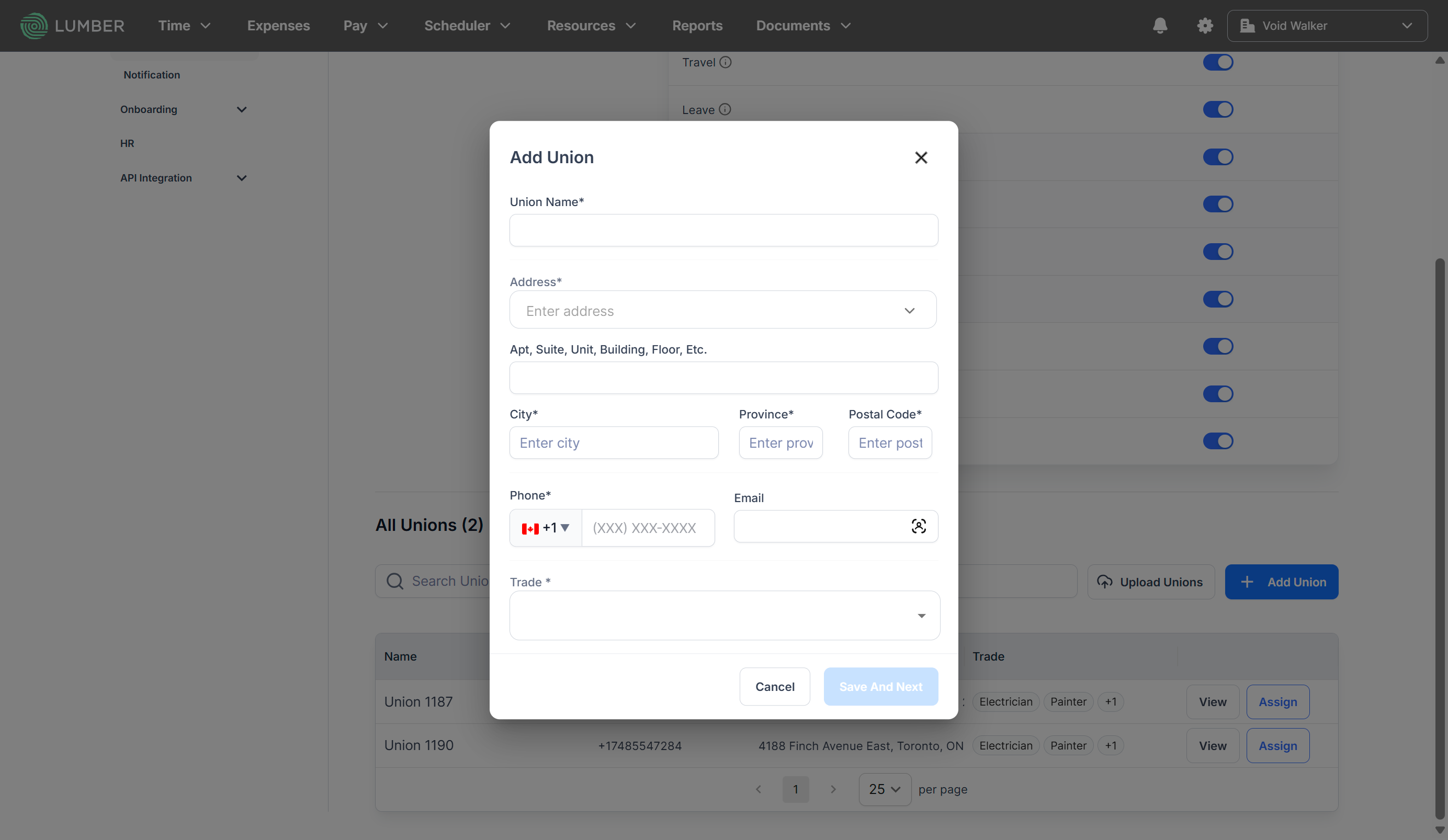
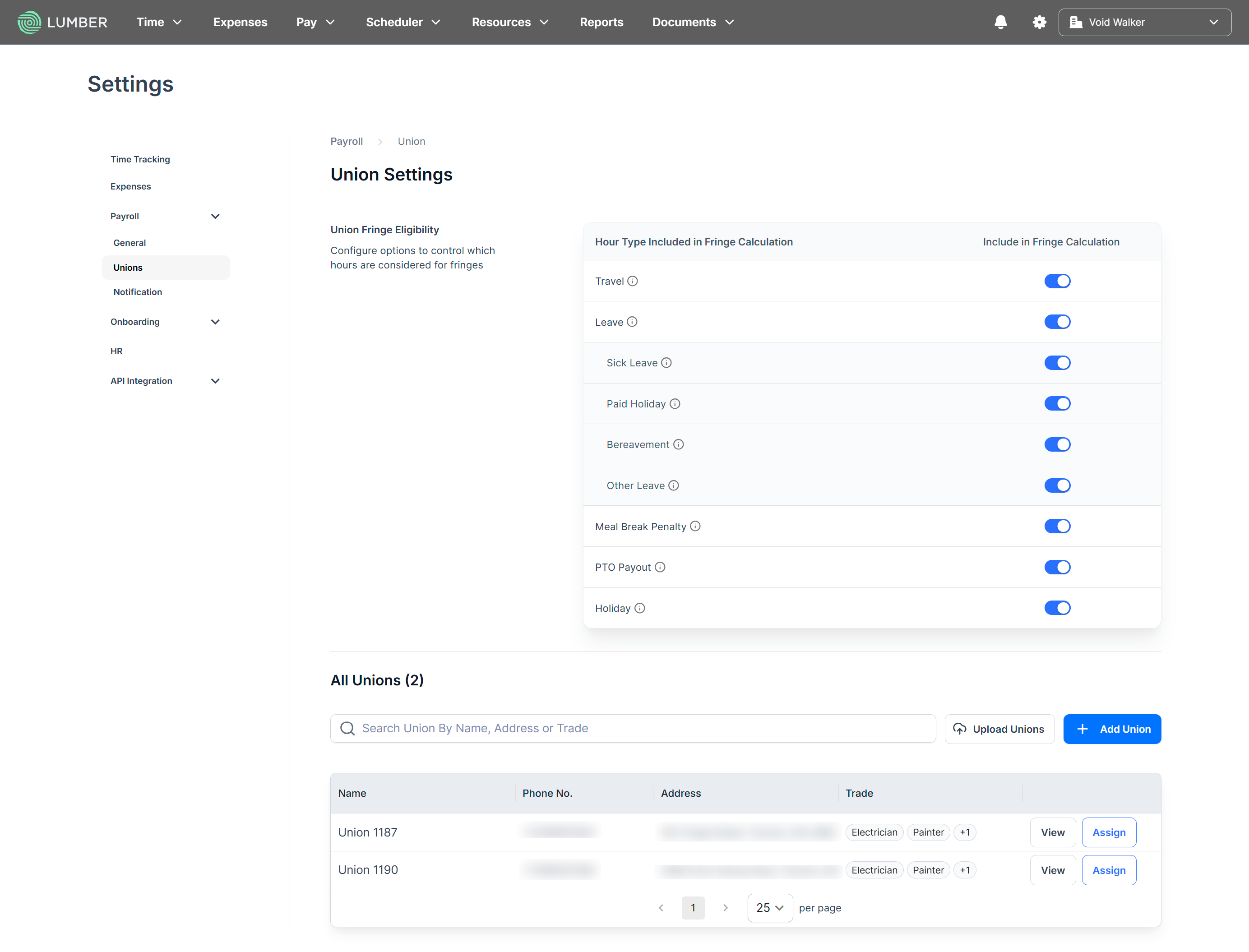
Contractors who treat this as a manual, spreadsheet-driven process increase the risk of missed remittances, classification errors, and reconciliation problems, particularly as they add employees, projects, jurisdictions, or agreement changes. The contractors who stay ahead of it are the ones who build a payroll process that tracks agreement terms, fund rates, and ratios consistently, not from memory.
Lumber’s Canadian payroll platform is built to handle exactly this kind of complexity, from union payroll and fringe fund contributions to CRA reporting, so GTA electrical contractors can spend less time reconciling remittances and more time running the job.
Lorem ipsum dolor sit amet, consectetur adipiscing elit. Donec ullamcorper mattis lorem non. Ultrices praesent amet ipsum justo massa. Eu dolor aliquet risus gravida nunc at feugiat consequat purus. Non massa enim vitae duis mattis. Vel in ultricies vel fringilla.
Introduction
Mi tincidunt elit, id quisque ligula ac diam, amet. Vel etiam suspendisse morbi eleifend faucibus eget vestibulum felis. Dictum quis montes, sit sit. Tellus aliquam enim urna, etiam. Mauris posuere vulputate arcu amet, vitae nisi, tellus tincidunt. At feugiat sapien varius id.
Eget quis mi enim, leo lacinia pharetra, semper. Eget in volutpat mollis at volutpat lectus velit, sed auctor. Porttitor fames arcu quis fusce augue enim. Quis at habitant diam at. Suscipit tristique risus, at donec. In turpis vel et quam imperdiet. Ipsum molestie aliquet sodales id est ac volutpat.


Ipsum sit mattis nulla quam nulla. Gravida id gravida ac enim mauris id. Non pellentesque congue eget consectetur turpis. Sapien, dictum molestie sem tempor. Diam elit, orci, tincidunt aenean tempus. Quis velit eget ut tortor tellus. Sed vel, congue felis elit erat nam nibh orci.

Dolor enim eu tortor urna sed duis nulla. Aliquam vestibulum, nulla odio nisl vitae. In aliquet pellentesque aenean hac vestibulum turpis mi bibendum diam. Tempor integer aliquam in vitae malesuada fringilla.
Elit nisi in eleifend sed nisi. Pulvinar at orci, proin imperdiet commodo consectetur convallis risus. Sed condimentum enim dignissim adipiscing faucibus consequat, urna. Viverra purus et erat auctor aliquam. Risus, volutpat vulputate posuere purus sit congue convallis aliquet. Arcu id augue ut feugiat donec porttitor neque. Mauris, neque ultricies eu vestibulum, bibendum quam lorem id. Dolor lacus, eget nunc lectus in tellus, pharetra, porttitor.
Ipsum sit mattis nulla quam nulla. Gravida id gravida ac enim mauris id. Non pellentesque congue eget consectetur turpis. Sapien, dictum molestie sem tempor. Diam elit, orci, tincidunt aenean tempus. Quis velit eget ut tortor tellus. Sed vel, congue felis elit erat nam nibh orci.
Mi tincidunt elit, id quisque ligula ac diam, amet. Vel etiam suspendisse morbi eleifend faucibus eget vestibulum felis. Dictum quis montes, sit sit. Tellus aliquam enim urna, etiam. Mauris posuere vulputate arcu amet, vitae nisi, tellus tincidunt. At feugiat sapien varius id.
Eget quis mi enim, leo lacinia pharetra, semper. Eget in volutpat mollis at volutpat lectus velit, sed auctor. Porttitor fames arcu quis fusce augue enim. Quis at habitant diam at. Suscipit tristique risus, at donec. In turpis vel et quam imperdiet. Ipsum molestie aliquet sodales id est ac volutpat.
Mi tincidunt elit, id quisque ligula ac diam, amet. Vel etiam suspendisse morbi eleifend faucibus eget vestibulum felis. Dictum quis montes, sit sit. Tellus aliquam enim urna, etiam. Mauris posuere vulputate arcu amet, vitae nisi, tellus tincidunt. At feugiat sapien varius id.
Eget quis mi enim, leo lacinia pharetra, semper. Eget in volutpat mollis at volutpat lectus velit, sed auctor. Porttitor fames arcu quis fusce augue enim. Quis at habitant diam at. Suscipit tristique risus, at donec. In turpis vel et quam imperdiet. Ipsum molestie aliquet sodales id est ac volutpat.
- Lectus id duis vitae porttitor enim gravida morbi.
- Eu turpis posuere semper feugiat volutpat elit, ultrices suspendisse. Auctor vel in vitae placerat.
- Suspendisse maecenas ac donec scelerisque diam sed est duis purus.
Lectus leo massa amet posuere. Malesuada mattis non convallis quisque. Libero sit et imperdiet bibendum quisque dictum vestibulum in non. Pretium ultricies tempor non est diam. Enim ut enim amet amet integer cursus. Sit ac commodo pretium sed etiam turpis suspendisse at.
Tristique odio senectus nam posuere ornare leo metus, ultricies. Blandit duis ultricies vulputate morbi feugiat cras placerat elit. Aliquam tellus lorem sed ac. Montes, sed mattis pellentesque suscipit accumsan. Cursus viverra aenean magna risus elementum faucibus molestie pellentesque. Arcu ultricies sed mauris vestibulum.

Critical Construction Compliance | Awareness Week
Mar 16, 2026
Apr 15, 2026
Nov 30, 2026
Dec 15, 2026
Essential resources for contractors