Top 5 Union Rules Union Agent Handles Automatically

.avif)



Managing collective bargaining agreements requires continuous administrative effort. As contractors join, agreements expire or are renegotiated, and classifications change. When a business agent receives an inquiry, they need immediate, accurate answers from the correct agreement, not from memory or lengthy document searches.
The problem is not that union staff do not know their CBAs. Most do. The challenge is volume. A mid-size local managing 40 or 50 agreements cannot realistically hold every overtime threshold, fringe rate, and reporting deadline in working memory simultaneously. That is where errors happen, and where payroll automation changes the equation.
Lumber’s Union Agent is CBA automation software powered by artificial intelligence and designed for construction unions and signatory contractors. Upload your collective bargaining agreements, and the AI extracts, organizes, and makes every provision instantly searchable. Business agents receive accurate answers in seconds, with citations to the exact contract section. Payroll staff access rates, rules, and deductions without manual document review.
Five categories of union rules create the most payroll complexity. Here is how Union Agent automatically handles each one.
Meet Union Agent: AI That Reads Your CBA for You
Union Agent centralizes your entire CBA library. Simply upload PDF versions of your agreements, and the AI processes each document automatically, usually within minutes.
The system extracts and organizes all critical provisions into structured, searchable categories. Authorized users can access this information instantly from any web browser on desktop, tablet, or smartphone. Business agents in the field have the same access as payroll staff in the office.
In addition to structured extraction, Union Agent supports plain-language queries. Instead of searching manually, users can simply ask questions:
- “What is the journeyman electrician rate for Smith Construction under the current agreement?”
- “Which contractors have overtime triggers before 40 weekly hours?”
- “Show me every agreement where the health fund contribution exceeds $9.00 per hour.”
Each answer includes a source citation from the CBA, the relevant contract clause, and the reasoning behind the response. The AI retrieves and cites information without paraphrasing or interpretation.
CBA automation at this level reduces the time staff spend searching for information and improves the consistency and accuracy of answers across your organization. New representatives receive the same information as experienced staff. Institutional knowledge remains accessible even as staff transition.
The Top 5 Union Rules Automatically Handled by Union Agent
1. Wage Rates by Classification and Year
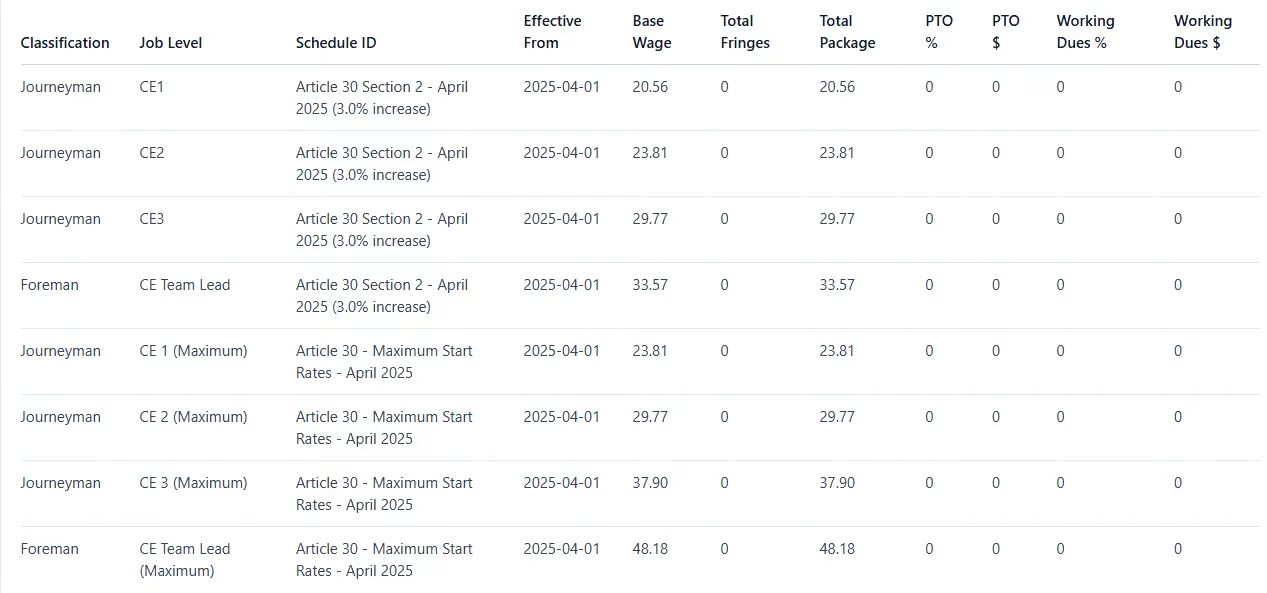
Wage misclassification is the most common source of payroll grievances on union jobsites. Errors such as using outdated rate schedules, applying incorrect classifications, or failing to update wage increases may not be intentional, but the liability remains the same. Union Agent extracts the full wage structure from each CBA and organizes it by classification, including:
- Base journeyman rates by trade and specialty
- Foreman and general foreman premiums, whether flat-dollar or percentage-based
- Apprentice progression schedules showing the wage percentage at each program step
- Geographic wage adjustments for work performed in different zones or jurisdictions within the same agreement
- Project-type wage scales for public works, heavy industrial, or other categories with separate requirements
For locals covering multiple trades, this visibility is essential. For example, an electrical local may have separate rates for linemen, inside wiremen, telecommunications workers, and low-voltage technicians, each with unique progression steps and foreman differentials. Union Agent organizes and makes these hierarchies searchable across all agreements.
When a member questions a pay rate, your representative can retrieve the exact classification schedule and effective date from the CBA in seconds. Payroll automation ensures staff provide accurate answers, supported by contract language.
2. Daily vs. Weekly Overtime Rules
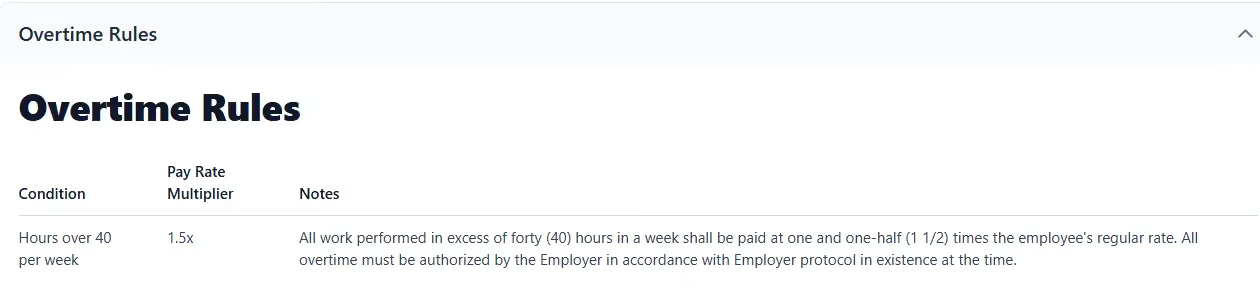
Overtime is the most disputed area of CBA compliance, with rules that vary significantly between agreements. Even contractors in the same city and trade may have different overtime thresholds, multipliers, and exceptions. Relying on memory across many agreements leads to errors.
Union Agent pulls the exact overtime provisions from each CBA and makes them immediately accessible. The variations that cause the most confusion include:
- Daily vs. weekly overtime: Some agreements trigger overtime after 8 hours in a single workday. Others calculate on a 40-hour weekly basis. Some require both, applying whichever produces the greater premium for the worker.
- Double-time triggers: Certain CBAs require double-time after a specific daily threshold, commonly 10 or 12 hours, or for all work on Sundays and holidays regardless of weekly totals.
- Consecutive-day premiums: Some trade agreements require an escalating premium when a worker completes a sixth or seventh consecutive day within a workweek.
- Pyramiding restrictions: Many CBAs prohibit pyramiding, meaning applying more than one overtime premium simultaneously. Union Agent surfaces these clauses, so your team can answer contractor questions accurately.
With payroll automation for overtime rules, when a contractor inquires about how Saturday hours are calculated, the answer is available immediately from the correct agreement, complete with section citation. This eliminates callbacks and guesswork.
3. Fringe Benefits, Dues, and Required Deductions
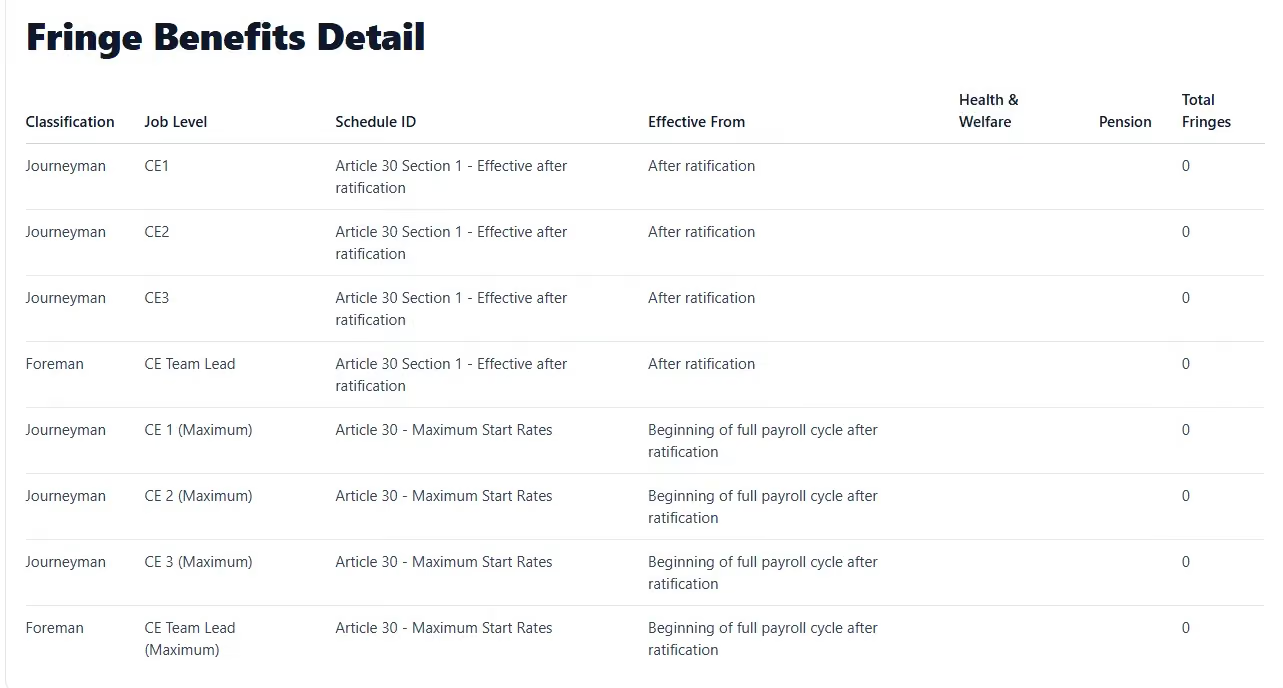
Fringe benefits and required deductions make up a substantial portion of total union compensation. Health insurance, pension, annuity funds, apprenticeship and training contributions, and working dues each have separate rates, funds, and reporting requirements. Missing or miscalculating any one of them creates audit liability.
Union Agent extracts all contribution rates from each agreement and organizes them into a comparable format. For each CBA, the system provides:
- Health and welfare fund contributions per hour worked
- Pension fund contribution rates
- Annuity contributions where applicable
- Apprenticeship and training fund contributions
- Vacation and holiday fund contributions in agreements that structure these as fund obligations
- Union dues, working assessments, and political fund deductions by classification
- Total hourly fringe package value across all funds
This data serves multiple functions. During payroll audits, your team cross-references submitted contribution amounts against the CBA rates in seconds. During organizing, representatives can demonstrate the full value of union compensation including all fringe contributions. During bargaining, negotiating committees can benchmark contribution levels across the entire agreement portfolio to identify where rates lag behind recent settlements.
With CBA automation for fringe benefits, auditors no longer manually review dozens of agreements to verify contribution rates. Comparisons are immediate, and discrepancies are identified early, before underpayments accumulate.
4. Shift Differentials, Show-Up Pay, and Scheduling Rules
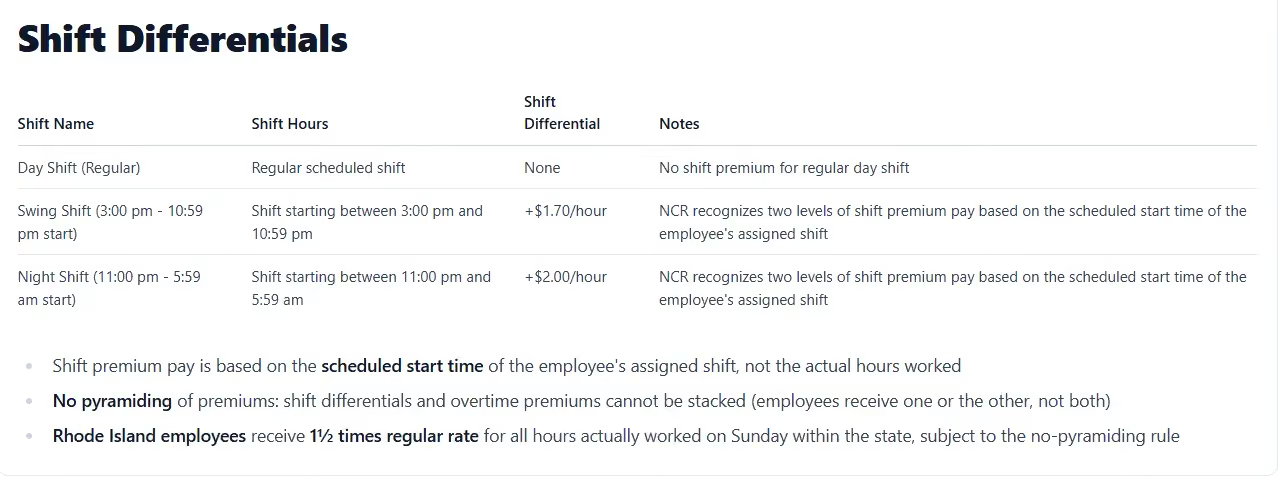
Shift differential rules are straightforward in principle: workers on evening or overnight shifts receive a premium above the standard rate. In practice, the details vary enough between agreements to create consistent payroll errors. Union Agent pulls these provisions from each CBA so your team always has the correct numbers when questions come in. The variables that differ most between agreements:
- Premium percentage: Differentials range from 5% above the base rate to 20% or more, depending on the trade and jurisdiction.
- Qualifying start times: One agreement may define a second shift as starting at or after 4:00 PM. Another sets the threshold at 5:00 PM. Getting this wrong means workers miss premiums they are owed, or contractors are overbilled.
- Minimum shift duration: Some agreements require a minimum number of hours on an off-hours shift before the differential applies.
- Show-up pay: Many CBAs guarantee a minimum number of paid hours when a worker reports to a job site and is sent home. These minimums vary by agreement and are often missed in payroll systems.
- Reporting time pay: Separate from show-up pay, some agreements require compensation for time spent waiting for work to begin when conditions delay the start of a shift.
- Weekend and holiday shift provisions: Whether a worker on an evening shift that starts the day before a holiday qualifies for holiday premium pay depends entirely on the specific CBA language.
On jobsites with rotating schedules or 24-hour operations, contractors working multiple trades need to apply different shift rules to each trade. Payroll automation for shift differentials means every rule is accessible by agreement, with the contract citation ready when a question comes up.
5. Crew Ratios and Staffing Requirements
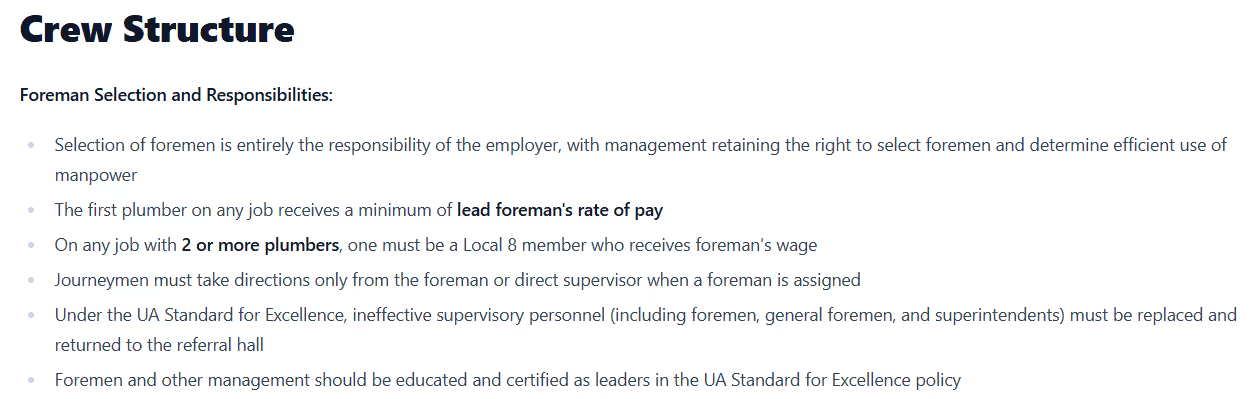
Crew structure requirements are among the most commonly overlooked provisions in CBA compliance. They are buried in sections that do not always have obvious headings, they vary by trade and contractor, and violations are not always visible until a grievance is filed.
Union Agent extracts crew structure and staffing rules from each CBA, including:
- Journeyman-to-apprentice ratios: Most agreements limit the number of apprentices who can work alongside each journeyman on a job site. These ratios differ by trade and sometimes by project type.
- Foreman requirements: Many CBAs require a foreman any time a crew exceeds a specific size. The threshold varies by agreement. A contractor running a crew of four under one agreement might not require a foreman, while the same crew size under a different agreement would.
- General foreman provisions: Larger crews may require a general foreman above a certain headcount. The thresholds and pay differentials are agreement-specific.
- Supervision rules: Some CBAs specify whether foremen can work with tools alongside the crew or must function in a supervisory-only capacity.
- Steward requirements: Certain agreements require a union steward on site when a crew reaches a defined size, or on specific project types.
Crew ratio violations are a direct source of grievances. When a contractor runs too many apprentices without the required journeyman coverage, or skips a foreman requirement, the cost is not just a grievance resolution. It is back pay, potential penalties, and a damaged working relationship.
With Union Agent, staffing requirements for each agreement are extracted and easily accessible. When a business agent needs to verify crew structure compliance, the answer is sourced directly from the contract.
Upload Your CBA. Get Instant, Payroll-Ready Compliance Insights
These five rule categories represent the areas where CBA payroll automation delivers the greatest value. Overtime calculations, wage classifications, fringe contributions, shift premiums, and crew ratios all involve provisions that vary by contractor, trade, jurisdiction, and negotiation cycle. Managing this variation manually across many agreements leads to errors.
Union Agent does not replace experienced business agents or payroll staff. Instead, it makes their knowledge more accessible and their work more consistent. New representatives receive the same contract-level accuracy as veterans. Contractors receive immediate answers backed by actual CBA language, eliminating the need for callbacks.
Every answer from Union Agent includes the source section and page from the agreement. When documenting a grievance, resolving a contractor dispute, or verifying a payroll submission, you work directly from the contract.
Try Lumber Union Agent for Free | Know more
Lorem ipsum dolor sit amet, consectetur adipiscing elit. Donec ullamcorper mattis lorem non. Ultrices praesent amet ipsum justo massa. Eu dolor aliquet risus gravida nunc at feugiat consequat purus. Non massa enim vitae duis mattis. Vel in ultricies vel fringilla.
Introduction
Mi tincidunt elit, id quisque ligula ac diam, amet. Vel etiam suspendisse morbi eleifend faucibus eget vestibulum felis. Dictum quis montes, sit sit. Tellus aliquam enim urna, etiam. Mauris posuere vulputate arcu amet, vitae nisi, tellus tincidunt. At feugiat sapien varius id.
Eget quis mi enim, leo lacinia pharetra, semper. Eget in volutpat mollis at volutpat lectus velit, sed auctor. Porttitor fames arcu quis fusce augue enim. Quis at habitant diam at. Suscipit tristique risus, at donec. In turpis vel et quam imperdiet. Ipsum molestie aliquet sodales id est ac volutpat.


Ipsum sit mattis nulla quam nulla. Gravida id gravida ac enim mauris id. Non pellentesque congue eget consectetur turpis. Sapien, dictum molestie sem tempor. Diam elit, orci, tincidunt aenean tempus. Quis velit eget ut tortor tellus. Sed vel, congue felis elit erat nam nibh orci.

Dolor enim eu tortor urna sed duis nulla. Aliquam vestibulum, nulla odio nisl vitae. In aliquet pellentesque aenean hac vestibulum turpis mi bibendum diam. Tempor integer aliquam in vitae malesuada fringilla.
Elit nisi in eleifend sed nisi. Pulvinar at orci, proin imperdiet commodo consectetur convallis risus. Sed condimentum enim dignissim adipiscing faucibus consequat, urna. Viverra purus et erat auctor aliquam. Risus, volutpat vulputate posuere purus sit congue convallis aliquet. Arcu id augue ut feugiat donec porttitor neque. Mauris, neque ultricies eu vestibulum, bibendum quam lorem id. Dolor lacus, eget nunc lectus in tellus, pharetra, porttitor.
Ipsum sit mattis nulla quam nulla. Gravida id gravida ac enim mauris id. Non pellentesque congue eget consectetur turpis. Sapien, dictum molestie sem tempor. Diam elit, orci, tincidunt aenean tempus. Quis velit eget ut tortor tellus. Sed vel, congue felis elit erat nam nibh orci.
Mi tincidunt elit, id quisque ligula ac diam, amet. Vel etiam suspendisse morbi eleifend faucibus eget vestibulum felis. Dictum quis montes, sit sit. Tellus aliquam enim urna, etiam. Mauris posuere vulputate arcu amet, vitae nisi, tellus tincidunt. At feugiat sapien varius id.
Eget quis mi enim, leo lacinia pharetra, semper. Eget in volutpat mollis at volutpat lectus velit, sed auctor. Porttitor fames arcu quis fusce augue enim. Quis at habitant diam at. Suscipit tristique risus, at donec. In turpis vel et quam imperdiet. Ipsum molestie aliquet sodales id est ac volutpat.
Mi tincidunt elit, id quisque ligula ac diam, amet. Vel etiam suspendisse morbi eleifend faucibus eget vestibulum felis. Dictum quis montes, sit sit. Tellus aliquam enim urna, etiam. Mauris posuere vulputate arcu amet, vitae nisi, tellus tincidunt. At feugiat sapien varius id.
Eget quis mi enim, leo lacinia pharetra, semper. Eget in volutpat mollis at volutpat lectus velit, sed auctor. Porttitor fames arcu quis fusce augue enim. Quis at habitant diam at. Suscipit tristique risus, at donec. In turpis vel et quam imperdiet. Ipsum molestie aliquet sodales id est ac volutpat.
- Lectus id duis vitae porttitor enim gravida morbi.
- Eu turpis posuere semper feugiat volutpat elit, ultrices suspendisse. Auctor vel in vitae placerat.
- Suspendisse maecenas ac donec scelerisque diam sed est duis purus.
Lectus leo massa amet posuere. Malesuada mattis non convallis quisque. Libero sit et imperdiet bibendum quisque dictum vestibulum in non. Pretium ultricies tempor non est diam. Enim ut enim amet amet integer cursus. Sit ac commodo pretium sed etiam turpis suspendisse at.
Tristique odio senectus nam posuere ornare leo metus, ultricies. Blandit duis ultricies vulputate morbi feugiat cras placerat elit. Aliquam tellus lorem sed ac. Montes, sed mattis pellentesque suscipit accumsan. Cursus viverra aenean magna risus elementum faucibus molestie pellentesque. Arcu ultricies sed mauris vestibulum.

Critical Construction Compliance | Awareness Week
Mar 16, 2026
Apr 15, 2026
Nov 30, 2026
Dec 15, 2026
Essential resources for contractors