Q2 Construction Payroll Compliance Calendar: Key Deadlines for April–June 2026




Q2 is a critical period for construction payroll teams. Spring project mobilizations begin, crews expand quickly, and federal and state compliance deadlines occur in rapid succession. Missing a deadline can result in penalties of $100 per day for late certified payroll submissions, 5% per month on late Form 941 filings (up to 25%), and increased audit risk from the Department of Labor.
This calendar outlines all key deadlines for construction payroll administrators, controllers, and general contractors managing prevailing wage projects from April 1 to June 30, 2026. All dates have been verified to account for weekends and federal holidays.
The Dates That Cannot Move
Before reviewing the monthly breakdown, note the four federal filing dates that every payroll team should have on their calendar before Q2 begins:
These dates are fixed. All other deadlines in this calendar are scheduled around them.
April 2026: Tax Filing Month + Construction Season Kickoff
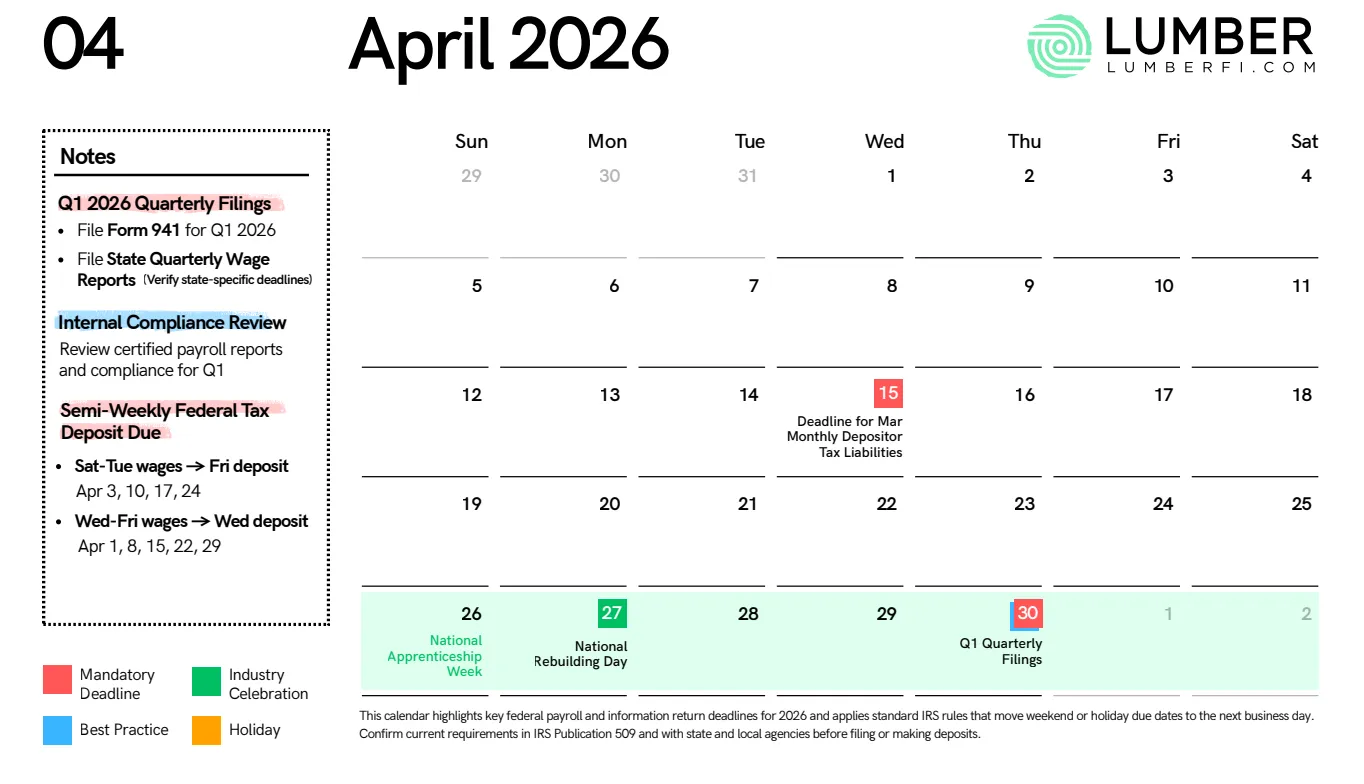
April is the most administratively demanding month of Q2. Payroll teams must close out Q1 tax obligations while managing the initial wave of spring project mobilizations. Each new public works project starting in April triggers certified payroll requirements from the first week.
Federal Tax Obligations
April 15 — Q1 estimated tax payments are due for construction owners and contractors who pay quarterly estimates (Form 1040-ES or Form 1120-W). This is also the general deadline for business and individual income tax returns. If you need more time, file for an extension by this date — but an extension to file is not an extension to pay.
April 30 — Form 941 Q1 is due. This covers all wages paid from January through March: federal income tax withheld, Social Security, and Medicare taxes. If your Q1 tax liability was fully deposited on time throughout the quarter, you have until May 11 instead. If you missed any deposit, the April 30 date applies.
Monthly depositors: The April 15 payroll tax deposit for March wages is due before Q2 begins. The next monthly deposit, for April wages, is due May 15.
Semiweekly depositors follow a rolling schedule based on payday. Payrolls paid Wednesday through Friday must be deposited by the following Wednesday. Payrolls paid Saturday through Tuesday must be deposited by the following Friday.
Certified Payroll — Every Week, No Exceptions
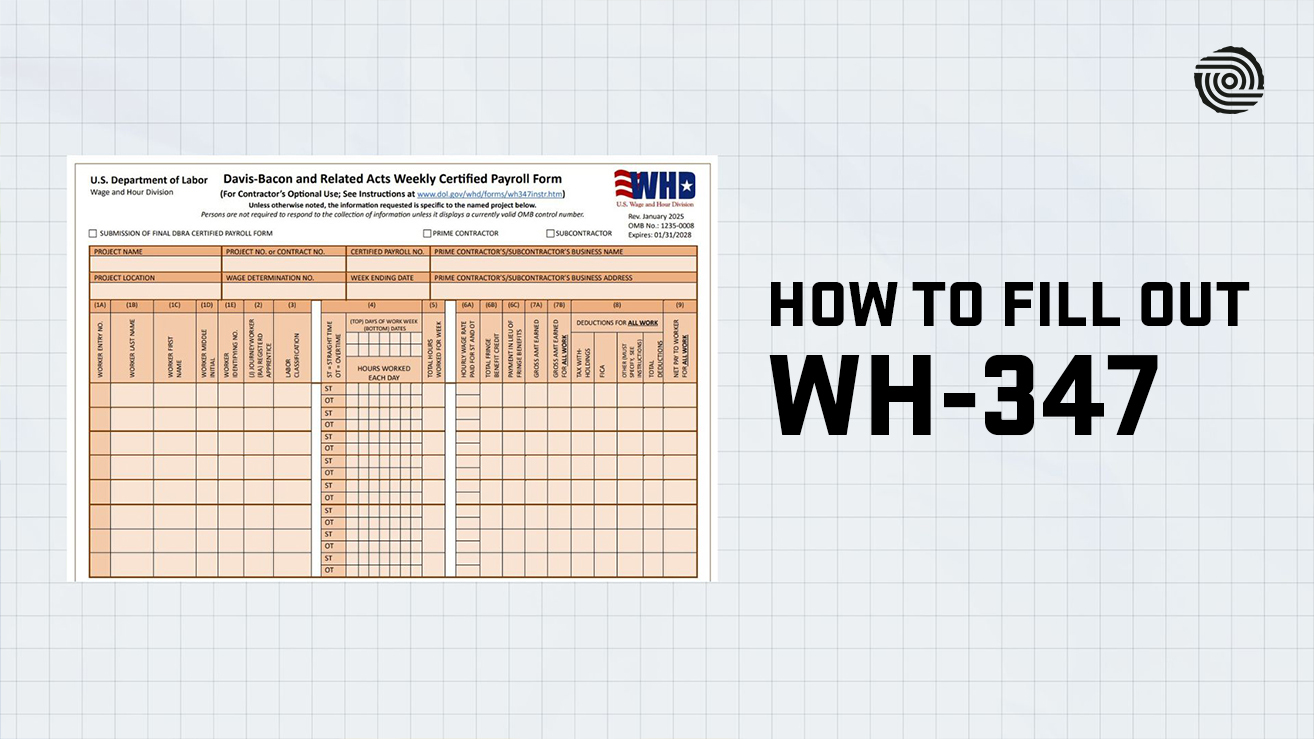
Every public works project starting in April requires weekly certified payroll submissions from the outset. Federal projects under the Davis-Bacon Act require a WH-347 submission within seven days after the regular payment date for each payroll period. State-funded projects have their own timelines. For example, New York requires weekly eCPR submissions to the NYSDOL portal, California DIR submissions are also weekly, and Illinois IDOL follows the same schedule.
For example, if a project starts on April 7, the first week’s certified payroll is due by April 14. There is no grace period.
April Checklist for Payroll Teams
- Confirm all Q1 federal tax deposits are complete before April 30.
- Register each new spring project in your certified payroll system before work begins on site.
- Obtain current prevailing wage determinations from http://SAM.gov for all new federally funded or federally assisted projects. The DOL’s 2024 final rule changed the methodology for setting rates, resulting in higher rates for most projects. Ensure you are using the most recent figures.
- Confirm that fringe benefit documentation is current for all active projects, especially in New York, California, and Illinois, where enforcement is strict.
May 2026: Apprentice Ratios, Memorial Day Deposits, and Safety Week
May typically sees the largest crew sizes of the spring. This is also when apprentice ratio compliance is most at risk, as new workers are added quickly and oversight may decrease across multiple active sites.
Federal Tax Obligations
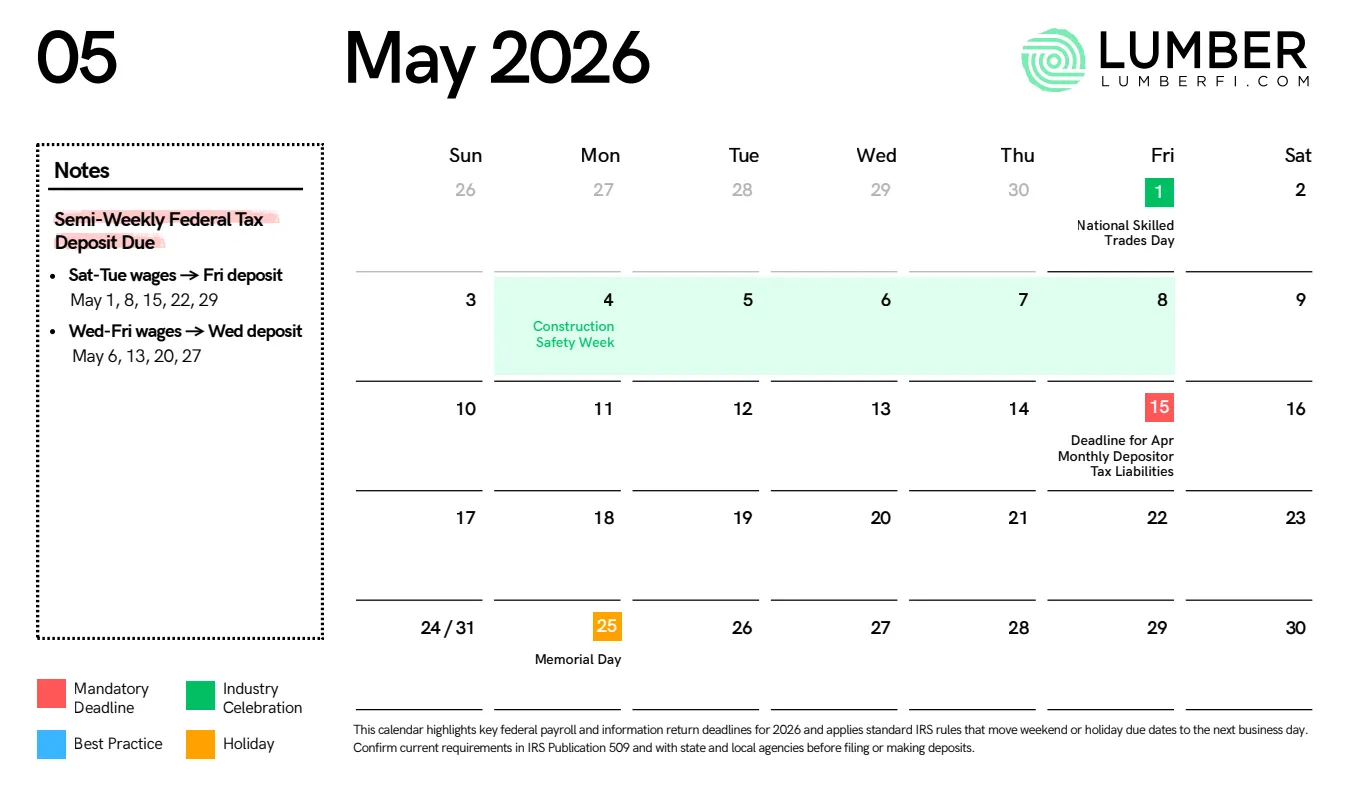
May 11: Extended Form 941 Q1 deadline. To use this extension, all Q1 deposits must have been made on time and in full. If there is any uncertainty about timely deposits, file by April 30.
May 15 (Friday): Monthly depositors must deposit payroll taxes for April wages by this date.
Memorial Day: (May 25) is a federal holiday that affects the semiweekly deposit schedule. Payrolls paid from Saturday, May 23, through Tuesday, May 26, follow an adjusted deposit window. Refer to IRS Publication 15 for the specific dates. If your standard schedule is near this window, plan payroll runs in advance.
Semiweekly depositors should plan the full May schedule in advance. The holiday shortens the administrative window, and late deposits result in automatic penalties.
Certified Payroll and Prevailing Wage
Certified payrolls must be submitted weekly on all active covered projects, with no exceptions for holidays. If there is a no-work week due to weather or scheduling, most state platforms still require a no-work week certification. Check your project-specific requirements.
Lumber's Prevailing Wage and Union Agents automatically apply the correct rates, fringes, and CBA rules to every payroll, so your certified payrolls are right before they're ever submitted. Try for free
Conduct an apprentice ratio audit in May:. As your workforce expands, review apprentice ratios for each project. Ratio rules vary by trade, collective bargaining agreement, and state, but enforcement is consistent: any apprentice working without proper journeyman supervision, even briefly, must be paid the journeyman rate for that time. Apprentice-related violations are among the most costly audit findings, with penalties reaching tens of thousands of dollars per project.
Before a worker steps on a prevailing wage project, Lumber's BuilderFax verifies every certification, license, and apprentice indenturement in seconds. Verify your workforce →
May 4–8: Construction Safety Week 2026. Use this week to audit training records and safety documentation. OSHA’s 2026 enforcement approach is documentation-driven; inspectors expect to see training logs, equipment inspection records, and evidence of hazard identification programs. A well-documented safety program also reduces your EMR, directly impacting insurance premiums and bonding capacity.
May Checklist for Payroll Teams
- Verify Form 941 Q1 has been filed (extended deadline May 11).
- Run an internal apprentice ratio audit across all active prevailing wage projects.
- Confirm that all workers added for the spring season have verified credentials before being assigned to public works projects.
- Adjust semiweekly deposit planning for Memorial Day (May 25).
- Check state quarterly wage report deadlines — some states require reports by May 31.
June 2026: Q2 Closes, Fringe Benefit Reviews, Pre-Q3 Prep
June is the time to prepare for Q3 while closing out Q2. Project volumes remain high, and July deadlines approach quickly.
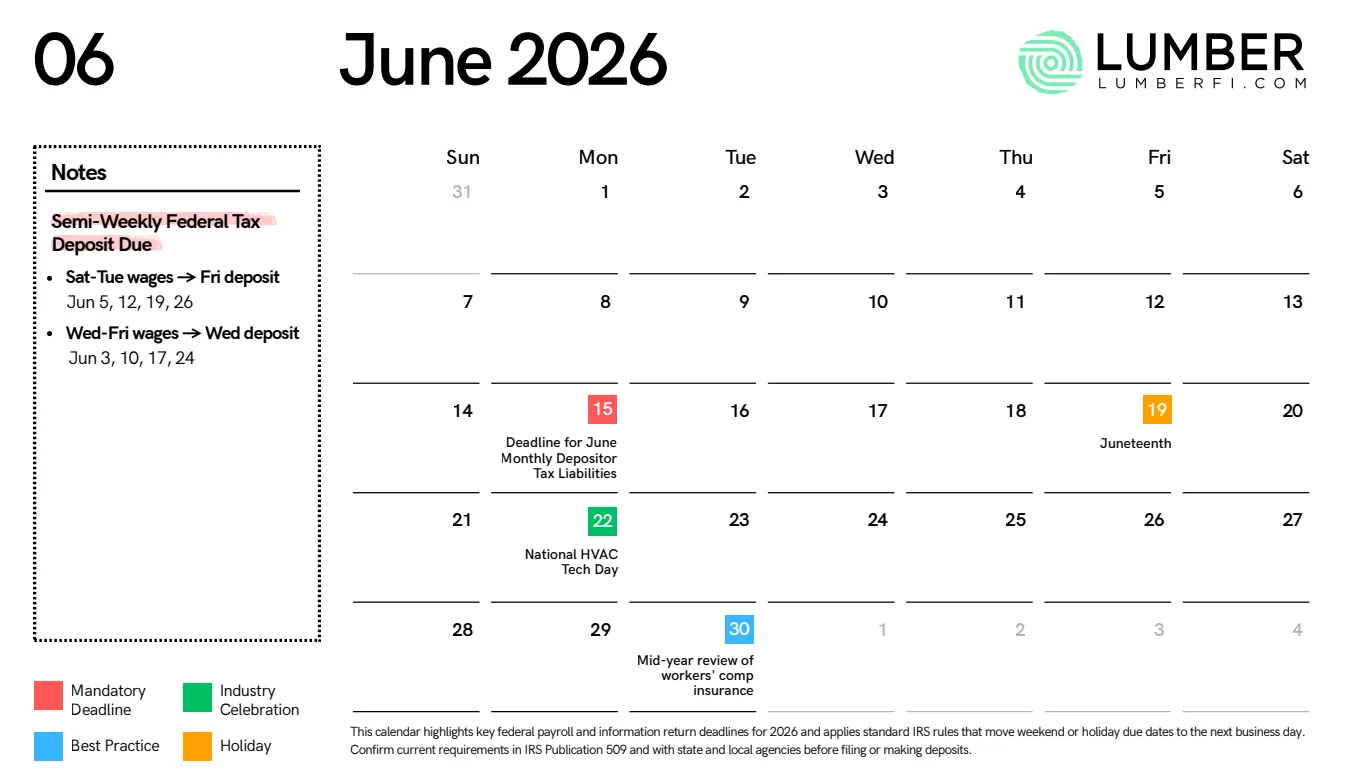
Federal Tax Obligations
June 15 (Monday): Q2 estimated tax payments are due for contractors and owners who pay quarterly estimates. This is also the deadline for monthly payroll tax deposits for May wages.
FUTA mid-year check: At the end of Q2, review your cumulative FUTA (Federal Unemployment Tax Act) liability. If it exceeds $500 at any point in the quarter, a deposit is required. Most construction companies reach this threshold before Q2 ends, making it a rolling obligation. If your Q2 FUTA liability exceeds $500, the deposit is due July 31.
Form 941 Q2 — prepare now, file by July 31: Begin reconciling wages, tip withholding, and tax deposits in June to ensure your Q2 941 is ready to file as soon as the quarter ends.
Certified Payroll and Compliance
June is the appropriate time to conduct a multi-state compliance audit before Q3 project volumes increase. If your company operates in multiple states, verify that each state’s certified payroll submission schedule, fringe benefit documentation requirements, and electronic filing formats are current. New York, California, Illinois, Oregon, and Washington have distinct requirements that differ from federal standards.
Mid-year fringe benefit review: Many union collective bargaining agreements have July 1 milestone dates, which means fringe benefit rates change at the start of Q3. Review your current CBA terms in June and update your payroll system before the first Q3 payroll run. Using outdated fringe rates on certified payrolls is a common and avoidable audit finding.
Recordkeeping check: Federal regulations require payroll records to be retained for at least three years after project completion, though state requirements may vary. Use the end of Q2 to confirm that records for projects closed in 2023 are properly archived and accessible.
June Checklist for Payroll Teams
- Make the Q2 estimated tax payment by June 15
- Deposit May wages (monthly depositors) by June 15
- Conduct a Q2 certified payroll submission audit to confirm there are no missed weeks on any active project, including no-work weeks.
- Review CBA fringe benefit rates for union projects with July 1 milestones and update the payroll system before Q3 begins.
- Confirm FUTA liability for Q2 and deposit if over the $500 threshold.
- Begin gathering Q2 payroll data for Form 941 preparation ahead of the July 31 deadline.
Weekly Non-Negotiables That Run the Entire Quarter
These obligations apply every week, regardless of other deadlines:
Certified payroll submissions: Submit weekly for every active covered project, within seven days of the regular pay date for federal projects. Some states have stricter timelines. Integrate this submission into your weekly payroll workflow.
Worker classification review: Each worker on every prevailing wage project must be correctly classified by trade for every week they appear on a certified payroll. Misclassification is the most common audit finding and results in the largest back-pay liabilities.
Lumber's time tracking lets workers clock in and out by trade classification in real time — so your certified payroll data is accurate before it ever reaches your payroll team. See how it works →
Subcontractor certified payroll monitoring: General contractors remain liable for subcontractor compliance. Establish a weekly receipt confirmation process, require subcontractors to send submission confirmations, and maintain a project-level log to ensure all subcontractors are current.
The Complete Q2 Date Reference
How to Stay Ahead of This Calendar
Payroll teams that miss deadlines in Q2 rarely do so due to lack of awareness. Most missed deadlines result from managing manual processes across multiple projects, states, and subcontractors, making it difficult to track all requirements.
Lumber automates weekly certified payroll generation using time tracking and worker classification data, maintains multi-state prevailing wage rate tables, sends alerts for missing submissions and expiring worker credentials through BuilderFax, and generates complete audit-ready documentation for every active project. The goal is to transform the above calendar from a list of potential issues into a routine process.
To see how the platform can support your specific project mix, book a demo here.
Lorem ipsum dolor sit amet, consectetur adipiscing elit. Donec ullamcorper mattis lorem non. Ultrices praesent amet ipsum justo massa. Eu dolor aliquet risus gravida nunc at feugiat consequat purus. Non massa enim vitae duis mattis. Vel in ultricies vel fringilla.
Introduction
Mi tincidunt elit, id quisque ligula ac diam, amet. Vel etiam suspendisse morbi eleifend faucibus eget vestibulum felis. Dictum quis montes, sit sit. Tellus aliquam enim urna, etiam. Mauris posuere vulputate arcu amet, vitae nisi, tellus tincidunt. At feugiat sapien varius id.
Eget quis mi enim, leo lacinia pharetra, semper. Eget in volutpat mollis at volutpat lectus velit, sed auctor. Porttitor fames arcu quis fusce augue enim. Quis at habitant diam at. Suscipit tristique risus, at donec. In turpis vel et quam imperdiet. Ipsum molestie aliquet sodales id est ac volutpat.


Ipsum sit mattis nulla quam nulla. Gravida id gravida ac enim mauris id. Non pellentesque congue eget consectetur turpis. Sapien, dictum molestie sem tempor. Diam elit, orci, tincidunt aenean tempus. Quis velit eget ut tortor tellus. Sed vel, congue felis elit erat nam nibh orci.

Dolor enim eu tortor urna sed duis nulla. Aliquam vestibulum, nulla odio nisl vitae. In aliquet pellentesque aenean hac vestibulum turpis mi bibendum diam. Tempor integer aliquam in vitae malesuada fringilla.
Elit nisi in eleifend sed nisi. Pulvinar at orci, proin imperdiet commodo consectetur convallis risus. Sed condimentum enim dignissim adipiscing faucibus consequat, urna. Viverra purus et erat auctor aliquam. Risus, volutpat vulputate posuere purus sit congue convallis aliquet. Arcu id augue ut feugiat donec porttitor neque. Mauris, neque ultricies eu vestibulum, bibendum quam lorem id. Dolor lacus, eget nunc lectus in tellus, pharetra, porttitor.
Ipsum sit mattis nulla quam nulla. Gravida id gravida ac enim mauris id. Non pellentesque congue eget consectetur turpis. Sapien, dictum molestie sem tempor. Diam elit, orci, tincidunt aenean tempus. Quis velit eget ut tortor tellus. Sed vel, congue felis elit erat nam nibh orci.
Mi tincidunt elit, id quisque ligula ac diam, amet. Vel etiam suspendisse morbi eleifend faucibus eget vestibulum felis. Dictum quis montes, sit sit. Tellus aliquam enim urna, etiam. Mauris posuere vulputate arcu amet, vitae nisi, tellus tincidunt. At feugiat sapien varius id.
Eget quis mi enim, leo lacinia pharetra, semper. Eget in volutpat mollis at volutpat lectus velit, sed auctor. Porttitor fames arcu quis fusce augue enim. Quis at habitant diam at. Suscipit tristique risus, at donec. In turpis vel et quam imperdiet. Ipsum molestie aliquet sodales id est ac volutpat.
Mi tincidunt elit, id quisque ligula ac diam, amet. Vel etiam suspendisse morbi eleifend faucibus eget vestibulum felis. Dictum quis montes, sit sit. Tellus aliquam enim urna, etiam. Mauris posuere vulputate arcu amet, vitae nisi, tellus tincidunt. At feugiat sapien varius id.
Eget quis mi enim, leo lacinia pharetra, semper. Eget in volutpat mollis at volutpat lectus velit, sed auctor. Porttitor fames arcu quis fusce augue enim. Quis at habitant diam at. Suscipit tristique risus, at donec. In turpis vel et quam imperdiet. Ipsum molestie aliquet sodales id est ac volutpat.
- Lectus id duis vitae porttitor enim gravida morbi.
- Eu turpis posuere semper feugiat volutpat elit, ultrices suspendisse. Auctor vel in vitae placerat.
- Suspendisse maecenas ac donec scelerisque diam sed est duis purus.
Lectus leo massa amet posuere. Malesuada mattis non convallis quisque. Libero sit et imperdiet bibendum quisque dictum vestibulum in non. Pretium ultricies tempor non est diam. Enim ut enim amet amet integer cursus. Sit ac commodo pretium sed etiam turpis suspendisse at.
Tristique odio senectus nam posuere ornare leo metus, ultricies. Blandit duis ultricies vulputate morbi feugiat cras placerat elit. Aliquam tellus lorem sed ac. Montes, sed mattis pellentesque suscipit accumsan. Cursus viverra aenean magna risus elementum faucibus molestie pellentesque. Arcu ultricies sed mauris vestibulum.

Critical Construction Compliance | Awareness Week
Mar 16, 2026
Apr 15, 2026
Nov 30, 2026
Dec 15, 2026
Essential resources for contractors