General Liability vs. Workers' Comp: What Fence Contractors Actually Need

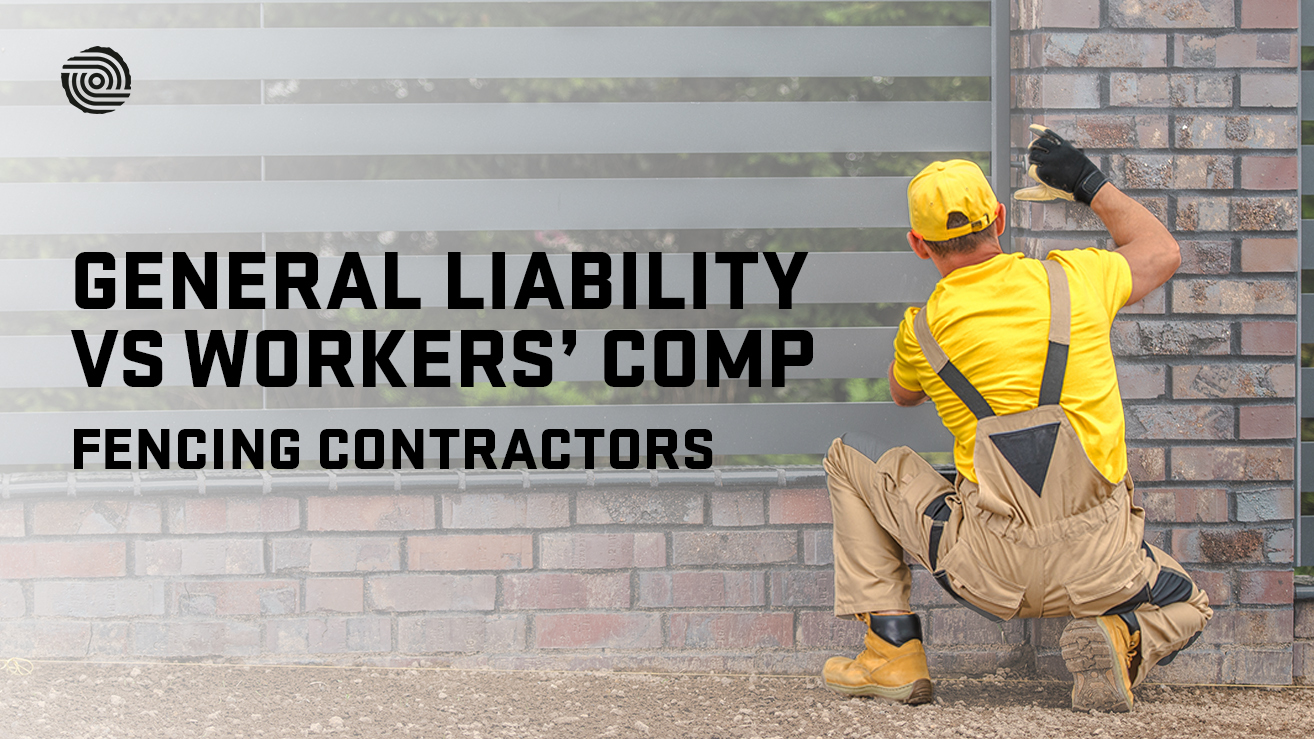


A crew is installing a chain-link fence along a client's property line. One worker hits a buried irrigation line with a post hole digger. Another slips off a ladder while stretching the top rail and breaks a wrist.
Same job site, same afternoon, two different kinds of insurance claims. The irrigation damage is the kind of loss general liability is built to respond to. Workers' compensation covers the broken wrist. If a contractor only carries one of these policies, one of those two claims comes out of the fencing contractor's pocket.
This mix-up is common in fencing because the trade sits at an odd intersection. Fence contractors can face significant property-damage exposure, including utility lines, landscaping, neighboring fences, and other property near the work area, and their crews face real physical risk from post-hole augers, wire tensioning, power tools, and work near roads and excavations.
Understanding what each policy covers, what's typically required, and where the two overlap protects the business and the people running it.
This article breaks down general liability and workers' comp for fence contractors, where most companies get coverage wrong, and how to figure out what your business needs. Because insurance and labor rules are set state by state, treat the specifics here as a starting point and confirm current requirements with your state's workers' compensation agency.
Key Takeaways
- General liability (GL) covers damage or injury that a fence company might cause to other people or their property, subject to your policy's specific terms and exclusions. It does not cover your own employees' injuries.
- Workers' compensation covers medical costs and lost wages for employees hurt on the job, regardless of fault.
- Workers' compensation is required for most employers in most states, but employee thresholds, exemptions, and construction-specific rules vary significantly by state. Texas is the main exception, since most private employers there aren't required to carry it, though certain government contracts change that.
- GL is rarely mandated directly by state law, but it is commonly required through contractor licensing, building permits, and private contracts.
- Some states apply stricter or different workers' comp coverage rules to construction businesses than to general employers, so fence contractors should check the rules in their specific state.
- Misclassifying employees as 1099 subcontractors to avoid workers' comp is a common mistake that can result in tax, workers' comp, and other compliance consequences.
- Workers' comp premiums are generally driven by payroll, job classification, and claims history, with an experience modification (EMR) factor applied where the state's rating system uses one.
- A fence contractor working with GCs, municipalities, or HOAs may be required to provide proof of both policies, depending on the contract and applicable law.
What Is General Liability Insurance?
General liability insurance protects your fence company against claims that your work damaged someone else's property or injured a third party, not your employee, subject to the specific terms and exclusions of your policy.
For fence contractors, this shows up constantly:
- A post hole auger severs an irrigation line or underground cable.
- A fence installed a few feet over the property line damages a neighbor's landscaping.
- A homeowner trips over unmarked post holes or leftover material.
- A gate installed for a commercial client fails and injures a customer.
Damage like this may trigger a GL claim, but whether it's actually covered depends on your specific policy language and any applicable exclusions. GL generally covers the resulting property damage or bodily injury, along with legal defense costs if you're sued.
A GL policy generally does not cover the cost of correcting defective work itself, as distinct from third-party damage that faulty artistry causes, and it does not cover injuries to your own employees.
Construction insurance policies draw the line between faulty work and resulting damage in ways that can get complicated, so it's worth reviewing your specific policy with your broker rather than assuming.
What Is Workers' Compensation Insurance?
Workers' compensation covers your employees, not third parties. If an employee is injured on the job, workers' comp generally pays for medical treatment, a portion of lost wages during recovery, and disability or death benefits in severe cases.
Fencing work generates real injury exposure:
- Falls from ladders during taller fence or gate installation
- Lacerations from wire, fencing tools, or power equipment
- Repetitive strain from manual post-hole digging or wire stretching
- Heat-related illness during summer installs
- Struck-by injuries near traffic, especially on commercial or municipal jobs
- Utility strikes during excavation, a hazard OSHA has specifically flagged when underground lines aren't located and marked before digging begins
Workers' comp is generally a no-fault system. The employee doesn't need to prove employer negligence to receive benefits. In exchange, employees are typically limited in their ability to sue the employer directly over the injury, subject to state-law exceptions. This trade-off is often called the exclusive remedy.
If an employer fails to maintain the coverage required in their state, they can face significant penalties and, depending on state law and the circumstances, lose some of the protections the workers' comp system normally provides against employee lawsuits.
Is Workers' Comp Legally Required for Fence Contractors?
In most states, once an employer meets that state's applicable employee count or industry-specific threshold, workers’ comp becomes legally required. But some states handle this differently.
Some examples of how differently states handle this:
- California requires workers' compensation coverage from an employer's very first employee, with no small-business exemption, under California Labor Code Section 3700.
- Florida requires coverage for construction industry employers, a category that can include fencing, once they have one or more employees, including certain owners and corporate officers. Non-construction employers in Florida aren't required to carry it until they reach four employees.
- Texas is the primary exception nationally. Most private employers there aren't required to carry workers' compensation, though businesses contracting with government entities and contractors on certain public construction projects generally must cover employees working on that project.
Because rules like these differ this much between just three states, a fence contractor should not assume any single threshold applies nationally, or even that the same threshold applies to fencing as to other trades in their state.
Some states apply a distinct, often lower, threshold to construction-classified businesses. Whether fencing specifically falls under a state's construction classification depends on that state's statutes and administrative rules, so confirm directly rather than assume.
A few additional practical notes:
- Sole proprietors and owners with no employees are commonly exempt or able to opt out, but the exact mechanics (waiver forms, ownership percentage requirements) vary by state.
- If you use 1099 subcontractors, some states will still treat a misclassified worker as an employee for workers' comp purposes during an audit.
- Rules change fairly often through state legislation. Confirm current requirements with your state's workers' compensation agency rather than relying on last year's numbers. The U.S. Department of Labor maintains a directory of state workers' compensation officials as a starting point for finding the right agency.
Is General Liability Insurance Legally Required?
State law rarely mandates general liability directly. Instead, it becomes a practical requirement through three channels: state contractor licensing boards, local building departments issuing permits, and private contracts.
When a state licensing board requires GL to maintain a contractor's license, it typically sets its own minimum coverage limits, and requirements differ by state and trade. Several states have no state-level insurance mandate at all for basic licensing.
Local permitting is a different story in some jurisdictions. New York City provides one example: certain categories of licensed contractors, including riggers and other specified license types, must maintain commercial general liability insurance as a condition of licensure.
Requirements vary by license type and permit, so this illustrates the kind of requirement fence contractors might encounter locally rather than a universal standard.
Private contracts are usually the strictest requirement fence contractors will encounter. GCs, property management companies, HOAs, and commercial property owners often require $1 million per occurrence and $2 million aggregate as a common contractual benchmark, with higher limits often demanded on larger commercial or municipal fencing projects.
Comparing the Two Policies
The table below compares general liability and workers' compensation across the factors that matter most to fence contractors.
Neither policy substitutes for the other. A fence contractor working commercial or municipal jobs will often need both, regardless of what state law technically requires.
Common Coverage Mistakes Fence Contractors Make
Assuming GL covers employee injuries. GL generally does not cover injuries to your own employees. Without required workers' comp coverage, the business may face direct liability for the injury, along with penalties and other consequences depending on state law.
Treating crew members as 1099 subcontractors to skip workers' comp. For federal tax purposes, the IRS applies a common-law test based on behavioral control, financial control, and the relationship between the parties. A worker who uses your tools, follows your schedule, and works exclusively for your company generally looks like an employee under that test, even if you label them a subcontractor and pay them on a 1099.
But workers' comp classification is ultimately governed by state law, and some states apply their own, sometimes stricter, tests specific to the construction industry. A worker treated as an independent contractor for tax purposes may still be treated as an employee for workers' comp purposes under state law, which can mean additional premium, penalties, or other liability in an audit.
Underinsuring GL limits on larger jobs. A policy that satisfies a state licensing minimum won't come close to satisfying a GC's contract requiring $2 million in aggregate coverage on a commercial fencing project.
Not updating coverage as the business grows. Adding a skid steer, a trencher, or a second crew changes your risk profile. Coverage bought for a two-person crew doesn't automatically scale.
Not keeping a current certificate of insurance (COI) on hand. A COI shows coverage is in place, not the policy itself, but contracts often require one showing both coverages are active before work starts.
How Fence Contractors Are Charged for Each Policy

GL premiums are driven mainly by annual revenue, the type of work performed, claims history, and how much work is subcontracted out.
Workers' comp premiums generally depend on payroll, job classification codes, applicable state rates or rating bureau rules, and claims history. In states rated by the National Council on Compensation Insurance (NCCI) or a similar bureau, many employers are also assigned an experience modification factor (EMR).
A factor of 1.0 generally represents the expected loss experience for a business of that size and classification; a factor above 1.0 generally increases premium, and a factor below 1.0 generally reduces it. Under NCCI's experience-rating framework, this calculation typically incorporates multiple years of payroll and loss data. However, the specific mechanics vary by jurisdiction and rating plan, and not every employer or state uses the same approach.
Because fencing involves physical installation work, its workers' comp classification and rate may be higher than lower-risk office-based classifications.
How to Determine What Your Fence Company Needs
Run through this before renewing or shopping for coverage:
- Do you have any W-2 employees, even part-time? If yes, check your specific state's workers' comp threshold and whether it applies a construction-specific rule.
- What does your state require for GL to maintain your contractor license, if your state licenses fencing contractors?
- What do your typical clients or GCs require in their contracts? Pull a few recent contracts and check the insurance clause.
- What's your project mix? A residential-only fence company has different exposure than one bidding municipal or utility-adjacent work.
- Are you using subcontractors, and are they genuinely independent under the applicable federal and state worker-classification rules, rather than labeled 1099 on paper?
If you operate in more than one state, document the workers' comp and GL requirements separately for each state where you have employees or active job sites, since neither the thresholds nor the classification rules are uniform nationally.
Frequently Asked Questions
1. Can a fence contractor operate with only general liability insurance?
Sometimes, if the business has no employees, since workers' comp requirements are generally tied to employee headcount. A solo owner-operator with no crew may be able to operate with GL alone, depending on that state's rules on owner exemptions.
Once the owner hires employees, workers' comp requirements depend on the state's employee threshold and any construction-specific rules; some states, like Florida for construction businesses, apply that requirement starting with the very first hire. Relying on GL alone once you have employees is a common compliance gap that surfaces during audits, licensing renewals, or after an injury claim.
2. Does workers' comp cover an owner-operator with no employees?
Generally not automatically, though many states allow owners to opt in voluntarily. Most states let sole proprietors and business owners opt out of mandatory coverage. Still, many choose to buy a policy anyway, since a serious injury with no coverage means paying medical costs and lost income entirely out of pocket. Some states, and some individual contracts, may still require owner coverage even where the general exemption would otherwise apply, so it's worth checking both state rules and contract language.
3. What happens if a fence contractor is caught without required workers' comp?
Consequences vary by state but commonly include fines, stop-work orders, and loss of the exclusive remedy protection, meaning an injured employee may be able to pursue a claim against the business directly rather than through the workers' comp system. Some states also impose criminal penalties for willful non-compliance. Beyond legal exposure, a lapse in required coverage can disqualify a contractor from bidding on GC and municipal work, since proof of current coverage is usually required before signing a contract.
4. Do I need both policies if I only hire 1099 subcontractors?
You still need GL regardless of your labor model, since it covers damage or injury to third parties caused by your business's operations. Whether you need workers' comp depends on whether those 1099 workers are correctly classified under both federal tax rules and your state's workers' comp classification rules, which aren't always identical. If they're genuinely independent under both standards, you may not be required to cover them under your policy. If they're misclassified, you're exposed on multiple fronts: state workers' comp penalties, IRS back taxes, and potential liability if one of them is injured on your job site.
5. How do multi-state fencing companies handle varying workers' comp rules?
They track requirements separately for every state where they have employees or active jobs, since thresholds, exemptions, and rating bureaus differ by state. Workers' comp policies can often cover multiple states, but employers must confirm each jurisdiction is properly covered and that the applicable classifications and rules are met. Payroll systems that tag employees and job classifications by state make this significantly easier to manage than tracking it manually across spreadsheets.
Final Thoughts
General liability and workers' comp solve two different problems. GL protects your fence company when your work damages someone else's property or injures a third party. Workers' comp protects your own crew when the job injures them, and protects your business from the exposure that comes with an uninsured workplace injury. Treating either one as a substitute for the other is how contractors end up paying claims out of pocket that should have been covered.
Start with an honest audit: confirm your state's current workers' comp threshold and whether it applies a construction-specific rule, check your GL limits against what your GC and client contracts require, and review how your crew is classified, especially if you rely on subcontractors. Getting classification and payroll data right matters here, since it's the foundation for both your experience mod and your legal exposure. Contractors managing multi-state crews often find it easier to keep this straight with a payroll system built for construction, paired with support from people who understand prevailing wage and compliance rather than handling every audit and classification question alone.
Workers' compensation and general liability requirements are state-specific and change through legislation. Employee thresholds, exemptions, construction-industry definitions, and subcontractor rules can differ significantly between states. The examples in this article are for general guidance and are not a substitute for confirming current requirements with your state's workers' compensation agency, your insurance broker, or legal counsel.
Lorem ipsum dolor sit amet, consectetur adipiscing elit. Donec ullamcorper mattis lorem non. Ultrices praesent amet ipsum justo massa. Eu dolor aliquet risus gravida nunc at feugiat consequat purus. Non massa enim vitae duis mattis. Vel in ultricies vel fringilla.
Introduction
Mi tincidunt elit, id quisque ligula ac diam, amet. Vel etiam suspendisse morbi eleifend faucibus eget vestibulum felis. Dictum quis montes, sit sit. Tellus aliquam enim urna, etiam. Mauris posuere vulputate arcu amet, vitae nisi, tellus tincidunt. At feugiat sapien varius id.
Eget quis mi enim, leo lacinia pharetra, semper. Eget in volutpat mollis at volutpat lectus velit, sed auctor. Porttitor fames arcu quis fusce augue enim. Quis at habitant diam at. Suscipit tristique risus, at donec. In turpis vel et quam imperdiet. Ipsum molestie aliquet sodales id est ac volutpat.


Ipsum sit mattis nulla quam nulla. Gravida id gravida ac enim mauris id. Non pellentesque congue eget consectetur turpis. Sapien, dictum molestie sem tempor. Diam elit, orci, tincidunt aenean tempus. Quis velit eget ut tortor tellus. Sed vel, congue felis elit erat nam nibh orci.

Dolor enim eu tortor urna sed duis nulla. Aliquam vestibulum, nulla odio nisl vitae. In aliquet pellentesque aenean hac vestibulum turpis mi bibendum diam. Tempor integer aliquam in vitae malesuada fringilla.
Elit nisi in eleifend sed nisi. Pulvinar at orci, proin imperdiet commodo consectetur convallis risus. Sed condimentum enim dignissim adipiscing faucibus consequat, urna. Viverra purus et erat auctor aliquam. Risus, volutpat vulputate posuere purus sit congue convallis aliquet. Arcu id augue ut feugiat donec porttitor neque. Mauris, neque ultricies eu vestibulum, bibendum quam lorem id. Dolor lacus, eget nunc lectus in tellus, pharetra, porttitor.
Ipsum sit mattis nulla quam nulla. Gravida id gravida ac enim mauris id. Non pellentesque congue eget consectetur turpis. Sapien, dictum molestie sem tempor. Diam elit, orci, tincidunt aenean tempus. Quis velit eget ut tortor tellus. Sed vel, congue felis elit erat nam nibh orci.
Mi tincidunt elit, id quisque ligula ac diam, amet. Vel etiam suspendisse morbi eleifend faucibus eget vestibulum felis. Dictum quis montes, sit sit. Tellus aliquam enim urna, etiam. Mauris posuere vulputate arcu amet, vitae nisi, tellus tincidunt. At feugiat sapien varius id.
Eget quis mi enim, leo lacinia pharetra, semper. Eget in volutpat mollis at volutpat lectus velit, sed auctor. Porttitor fames arcu quis fusce augue enim. Quis at habitant diam at. Suscipit tristique risus, at donec. In turpis vel et quam imperdiet. Ipsum molestie aliquet sodales id est ac volutpat.
Mi tincidunt elit, id quisque ligula ac diam, amet. Vel etiam suspendisse morbi eleifend faucibus eget vestibulum felis. Dictum quis montes, sit sit. Tellus aliquam enim urna, etiam. Mauris posuere vulputate arcu amet, vitae nisi, tellus tincidunt. At feugiat sapien varius id.
Eget quis mi enim, leo lacinia pharetra, semper. Eget in volutpat mollis at volutpat lectus velit, sed auctor. Porttitor fames arcu quis fusce augue enim. Quis at habitant diam at. Suscipit tristique risus, at donec. In turpis vel et quam imperdiet. Ipsum molestie aliquet sodales id est ac volutpat.
- Lectus id duis vitae porttitor enim gravida morbi.
- Eu turpis posuere semper feugiat volutpat elit, ultrices suspendisse. Auctor vel in vitae placerat.
- Suspendisse maecenas ac donec scelerisque diam sed est duis purus.
Lectus leo massa amet posuere. Malesuada mattis non convallis quisque. Libero sit et imperdiet bibendum quisque dictum vestibulum in non. Pretium ultricies tempor non est diam. Enim ut enim amet amet integer cursus. Sit ac commodo pretium sed etiam turpis suspendisse at.
Tristique odio senectus nam posuere ornare leo metus, ultricies. Blandit duis ultricies vulputate morbi feugiat cras placerat elit. Aliquam tellus lorem sed ac. Montes, sed mattis pellentesque suscipit accumsan. Cursus viverra aenean magna risus elementum faucibus molestie pellentesque. Arcu ultricies sed mauris vestibulum.

Critical Construction Compliance | Awareness Week
Mar 16, 2026
Apr 15, 2026
Nov 30, 2026
Dec 15, 2026
Essential resources for contractors