What Is Union Reporting in Construction, and How Often Do You Submit It?



A contractor in Chicago wins a union job, runs payroll correctly for three months, then gets a letter from the local trust fund flagging a missed remittance from month one. The wages were right. The hours were right. The report went in nine days late, and now there’s an interest charge attached, plus a note in the file that gets pulled up the next time the union reviews the contractor for future work.
This happens more often than most office managers expect, and it rarely comes from paying workers wrong. It comes from not knowing exactly when, and to whom, union reports are due.
Union reporting affects any contractor who employs union labor, whether that’s one crew on one job or a mixed union and open-shop operation across several states. Office managers, payroll leads, and compliance staff feel it directly, because a missed deadline shows up as their problem first.
This article breaks down what union reporting actually covers, how it differs from certified payroll, and how often reports go out the door.
Key Takeaways
- Union reporting means reporting hours, wages, and fringe benefit contributions to a union trust fund, not directly to a government agency.
- The collective bargaining agreement (CBA) and the specific trust fund govern it, not a single federal rule, which is why frequency varies by local.
- Most union fringe and dues reporting happens monthly, commonly due by the 15th of the following month, though some locals require weekly or semi-monthly submission.
- Certified payroll is a separate, federally driven requirement for prevailing wage jobs, filed weekly using Form WH-347, and it is easy to confuse with union reporting.
- Contractors working both union and prevailing wage jobs are often managing two different reporting calendars at the same time.
- Late or inaccurate union reports typically trigger interest charges and trust fund audits, and repeated issues can affect a contractor's standing to bid future union work.
- Reporting requirements, formats, and penalties differ by local and by trust fund, so always confirm the specific agreement rather than assuming a standard schedule applies.
What Is Union Reporting?

Union reporting is the process of reporting hours worked, wages paid, and fringe benefit contributions to a union's trust fund so that pension, health and welfare, apprenticeship, and training funds get credited correctly for each worker.
It is not a single document. It is an ongoing obligation that runs as long as a contractor employs workers under a collective bargaining agreement (CBA), the contract negotiated between the union and the employer that sets wage rates, benefit contributions, and reporting rules.
This is where contractors most often get tripped up: union reporting and certified payroll sound similar but are not the same thing.
Certified payroll is a requirement tied to prevailing wage law, most commonly the Davis-Bacon Act, on federally funded or federally assisted construction projects. It gets filed with the contracting agency, typically using Form WH-347, the standard weekly certified payroll form published by the U.S. Department of Labor's Wage and Hour Division.
Union reporting is a separate obligation owed to the union’s trust funds, based on the CBA the contractor signed. A contractor can owe union reports on a job that has nothing to do with prevailing wage, and a prevailing wage job can involve zero union labor.
When a job is both union and prevailing wage, which happens often in public construction, the contractor owes both reports on separate schedules.
Who Requires Union Reports?
Several parties can be on the receiving end of a union report, and it depends on the fund structure the local uses:
- Union trust funds, covering pension, health and welfare, apprenticeship, and training contributions
- The local union itself, for dues remittance and membership tracking
- Third-party fund administrators, who many locals use to process contributions and issue their own reporting portals and formats
A contractor working with three different locals may file with three different administrators, each with its own deadline, required format, and point of contact.
How Often Do You Submit Union Reports?
There is no single national answer, and any source that gives you one flat number is oversimplifying it. The CBA and the specific trust fund administering the benefits set reporting frequency, not a federal statute that applies across the board.
That said, a few patterns hold across most locals:
- Monthly is the most common cadence for fringe benefit and dues reporting, frequently due by the 15th of the month following the work performed.
- Weekly reporting shows up when union work overlaps with prevailing wage requirements, since certified payroll runs on its own weekly clock regardless of the union schedule underneath it.
- Some locals use semi-monthly schedules, particularly where the trust fund ties reporting to the employer's own pay periods.
The table below lays out how these obligations typically compare, though the exact cadence for any given contractor depends on the CBA and fund in question.
The takeaway from this table is simple: contractors working union and prevailing wage jobs at the same time are usually running a weekly clock and a monthly clock simultaneously, and confusing the two is one of the most common ways reporting slips through the cracks.
What Information Goes Into a Union Report?
Most union reports need the same core categories of data, even though formats differ by fund:
- Hours worked, broken out by job classification, since a worker can be a journeyman one day and a supervisor the next.
- Fringe benefit contributions by fund type (pension, health and welfare, training, apprenticeship).
- Union dues withheld from the worker’s pay.
- Apprentice-to-journeyman ratios, where the CBA sets a required ratio on the job.
This is why classification-level time tracking matters more in union payroll than in standard payroll. If a worker’s classification is coded wrong at the timekeeping stage, the fringe rate and dues calculation downstream will be wrong too, even if every other part of payroll is processed correctly.
Apprentice ratio tracking deserves its own attention here. Most CBAs and prevailing wage rules cap how many apprentices can work relative to journeymen on a given job, and a timesheet showing an apprentice clocked in with no journeyman coverage that day is a compliance gap worth catching before payroll finalizes, not after a union or agency flags it.
What Happens If You Report Late or Incorrectly?
Consequences vary by local and by fund, but a few outcomes are common across the industry:
- Interest and penalty charges applied by the trust fund for late contributions.
- Trust fund audits, which happen more frequently than government audits for most union contractors, since the fund itself has a direct financial interest in verifying contributions.
- Risk to future bid eligibility, since some unions track a contractor’s reporting history when deciding whether to refer workers to that contractor again.
- Compounding shortfalls, when errors go uncaught for months because reconciliation only happens once a year instead of monthly.
Because penalty structures and audit triggers differ from one CBA to the next, confirm the specific consequences in your own agreement rather than assuming a standard applies. What’s true almost everywhere is that a small, caught-early discrepancy is far cheaper to fix than one that surfaces during a full trust fund audit.
Common Mistakes Contractors Make with Union Reporting
- Treating union reporting and certified payroll as one requirement. They have different recipients, different formats, and different deadlines, even on the same job.
- Applying a single fringe rate across multiple classifications or locals. Fringe rates are classification-specific and often fund-specific, not a flat number per worker.
- Reconciling annually instead of monthly. Waiting until year-end to catch a shortfall means months of compounded underpayment by the time it’s found.
- Missing overlapping deadlines when a crew works under multiple CBAs. A crew that splits time between two locals in one month owes two separate reports, on two separate calendars.
- Letting a worker’s timesheet entry drift from their profile classification. If a worker’s classification on a given shift doesn’t match what’s set up on their profile, the fringe amount paid for that shift can be wrong even though nothing looks broken on the surface. Catching this at the timesheet level, before the remittance goes out, is far cheaper than catching it during a fund audit.
How to Stay on Top of Union Reporting Deadlines
A few habits keep this manageable even with multiple locals in play:
- Calendar each local's specific due date individually. Don't assume the 15th of the month applies everywhere just because it’s common.
- Reconcile fringe contributions monthly, not at year-end, so a shortfall gets caught while it's still small.
- Keep classification-level time records so hours are traceable by trade if a fund ever requests documentation.
- Centralize reporting if you're working with more than one trust fund, so nothing depends on someone remembering a deadline. Generating a fringe remittance report per union, per pay period, and exporting it in whatever format the fund accepts (PDF for submission, Excel for internal tracking) keeps the process repeatable instead of rebuilding it from scratch each month.
- Limit who can touch union and prevailing wage data. Compliance staff often need visibility into union reports without needing full payroll administrator access, especially to salaried employee records that have nothing to do with union work. A restricted, compliance-only access level keeps reporting duties separate from broader payroll permissions, which matters both for internal controls and for keeping sensitive salaried data out of reports it doesn’t belong in.
Frequently Asked Questions
Is union reporting the same as certified payroll?
No. Certified payroll is a prevailing wage requirement tied to federally funded or federally assisted construction contracts, filed weekly with the contracting agency using Form WH-347.
Union reporting is a separate obligation owed to a union’s trust funds under the terms of the collective bargaining agreement and covers fringe benefit contributions and dues. A job can require one, both, or neither, depending on whether it involves prevailing wage law, union labor, or both. Contractors working union labor on a prevailing wage job typically owe both reports, on their own separate schedules, to two different recipients.
How often do I have to submit union fringe reports?
It depends on the CBA and the specific trust fund administering the benefits. Monthly reporting, often due by the 15th of the following month, is the most common pattern across the industry. Some locals require weekly or semi-monthly submission instead, particularly when union work overlaps with prevailing wage requirements. No single federal deadline applies to every union contractor, so confirm the exact schedule in your CBA or with the fund administrator rather than assuming a standard timeline.
What happens if I miss a union reporting deadline?
Consequences vary by fund, but late union reports commonly trigger interest charges on the outstanding contribution and increase the likelihood of a trust fund audit. Repeatedly late or inaccurate reporting can also affect a contractor’s standing with the union for future work referrals. Because penalty structures differ from one CBA to the next, the specific financial and standing impact of a missed deadline should be confirmed against your own agreement rather than assumed from general industry patterns.
Do all union locals use the same reporting format?
No. The reporting format is set by the individual trust fund or its third-party administrator, so a contractor working with multiple locals may file several different formats on several different portals. Some funds accept a standard remittance form, others require submission through a proprietary online system, and requirements can change when a fund switches administrators. Contractors managing multiple CBAs should confirm the current format and submission method for each fund rather than assuming consistency across locals.
Who enforces union reporting requirements?
Enforcement primarily comes from the trust funds themselves, since they have a direct financial interest in verifying that contributions match hours worked. Trust funds can and do audit contractor payroll records to confirm reported contributions are accurate. Separately, if the job is also subject to prevailing wage law, government agencies enforce certified payroll requirements independently of the union’s own reporting process. A contractor can face union fund enforcement, government enforcement, or both, depending on the nature of the job.
Final Thoughts
.avif)
Union reporting comes down to one core fact: it is set by the CBA and the trust fund behind it, not by a single national rule, which is exactly why the frequency and format shift from one local to the next. For most contractors, that means monthly fringe and dues reporting running alongside a separate weekly certified payroll clock on any prevailing wage work.
The practical fix isn't complicated. Confirm the exact deadline for every local you work with, reconcile fringe contributions monthly instead of waiting for year-end, and keep classification-level records so nothing is a guess if a fund ever asks questions. Contractors who build that rhythm into their payroll process rarely end up on the wrong side of a trust fund audit.
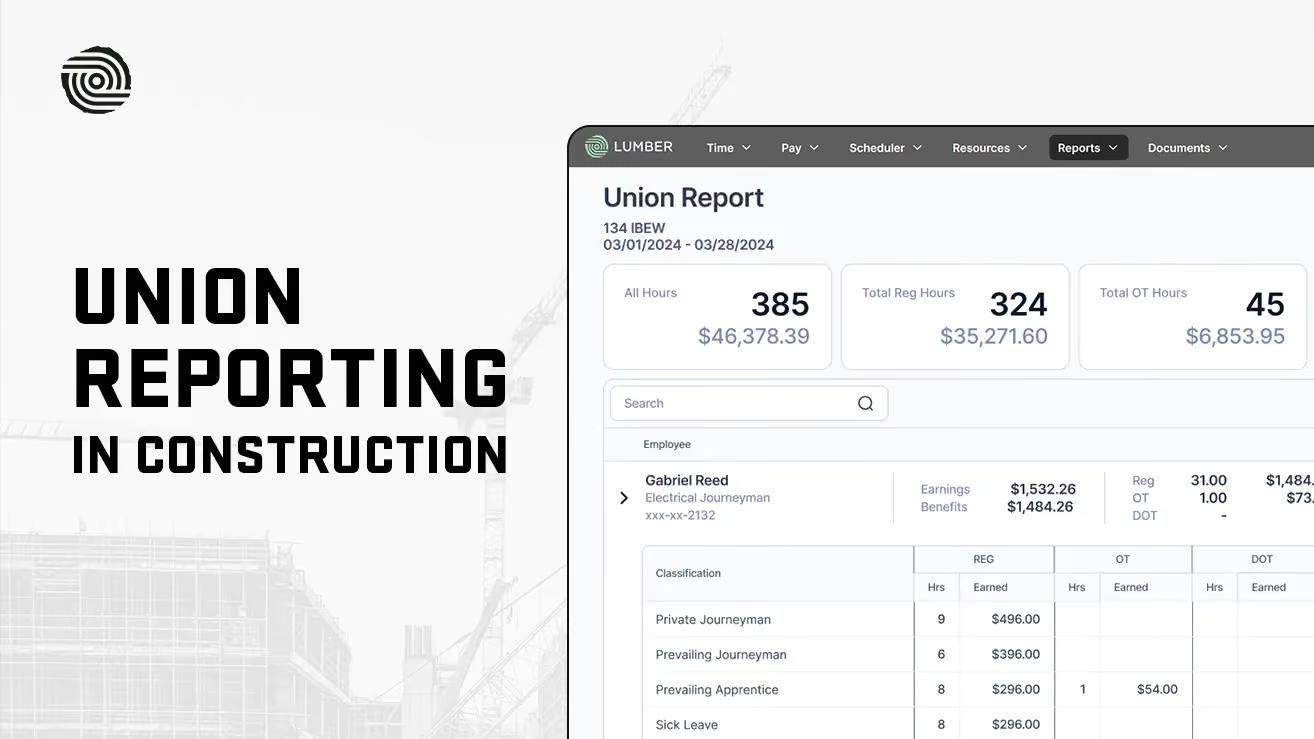
Lumber handles union reporting as a built-in part of payroll, not as a separate process bolted on afterward. For any pay period, Lumber generates a Union Fringe Remittance Report per union that summarizes hours worked and fringe contributions owed, broken down by employee and classification. It uses the job level and classification that were actually paid on each timesheet entry, not whatever the employee's profile says today.
Hence, a later job title change never rewrites what a past remittance owed. Reports export as PDF for submitting straight to the union administrator or as Excel for internal tracking, and settings like masking SSNs or including imputed income in gross wages are handled at the report level so the same output works for both compliance filing and internal review.
Because classification errors are one of the most common ways fringe amounts go wrong, Lumber also runs a separate weekly check comparing what was recorded on each timesheet entry against what’s configured on the employee’s profile, and flags any mismatch before it turns into a remittance error.
A related report tracks apprentice-to-journeyman hour ratios and flags any shift where an apprentice worked without journeyman coverage, so ratio compliance gets caught at the timesheet stage instead of during an audit. For teams that need compliance staff to run and review union reports without giving them full payroll access, Lumber supports a restricted admin role scoped specifically to union and prevailing wage data, with salaried employee information excluded entirely from what that role can see. Together, this keeps union reporting accurate at the source, not just correct on the form that eventually goes out the door.
Lorem ipsum dolor sit amet, consectetur adipiscing elit. Donec ullamcorper mattis lorem non. Ultrices praesent amet ipsum justo massa. Eu dolor aliquet risus gravida nunc at feugiat consequat purus. Non massa enim vitae duis mattis. Vel in ultricies vel fringilla.
Introduction
Mi tincidunt elit, id quisque ligula ac diam, amet. Vel etiam suspendisse morbi eleifend faucibus eget vestibulum felis. Dictum quis montes, sit sit. Tellus aliquam enim urna, etiam. Mauris posuere vulputate arcu amet, vitae nisi, tellus tincidunt. At feugiat sapien varius id.
Eget quis mi enim, leo lacinia pharetra, semper. Eget in volutpat mollis at volutpat lectus velit, sed auctor. Porttitor fames arcu quis fusce augue enim. Quis at habitant diam at. Suscipit tristique risus, at donec. In turpis vel et quam imperdiet. Ipsum molestie aliquet sodales id est ac volutpat.


Ipsum sit mattis nulla quam nulla. Gravida id gravida ac enim mauris id. Non pellentesque congue eget consectetur turpis. Sapien, dictum molestie sem tempor. Diam elit, orci, tincidunt aenean tempus. Quis velit eget ut tortor tellus. Sed vel, congue felis elit erat nam nibh orci.

Dolor enim eu tortor urna sed duis nulla. Aliquam vestibulum, nulla odio nisl vitae. In aliquet pellentesque aenean hac vestibulum turpis mi bibendum diam. Tempor integer aliquam in vitae malesuada fringilla.
Elit nisi in eleifend sed nisi. Pulvinar at orci, proin imperdiet commodo consectetur convallis risus. Sed condimentum enim dignissim adipiscing faucibus consequat, urna. Viverra purus et erat auctor aliquam. Risus, volutpat vulputate posuere purus sit congue convallis aliquet. Arcu id augue ut feugiat donec porttitor neque. Mauris, neque ultricies eu vestibulum, bibendum quam lorem id. Dolor lacus, eget nunc lectus in tellus, pharetra, porttitor.
Ipsum sit mattis nulla quam nulla. Gravida id gravida ac enim mauris id. Non pellentesque congue eget consectetur turpis. Sapien, dictum molestie sem tempor. Diam elit, orci, tincidunt aenean tempus. Quis velit eget ut tortor tellus. Sed vel, congue felis elit erat nam nibh orci.
Mi tincidunt elit, id quisque ligula ac diam, amet. Vel etiam suspendisse morbi eleifend faucibus eget vestibulum felis. Dictum quis montes, sit sit. Tellus aliquam enim urna, etiam. Mauris posuere vulputate arcu amet, vitae nisi, tellus tincidunt. At feugiat sapien varius id.
Eget quis mi enim, leo lacinia pharetra, semper. Eget in volutpat mollis at volutpat lectus velit, sed auctor. Porttitor fames arcu quis fusce augue enim. Quis at habitant diam at. Suscipit tristique risus, at donec. In turpis vel et quam imperdiet. Ipsum molestie aliquet sodales id est ac volutpat.
Mi tincidunt elit, id quisque ligula ac diam, amet. Vel etiam suspendisse morbi eleifend faucibus eget vestibulum felis. Dictum quis montes, sit sit. Tellus aliquam enim urna, etiam. Mauris posuere vulputate arcu amet, vitae nisi, tellus tincidunt. At feugiat sapien varius id.
Eget quis mi enim, leo lacinia pharetra, semper. Eget in volutpat mollis at volutpat lectus velit, sed auctor. Porttitor fames arcu quis fusce augue enim. Quis at habitant diam at. Suscipit tristique risus, at donec. In turpis vel et quam imperdiet. Ipsum molestie aliquet sodales id est ac volutpat.
- Lectus id duis vitae porttitor enim gravida morbi.
- Eu turpis posuere semper feugiat volutpat elit, ultrices suspendisse. Auctor vel in vitae placerat.
- Suspendisse maecenas ac donec scelerisque diam sed est duis purus.
Lectus leo massa amet posuere. Malesuada mattis non convallis quisque. Libero sit et imperdiet bibendum quisque dictum vestibulum in non. Pretium ultricies tempor non est diam. Enim ut enim amet amet integer cursus. Sit ac commodo pretium sed etiam turpis suspendisse at.
Tristique odio senectus nam posuere ornare leo metus, ultricies. Blandit duis ultricies vulputate morbi feugiat cras placerat elit. Aliquam tellus lorem sed ac. Montes, sed mattis pellentesque suscipit accumsan. Cursus viverra aenean magna risus elementum faucibus molestie pellentesque. Arcu ultricies sed mauris vestibulum.

Critical Construction Compliance | Awareness Week
Mar 16, 2026
Apr 15, 2026
Nov 30, 2026
Dec 15, 2026
Essential resources for contractors