How to Handle Per Diem and Travel Pay in Construction Projects


Per diem and travel pay are required on most construction projects, particularly when crews work at multiple sites or away from home. Errors in these payments can lead to wage theft claims, tax issues, and certified payroll violations. This guide explains key requirements, 2025 and 2026 rate updates, state-specific rules, and tax considerations. Managing travel pay and per diem is a critical part of payroll for construction companies with distributed job sites.
What Is Per Diem in Construction?
Per diem, meaning 'per day,' is a daily allowance for workers covering expenses when working away from home. It typically includes meals, lodging, and incidentals. Per diem is a reimbursement, not wages, and is non-taxable if structured according to IRS rules.
On public works projects, per diem is often required as part of the prevailing wage package, not optional.
What Is Travel Time Pay?
Travel time pay compensates workers for travel required during the workday at the employer's direction. Not all travel qualifies; eligibility depends on when and why the travel occurs.
Who Qualifies for Travel Time Pay?
Eligibility depends on three factors:
- Nature of the travel: Employer-directed travel between job sites during the workday is generally compensable. Regular home-to-work commuting is not.
- Time of day: Travel during normal working hours is more likely to be paid.
- Distance and location: Long-distance travel required by the employer, especially overnight, is typically compensable.
2025 and 2026 Federal Per Diem Rates
.avif)
The General Services Administration (GSA) sets federal per diem rates that serve as the standard baseline for construction projects. For FY2025, the standard lodging rate increased to $110 per night, with Meals and Incidental Expenses (M&IE) rates ranging from $68 to $92 per day, up from the prior range of $59 to $79.
For FY2026, GSA kept rates at the same level as FY2025. These rates are effective October 1, 2025, through September 30, 2026. If your contracts or policies reference annual rate updates, no adjustment is required for 2026.
On the first and last day of travel, workers receive 75% of the applicable M&IE rate under federal rules. This applies to both standard and high-cost area rates. Ensure your payroll policy reflects this requirement.
High-Cost Area Rates
Many construction markets fall into GSA high-cost area designations with higher lodging and M&IE rates. Always verify the GSA rate for the specific county or city where your project is located, not just the state-level average. Use the GSA Per Diem lookup tool at gsa.gov for current rates by location.
Transportation Industry Per Diem
For drivers or equipment operators covered by DOT hours-of-service rules, a separate M&IE rate applies. In 2025 and 2026, the transportation industry rate is $80 per day for domestic travel (CONUS) and $86 per day for travel outside the continental US (OCONUS). These rates differ from the standard GSA schedule.
Key Factors That Determine Per Diem Rates
Per diem rates on construction projects are influenced by several variables:
- Project location: High-cost metro areas carry higher GSA-designated rates.
- Project duration: Longer projects may have negotiated per diem agreements in the original contract.
- Contract terms: Union agreements and individual employment contracts may specify rates that differ from the GSA baseline.
- Project type: Public works projects subject to prevailing wage laws may have per diem amounts set by state wage determinations, which must be followed as minimums.
State-Specific Rules
California
California has some of the most detailed labor compliance requirements in the country. For public works projects, per diem must be included in the total prevailing wage package where required by wage determinations issued by the Department of Industrial Relations (DIR).
California prevailing wage determinations are issued twice per year, on February 22 and August 22, with rates taking effect ten days after issuance. If your project spans one of these dates, check whether an updated determination applies.
Travel time during the normal workday must be paid under the California Labor Code. If an employee is directed to travel from one job site to another during work hours, that time counts as hours worked. Commuting from home to the first job site does not qualify.
Compliance note: Underpaying workers on California public works projects can result in fines of up to $200 per day per worker. Repeat or willful violations carry higher penalties and can result in contractor debarment for up to three years.
California is also considering new construction wage tiers under proposed CEQA exemption legislation (AB 130 and related proposals) that would allow lower wage rates on qualifying projects. This is still under discussion as of early 2026, but contractors bidding projects in California should monitor DIR guidance on whether these tiers apply to their work.
Washington
Washington State's Department of Labor and Industries (L&I) requires travel pay when travel is a mandated part of the workday. If work begins at an employer-designated site, travel from that site to other locations during the workday is compensable.
For multi-city or multi-state assignments, per diem must cover reasonable lodging and meal expenses consistent with prevailing wage requirements. Employers must maintain accurate records to demonstrate compliance. Washington enforces certified payroll requirements on public works projects, and inadequate travel pay documentation is a common audit trigger.
Per Diem for Contractors vs. Employees
W-2 Employees
Employees can receive non-taxable per diem reimbursements if the payments fall within IRS accountable plan rules. The three conditions are:
- The expense must have a legitimate business purpose.
- Expense reports must be submitted within 60 days of incurring the expense.
- Any amount paid above the GSA rate must be returned within 120 days.
Payments that do not meet all three conditions are treated as taxable wages and must be included in the employee's W-2.
1099 Independent Contractors
Independent contractors cannot receive employer-paid, non-taxable per diem in the same way as W-2 workers. Instead, they deduct eligible travel expenses directly on their tax returns using IRS Publication 463 as guidance.
If a contract includes a per diem stipend for a 1099 contractor, that payment is typically treated as taxable income to the contractor unless the contractor has their own accountable plan. Contractors should be advised to document travel expenses carefully, including dates, locations, and business purposes.
Tax note: Payments above GSA per diem rates, whether to employees or contractors, are taxable unless the excess is returned. Document all per diem payments and confirm your accountable plan is in writing.
What Per Diem Covers and What It Does Not
Included
- Lodging at the project location or the nearest reasonable option
- Meals and non-alcoholic beverages during the travel period
- Incidental expenses such as service tips and small fees directly related to the work trip
Not Included
- Personal expenses unrelated to work
- Entertainment or leisure activities
- Travel for personal reasons during a work trip
- Alcoholic beverages
Best Practices for Managing Per Diem and Travel Pay

Document Everything
Keep records of all per diem and travel pay disbursements. This includes worker locations, project assignments, dates, and payment amounts. Certified payroll compliance requires this level of documentation on public works projects.
Build a Written Per Diem Policy
A written policy removes ambiguity. It should specify which workers qualify, which expenses are covered, the applicable rate for each project location, how expenses are submitted and approved, and how amounts above the GSA rate are handled.
Update Rates When GSA Rates Change
GSA rates update each October 1. Include a review in your annual payroll process. For FY2026, rates remain unchanged from FY2025, but verify rates for your project counties.
Integrate Per Diem Into Your Payroll System
Manual per diem tracking increases the risk of errors. Integrating per diem rules with payroll processing reduces miscalculations, supports prevailing wage compliance, and simplifies audits.
Train Your Supervisors
Field supervisors are the primary contact for per diem and travel pay questions. Ensure they understand the policy, know which workers qualify, and can refer questions to payroll before issues arise.
How Lumber Handles Per Diem and Travel Pay
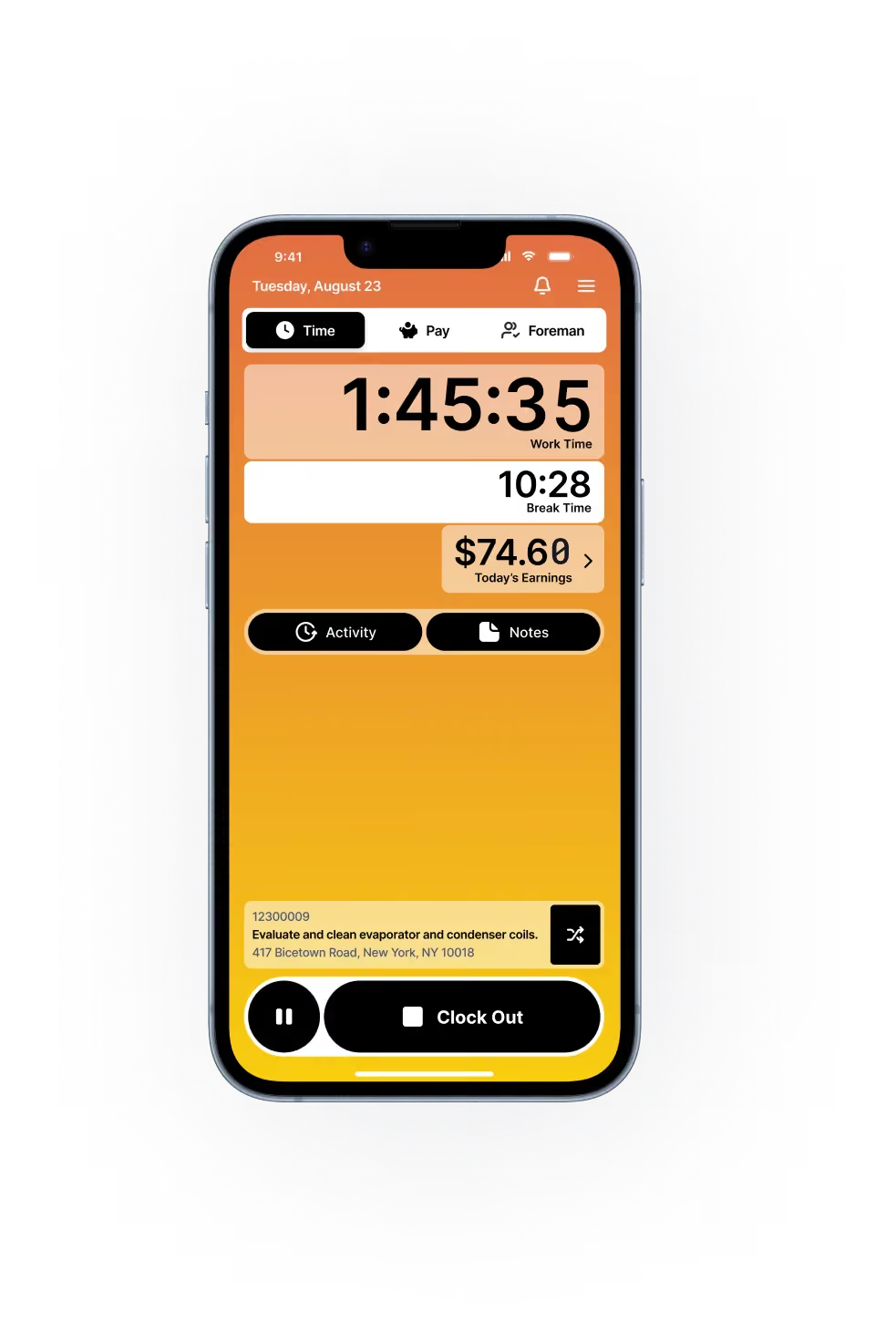
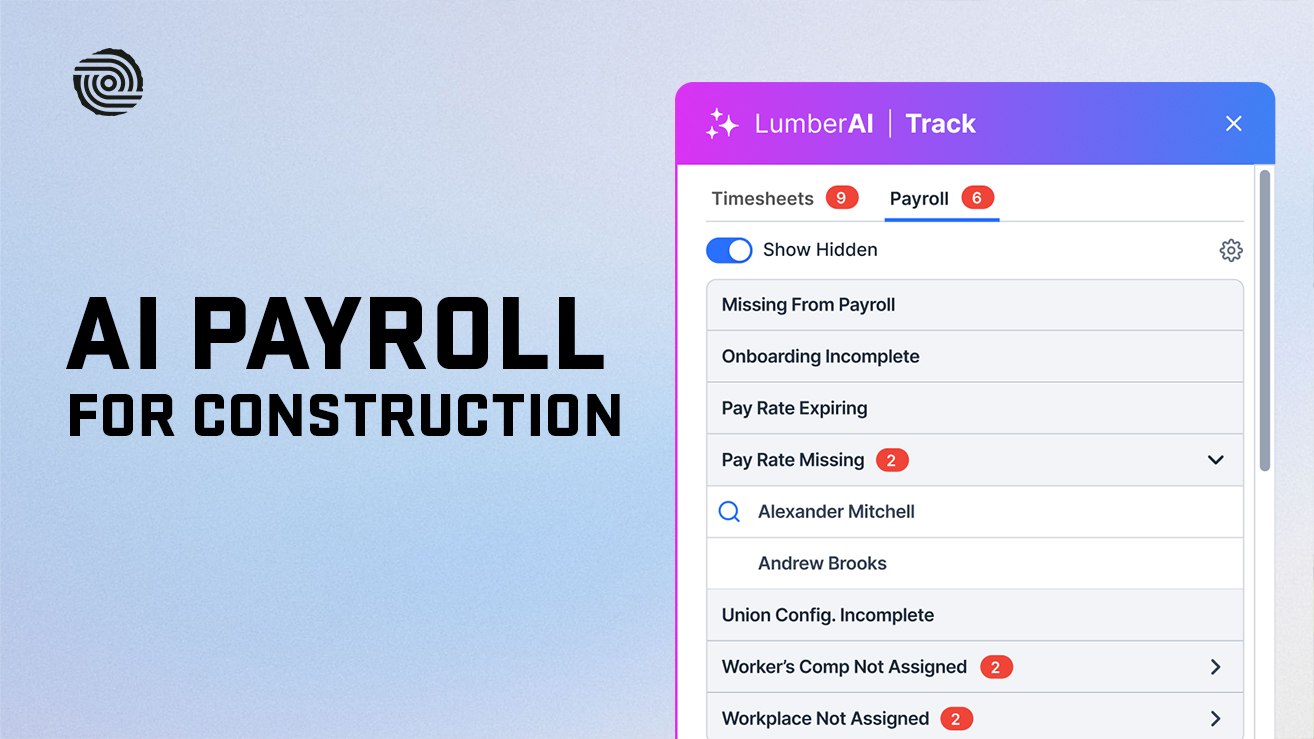
Lumber's payroll and time tracking platform handles per diem and travel pay as part of its core construction compliance toolset. Here is what the platform does specifically:
Per Diem Configuration
You can set daily allowances and lodging reimbursements using flat or bracketed rates, adjusted by project location and proximity to home base. Policies apply separately at prevailing wage, union, or private pay levels, and the system automatically applies the correct rate based on project and worker classification.
Travel Time Integration
Travel time pay is calculated within the timesheet workflow. You can set hourly, bracketed, or per-mile travel compensation rules. Workers record travel time in the app, and the system applies the correct rate automatically, eliminating manual payroll adjustments.
Prevailing Wage Compliance Logic
Lumber prioritizes prevailing wage configurations, followed by union and then private pay rates, to ensure the highest applicable rate is used for both wages and per diem on public works projects.
Location Verification and Anti-Fraud
Lumber uses AI-based face matching to prevent buddy punching by comparing check-in selfies to registered employee photo IDs. GPS location is recorded at clock-in and clock-out, providing verifiable data for travel pay eligibility and certified payroll documentation.

Offline Capability
Lumber operates in areas without reliable internet, common on remote sites. Time and location data sync automatically when connectivity returns, so workers can clock in or out without waiting for a signal.
Expense Management
Workers submit receipts and expense reports through the Lumber app. Project managers review and approve expenses in the same platform, and approved expenses feed directly into payroll, eliminating paper workflows and reducing delays.
Frequently Asked Questions
Is per diem taxable for contractors?
Per diem can be non-taxable for employees if it meets IRS accountable plan requirements and does not exceed GSA rates. For 1099 contractors, per diem received from a client is generally taxable income. Contractors deduct qualified travel expenses separately when filing taxes. Any amount above GSA rates is taxable for both employees and contractors.
Can independent contractors receive per diem?
Yes. A contract can include a per diem stipend for a 1099 contractor, but it will typically be treated as part of taxable compensation. Contractors should track actual expenses and deduct them on their returns per IRS Publication 463. Proper documentation of dates, locations, and business purposes is required.
What is the difference between a per diem employee and a contractor?
A per diem employee is a W-2 worker hired on a short-term or shift basis. They receive employer benefits and can receive non-taxable per diem under an accountable plan. A contractor is a 1099 worker who is self-employed. Contractors do not receive employer benefits and cannot receive non-taxable per diem reimbursements in the same manner. They handle travel deductions through their own tax filings.
What happens if we pay above the GSA rate?
The excess is taxable. If you pay $120 per night for lodging in a market where the GSA rate is $110, the $10 difference must be treated as wages and included in payroll tax calculations. Document this clearly in your payroll records to avoid discrepancies during an audit.
Do per diem rates change in 2026?
No. GSA confirmed that FY2026 per diem rates are unchanged from FY2025. The standard lodging rate remains $110 per night. M&IE rates remain $68 to $92 per day depending on location. Rates for specific high-cost counties should still be verified at gsa.gov.
Lorem ipsum dolor sit amet, consectetur adipiscing elit. Donec ullamcorper mattis lorem non. Ultrices praesent amet ipsum justo massa. Eu dolor aliquet risus gravida nunc at feugiat consequat purus. Non massa enim vitae duis mattis. Vel in ultricies vel fringilla.
Introduction
Mi tincidunt elit, id quisque ligula ac diam, amet. Vel etiam suspendisse morbi eleifend faucibus eget vestibulum felis. Dictum quis montes, sit sit. Tellus aliquam enim urna, etiam. Mauris posuere vulputate arcu amet, vitae nisi, tellus tincidunt. At feugiat sapien varius id.
Eget quis mi enim, leo lacinia pharetra, semper. Eget in volutpat mollis at volutpat lectus velit, sed auctor. Porttitor fames arcu quis fusce augue enim. Quis at habitant diam at. Suscipit tristique risus, at donec. In turpis vel et quam imperdiet. Ipsum molestie aliquet sodales id est ac volutpat.


Ipsum sit mattis nulla quam nulla. Gravida id gravida ac enim mauris id. Non pellentesque congue eget consectetur turpis. Sapien, dictum molestie sem tempor. Diam elit, orci, tincidunt aenean tempus. Quis velit eget ut tortor tellus. Sed vel, congue felis elit erat nam nibh orci.

Dolor enim eu tortor urna sed duis nulla. Aliquam vestibulum, nulla odio nisl vitae. In aliquet pellentesque aenean hac vestibulum turpis mi bibendum diam. Tempor integer aliquam in vitae malesuada fringilla.
Elit nisi in eleifend sed nisi. Pulvinar at orci, proin imperdiet commodo consectetur convallis risus. Sed condimentum enim dignissim adipiscing faucibus consequat, urna. Viverra purus et erat auctor aliquam. Risus, volutpat vulputate posuere purus sit congue convallis aliquet. Arcu id augue ut feugiat donec porttitor neque. Mauris, neque ultricies eu vestibulum, bibendum quam lorem id. Dolor lacus, eget nunc lectus in tellus, pharetra, porttitor.
Ipsum sit mattis nulla quam nulla. Gravida id gravida ac enim mauris id. Non pellentesque congue eget consectetur turpis. Sapien, dictum molestie sem tempor. Diam elit, orci, tincidunt aenean tempus. Quis velit eget ut tortor tellus. Sed vel, congue felis elit erat nam nibh orci.
Mi tincidunt elit, id quisque ligula ac diam, amet. Vel etiam suspendisse morbi eleifend faucibus eget vestibulum felis. Dictum quis montes, sit sit. Tellus aliquam enim urna, etiam. Mauris posuere vulputate arcu amet, vitae nisi, tellus tincidunt. At feugiat sapien varius id.
Eget quis mi enim, leo lacinia pharetra, semper. Eget in volutpat mollis at volutpat lectus velit, sed auctor. Porttitor fames arcu quis fusce augue enim. Quis at habitant diam at. Suscipit tristique risus, at donec. In turpis vel et quam imperdiet. Ipsum molestie aliquet sodales id est ac volutpat.
Mi tincidunt elit, id quisque ligula ac diam, amet. Vel etiam suspendisse morbi eleifend faucibus eget vestibulum felis. Dictum quis montes, sit sit. Tellus aliquam enim urna, etiam. Mauris posuere vulputate arcu amet, vitae nisi, tellus tincidunt. At feugiat sapien varius id.
Eget quis mi enim, leo lacinia pharetra, semper. Eget in volutpat mollis at volutpat lectus velit, sed auctor. Porttitor fames arcu quis fusce augue enim. Quis at habitant diam at. Suscipit tristique risus, at donec. In turpis vel et quam imperdiet. Ipsum molestie aliquet sodales id est ac volutpat.
- Lectus id duis vitae porttitor enim gravida morbi.
- Eu turpis posuere semper feugiat volutpat elit, ultrices suspendisse. Auctor vel in vitae placerat.
- Suspendisse maecenas ac donec scelerisque diam sed est duis purus.
Lectus leo massa amet posuere. Malesuada mattis non convallis quisque. Libero sit et imperdiet bibendum quisque dictum vestibulum in non. Pretium ultricies tempor non est diam. Enim ut enim amet amet integer cursus. Sit ac commodo pretium sed etiam turpis suspendisse at.
Tristique odio senectus nam posuere ornare leo metus, ultricies. Blandit duis ultricies vulputate morbi feugiat cras placerat elit. Aliquam tellus lorem sed ac. Montes, sed mattis pellentesque suscipit accumsan. Cursus viverra aenean magna risus elementum faucibus molestie pellentesque. Arcu ultricies sed mauris vestibulum.

Critical Construction Compliance | Awareness Week
Mar 16, 2026
Apr 15, 2026
Nov 30, 2026
Dec 15, 2026
Essential resources for contractors