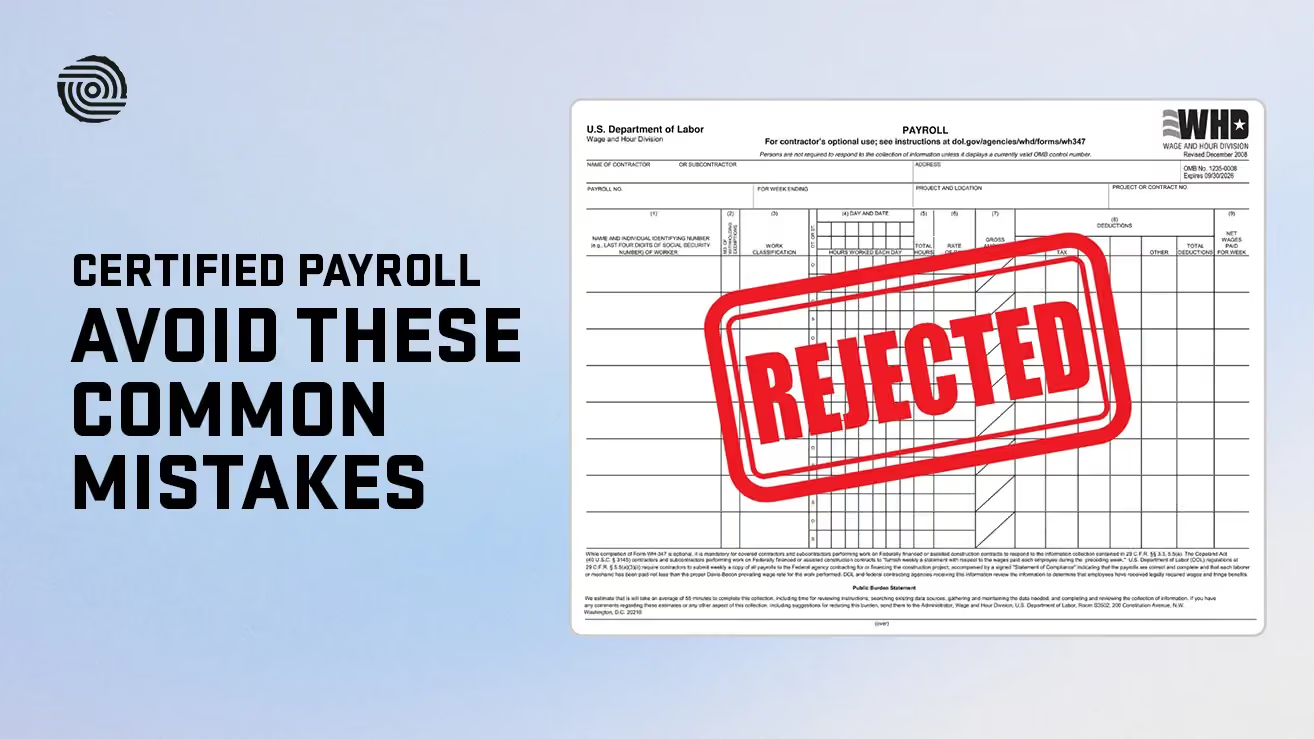
Why Certified Payroll Reports (CPRs) Get Rejected



Key Takeaways
- Certified Payroll Reports (CPRs) are legal compliance documents, and even minor mistakes can result in report rejections, delayed payments, back wage liability, penalties, or debarment from future public works projects.
- Employee misclassification is one of the most common reasons CPRs are rejected. Workers must be classified according to the work they actually perform, with accurate daily records for each trade.
- Payroll inconsistencies, including duplicate check numbers, mismatched payroll records, and reconciliation errors, can trigger agency reviews and payment delays.
- Apprentices must meet all prevailing wage requirements, including proper registration and required journeyman supervision. Failure to maintain apprentice ratios can result in contractors owing full journeyman wages.
- Fringe benefits must satisfy the required hourly prevailing wage rate. Any shortfall must be paid as cash wages, and only qualifying bona fide benefits can be counted toward fringe obligations.
- Certified payroll reports must be submitted on the schedule required by the project. Contractors with biweekly payroll cycles still need to file weekly CPRs when required by federal or state law.
- Accurate daily timekeeping is essential. Errors in recorded hours, overtime calculations, project allocation, or rounding practices are common audit triggers.
- General contractors are responsible for reviewing subcontractor CPRs before submission, since subcontractor errors can expose the entire project to compliance risks.
- Using payroll software built specifically for prevailing wage compliance helps automate wage calculations, fringe tracking, apprentice management, and CPR generation, significantly reducing manual errors.
- Establishing consistent payroll processes, maintaining complete documentation, and understanding project-specific prevailing wage requirements are the best ways to prevent CPR rejections and costly compliance issues.
Six Common Mistakes Contractors Must Avoid
Certified payroll reporting is one of the most compliance-heavy obligations on any public works project and is also the most misunderstood. Contractors working on federally funded or state-funded construction projects under the Davis-Bacon Act or related state prevailing wage laws are required to submit weekly payroll certifications. When those reports contain errors, agencies reject them, withhold payment, and, in repeat violation, debar contractors from future public work.
The penalties are not theoretical. Between 2024 and 2025, the San Francisco Office of Labor Standards Enforcement (OLSE) reported that prevailing wage enforcement made up the majority of case resolutions for the ninth consecutive year, collecting nearly $1.5 million in back wages and penalties in that metro area alone. Nationally, the DOL Wage and Hour Division lists failure to pay full prevailing wages, including fringe benefits, as one of its top Davis-Bacon violation categories year after year.
This article breaks down the six most common reasons CPRs get rejected, explains the mechanics of each mistake, and gives you actionable steps to prevent them before you click submit.
What Is a Certified Payroll Report and Why Does Accuracy Matter?
A Certified Payroll Report (CPR) is a weekly payroll record that documents every worker on a prevailing wage project, their job classification, hours worked each day, hourly wage rate, fringe benefit contributions, and deductions. On federal projects, contractors submit Form WH-347 to the contracting agency. California uses its own electronic eCPR system through the DIR’s Public Works portal.
The certification statement on the form is a legal declaration. Knowingly falsifying a CPR can result in criminal prosecution, fines, and imprisonment under the Copeland Anti-Kickback Act. Honest errors are treated differently, but they still trigger back wage liability, interest penalties, and payment holds.
General contractors carry particular exposure because agency reviewers hold them accountable for subcontractor CPR accuracy. If a subcontractor’s report has a problem, it becomes the GC’s problem.
Mistake 1: Employee Misclassification
Worker classification is the foundation of every CPR. Every worker must be assigned the correct trade classification from the applicable wage determination, and that classification must match the work the person actually performed on-site that day.
The most common version of this mistake is listing a worker as a laborer when their actual duties correspond to a higher-paid classification, such as carpenter, ironworker, or electrician. Agencies and auditors compare job descriptions to certified payroll classifications routinely. When they do not match, the contractor owes the wage difference for every hour that worker was underpaid, plus penalties.
A separate but equally consequential form of misclassification is treating workers as independent contractors when they function as employees. A Pennsylvania drywall contractor was charged in 2021 after sourcing workers for a commercial construction project in Delaware County and misclassifying more than 30 of them as independent subcontractors to avoid paying taxes, wages, and workers' compensation. The owner, pleaded guilty to felony theft and conspiracy to commit workers' compensation fraud. He was sentenced to time served to 23 months, with 12 months of consecutive probation. It was the first criminal prosecution in Pennsylvania under the state's Construction Workplace Misclassification Act, and it was explicitly framed by the Delaware County District Attorney as a message to contractors statewide.
On prevailing wage projects, classifying a worker as an independent contractor does not relieve the contractor of the obligation to pay prevailing wages for work performed on a covered project.
California's DIR enforcement is particularly rigorous. Daily time tracking by classification is required. If a worker performs electrical work in the morning and general laborer tasks in the afternoon, those hours must be documented separately with the correct wage rates for each. Averaging across classifications or defaulting to a single lower-paid classification on the CPR is an audit trigger.
What to do: Cross-reference job duties against the wage determination classifications before the worker's first shift. Keep daily time records that reflect the actual scope of work performed, not just hours logged. Review DOL's classification guidance if you have mixed-trade workers.
Mistake 2: Duplicate Check Numbers and Payroll Record Inconsistencies
Auditors use payroll data cross-referencing as a baseline check. When check numbers appear on more than one payroll report, or when payroll records submitted to the contracting agency do not match the contractor’s own bookkeeping records, it signals possible fraud, even if the cause is a simple data entry or software export error.
Duplicate check numbers arise in a few predictable scenarios: manual entry errors, software that resets check numbering at the start of a fiscal period, or subcontractors running the same check against multiple project reports. Payroll record inconsistencies show up when the total wages reported on a CPR do not reconcile with the amounts shown on W-2s or state wage records.
In Wisconsin, the WisDOT eCPR system sends an automatic rejection notification when an agency reviewer flags payroll data issues, and the submitting contractor must correct and resubmit before payment is released. Most state portals operate similarly. Once your CPR moves into “Agency Reject” status, all downstream payments can stall.
What to do: Run a sequential check number audit before submission. If your payroll software generates reports for multiple projects, confirm it is not assigning the same check numbers across project reports. Reconcile your CPR totals against your internal payroll register every week, not just at project closeout.
Mistake 3: Apprentices Working Without Proper Journeyman Supervision
Federal prevailing wage rules allow contractors to pay apprentice wage rates, which are lower than journeyman rates, but only under strict conditions. The apprentice must be enrolled in a DOL-registered apprenticeship program (RAP), the contractor must hold a valid apprenticeship agreement with that program, and the apprentice-to-journeyman ratio must be maintained on the jobsite.
Under Davis-Bacon, the ratio of apprentice to journeyman varies by trade and state. If ratios are not met, apprentices' hours worked beyond the allowable ratio are reclassified as journeyman hours. The contractor then owes the wage difference for every affected hour.
California applies its own apprenticeship utilization requirements under Labor Code Section 1777.5, covering every contractor or subcontractor on a public works project valued over $30,000.
The Inflation Reduction Act (IRA) added a new dimension. Projects seeking enhanced tax credits under the IRA must meet a 15 percent apprentice labor-hour requirement. If that threshold is not met, the penalty is $50 per deficient hour, rising to $500 per hour for intentional disregard. California separately collected $18.7 million in apprenticeship penalties between 2022 and 2025.
What to do: Before the project begins, request apprentice dispatch from an approved Registered Apprenticeship Program. Verify apprentice registration paperwork and keep copies on file. Track apprentice-to-journeyman ratios daily. If crew size changes mid-project, recalculate compliance immediately. Reference DOL’s apprenticeship resources for ratio requirements by trade.
Mistake 4: Healthcare Benefit Underpayments
On prevailing wage jobs, the total compensation owed to a worker has two components: the base hourly wage and the fringe benefit rate. Both are listed on the wage determination. Both must be satisfied each week. A CPR that reports correct base wages but underpays or misreports fringe benefits is still non-compliant and will fail an audit review.
The mechanics are straightforward, but often misapplied. If a contractor’s health insurance plan costs $6.00 per hour per employee, and the wage determination requires $10.00 per hour in fringe benefits, the contractor must pay the remaining $4.00 per hour as cash wages to the worker. Failing to make up that difference with cash creates a shortfall that the DOL classifies as an underpayment of prevailing wage.
Not all benefit plans qualify for fringe credit. The DOL requires that fringe benefits be “bona fide,” meaning they must be established under a legitimate, written plan administered by a trustee or third party. Workers’ compensation premiums, FICA taxes, and general liability insurance do not count toward fringe credit, even though they represent real labor costs to the contractor. Administrative costs for running a plan also cannot be credited.
A related error: some contractors apply fringe calculations as a weekly or monthly average rather than per hour worked on the project. This leads to compliance gaps and inaccurate CPR data. Fringe must be calculated and reported per hour worked on the prevailing wage project each week.
According to the DOL’s Davis-Bacon compliance guidance, contributions to a bona fide fringe fund made irrevocably to a trustee or third party can be credited toward the prevailing wage requirement without prior DOL approval. Unfunded plans drawn from general company assets require written DOL approval before any fringe credit can be claimed.
What to do: For each trade classification on a project, confirm the wage determination’s fringe rate and calculate the exact hourly value of any qualifying benefit contributions. Pay any shortfall as cash and document both on the CPR. Review your benefit plans against DOL’s bona fide fringe benefit criteria before the project starts. Never average fringe across periods.
Mistake 5: Submitting Biweekly Labor Data for Projects Requiring Weekly Payroll Reporting
This error is common among contractors who run biweekly or semi-monthly payroll cycles in their regular business operations and then try to adapt that schedule to prevailing wage project reporting without adjusting their cadence.
Under the Davis-Bacon Act and most state prevailing wage statutes, certified payroll reports must be submitted weekly, covering the work week in which wages were earned. A biweekly CPR covering two work weeks in a single submission is non-compliant regardless of whether the underlying wage data is correct. Agencies require weekly submissions because they provide a continuous audit trail aligned with the project timeline.
New York State’s new electronic payroll portal, which became mandatory for all contractors and subcontractors on Article 8 public works projects starting December 31, 2025, requires submission every 30 days for state-covered work, but federal Davis-Bacon projects on the same jobsite still require weekly federal reporting. Contractors working on dual-covered projects must maintain both schedules.
Submitting combined payroll data late or in aggregated batches not only causes CPR rejections but also puts contractors at risk of payment withholding. Contracting agencies are authorized to withhold contract funds to cover back wage liability when certified payroll is not submitted in the correct format and on the correct schedule.
What to do: Separate your prevailing wage payroll reporting from your internal payroll cycle. Set up a dedicated weekly review workflow that captures, calculates, and submits CPRs for each work week independently. If you manage projects in multiple states, map the reporting frequency requirement for each project at the kickoff stage. A payroll compliance calendar specific to each active project is a practical tool that prevents scheduling errors.
Mistake 6: Timekeeping Errors and Trailing-Minute Discrepancies
Timekeeping accuracy directly determines whether reported hours on a CPR are defensible in an audit. Vague, reconstructed, or internally inconsistent time records are one of the most common reasons agencies request further documentation and one of the fastest paths to a formal investigation.
Trailing-minute discrepancies refer to systematic rounding practices that slightly reduce reported hours over time. For example, if a time system always rounds clock-out times down to the nearest quarter hour, a worker who consistently leaves at 4:58 PM has their time logged as 4:45 PM. Over a 20-week project, this can accumulate to several unpaid hours per worker. If that worker is a journeyman electrician at $45.00 per hour plus fringe, the underpayment exposure compounds quickly.
California’s DIR regulations are explicit on this point: daily overtime calculations are required. You cannot average hours across the week to avoid daily overtime triggers. A worker who logs 10 hours on Monday must be paid daily overtime for those hours, regardless of how many hours they work later in the week.
Timekeeping errors also include: failing to capture all hours worked on a project when a crew is split between a public works site and a private job on the same day, recording hours by project after the fact rather than in real time, and failing to keep daily time records by trade classification when workers perform multiple scopes.
What to do: Use digital time capture tools that record time at the point of entry, not reconstructed at week’s end. If your workers split time between prevailing wage and non-prevailing wage work on the same day, use a system that tracks by project in real time. Avoid blanket rounding rules that consistently disadvantage workers. Keep daily timesheets that reflect trade classification alongside hours. These records will serve as your primary defense in any audit.
Best Practices to Prevent CPR Rejections
The following practices address the structural causes of CPR errors rather than just the symptoms.
Assign CPR preparation responsibility to trained staff. You do not need a Certified Payroll Professional (CPP), a credential that involves a separate application and exam process through the American Payroll Association. But whoever prepares your CPRs should understand prevailing wage law, wage determinations, fringe benefit mechanics, and the specific portal requirements of the contracting agency.
Audit subcontractor CPRs before forwarding them. General contractors are responsible for the accuracy of their subcontractors’ payroll reports. Build a subcontractor CPR review step into your project workflow. Catch errors before they go to the agency.
Use prevailing wage-specific payroll software. Standard payroll platforms are not built for certified payroll compliance. Tools like Lumber Payroll that are designed for construction public works projects can automate wage determination lookups, fringe calculations, apprentice ratio tracking, and WH-347 or state-specific form generation. This reduces manual entry errors significantly.
Maintain documentation for the required retention period. Federal projects require payroll records to be retained for at least three years after project completion. State requirements vary, typically between two and four years. Audits can arrive after project closeout. A contractor who cannot produce records faces penalties without a practical means of defense.
Submit on time, every week. Late submission is treated the same as a missing submission by most agencies. Build your CPR submission into a standing weekly workflow tied to payroll processing.
Know the state-specific rules for each project. California, New York, Illinois, Washington, and many other states have prevailing wage requirements that differ from federal Davis-Bacon rules, including different wage rates, different forms, different electronic submission systems, and different overtime calculation methods. Using federal wage rates on a California project is one of the most cited compliance errors in the state. Always pull the applicable wage determination for the jurisdiction where the work is performed.
The Cost of Getting It Wrong
Rejections are not just an administrative inconvenience. A single rejected CPR can hold up progress payments for weeks. A pattern of CPR errors leads to audits. Audits lead to Civil Wage and Penalty Assessments or DOL investigations. At that point, the contractor is dealing with back wage liability, liquidated damages, penalty assessments, and, in serious cases, debarment from public works bidding.
Contractors debarred by the New York State DOL are listed publicly on the state’s debarment registry. Debarment at the federal level is tracked through SAM.gov, which is visible to any public agency reviewing bids. The reputational damage extends beyond the projects directly affected.
None of the six errors covered in this article requires complex technical knowledge to prevent. They require a consistent process, accurate records, and a working understanding of what contracting agencies actually review. Build that process before the first week of payroll, not after the first rejection.
Lorem ipsum dolor sit amet, consectetur adipiscing elit. Donec ullamcorper mattis lorem non. Ultrices praesent amet ipsum justo massa. Eu dolor aliquet risus gravida nunc at feugiat consequat purus. Non massa enim vitae duis mattis. Vel in ultricies vel fringilla.
Introduction
Mi tincidunt elit, id quisque ligula ac diam, amet. Vel etiam suspendisse morbi eleifend faucibus eget vestibulum felis. Dictum quis montes, sit sit. Tellus aliquam enim urna, etiam. Mauris posuere vulputate arcu amet, vitae nisi, tellus tincidunt. At feugiat sapien varius id.
Eget quis mi enim, leo lacinia pharetra, semper. Eget in volutpat mollis at volutpat lectus velit, sed auctor. Porttitor fames arcu quis fusce augue enim. Quis at habitant diam at. Suscipit tristique risus, at donec. In turpis vel et quam imperdiet. Ipsum molestie aliquet sodales id est ac volutpat.


Ipsum sit mattis nulla quam nulla. Gravida id gravida ac enim mauris id. Non pellentesque congue eget consectetur turpis. Sapien, dictum molestie sem tempor. Diam elit, orci, tincidunt aenean tempus. Quis velit eget ut tortor tellus. Sed vel, congue felis elit erat nam nibh orci.

Dolor enim eu tortor urna sed duis nulla. Aliquam vestibulum, nulla odio nisl vitae. In aliquet pellentesque aenean hac vestibulum turpis mi bibendum diam. Tempor integer aliquam in vitae malesuada fringilla.
Elit nisi in eleifend sed nisi. Pulvinar at orci, proin imperdiet commodo consectetur convallis risus. Sed condimentum enim dignissim adipiscing faucibus consequat, urna. Viverra purus et erat auctor aliquam. Risus, volutpat vulputate posuere purus sit congue convallis aliquet. Arcu id augue ut feugiat donec porttitor neque. Mauris, neque ultricies eu vestibulum, bibendum quam lorem id. Dolor lacus, eget nunc lectus in tellus, pharetra, porttitor.
Ipsum sit mattis nulla quam nulla. Gravida id gravida ac enim mauris id. Non pellentesque congue eget consectetur turpis. Sapien, dictum molestie sem tempor. Diam elit, orci, tincidunt aenean tempus. Quis velit eget ut tortor tellus. Sed vel, congue felis elit erat nam nibh orci.
Mi tincidunt elit, id quisque ligula ac diam, amet. Vel etiam suspendisse morbi eleifend faucibus eget vestibulum felis. Dictum quis montes, sit sit. Tellus aliquam enim urna, etiam. Mauris posuere vulputate arcu amet, vitae nisi, tellus tincidunt. At feugiat sapien varius id.
Eget quis mi enim, leo lacinia pharetra, semper. Eget in volutpat mollis at volutpat lectus velit, sed auctor. Porttitor fames arcu quis fusce augue enim. Quis at habitant diam at. Suscipit tristique risus, at donec. In turpis vel et quam imperdiet. Ipsum molestie aliquet sodales id est ac volutpat.
Mi tincidunt elit, id quisque ligula ac diam, amet. Vel etiam suspendisse morbi eleifend faucibus eget vestibulum felis. Dictum quis montes, sit sit. Tellus aliquam enim urna, etiam. Mauris posuere vulputate arcu amet, vitae nisi, tellus tincidunt. At feugiat sapien varius id.
Eget quis mi enim, leo lacinia pharetra, semper. Eget in volutpat mollis at volutpat lectus velit, sed auctor. Porttitor fames arcu quis fusce augue enim. Quis at habitant diam at. Suscipit tristique risus, at donec. In turpis vel et quam imperdiet. Ipsum molestie aliquet sodales id est ac volutpat.
- Lectus id duis vitae porttitor enim gravida morbi.
- Eu turpis posuere semper feugiat volutpat elit, ultrices suspendisse. Auctor vel in vitae placerat.
- Suspendisse maecenas ac donec scelerisque diam sed est duis purus.
Lectus leo massa amet posuere. Malesuada mattis non convallis quisque. Libero sit et imperdiet bibendum quisque dictum vestibulum in non. Pretium ultricies tempor non est diam. Enim ut enim amet amet integer cursus. Sit ac commodo pretium sed etiam turpis suspendisse at.
Tristique odio senectus nam posuere ornare leo metus, ultricies. Blandit duis ultricies vulputate morbi feugiat cras placerat elit. Aliquam tellus lorem sed ac. Montes, sed mattis pellentesque suscipit accumsan. Cursus viverra aenean magna risus elementum faucibus molestie pellentesque. Arcu ultricies sed mauris vestibulum.

Critical Construction Compliance | Awareness Week
Mar 16, 2026
Apr 15, 2026
Nov 30, 2026
Dec 15, 2026
Essential resources for contractors