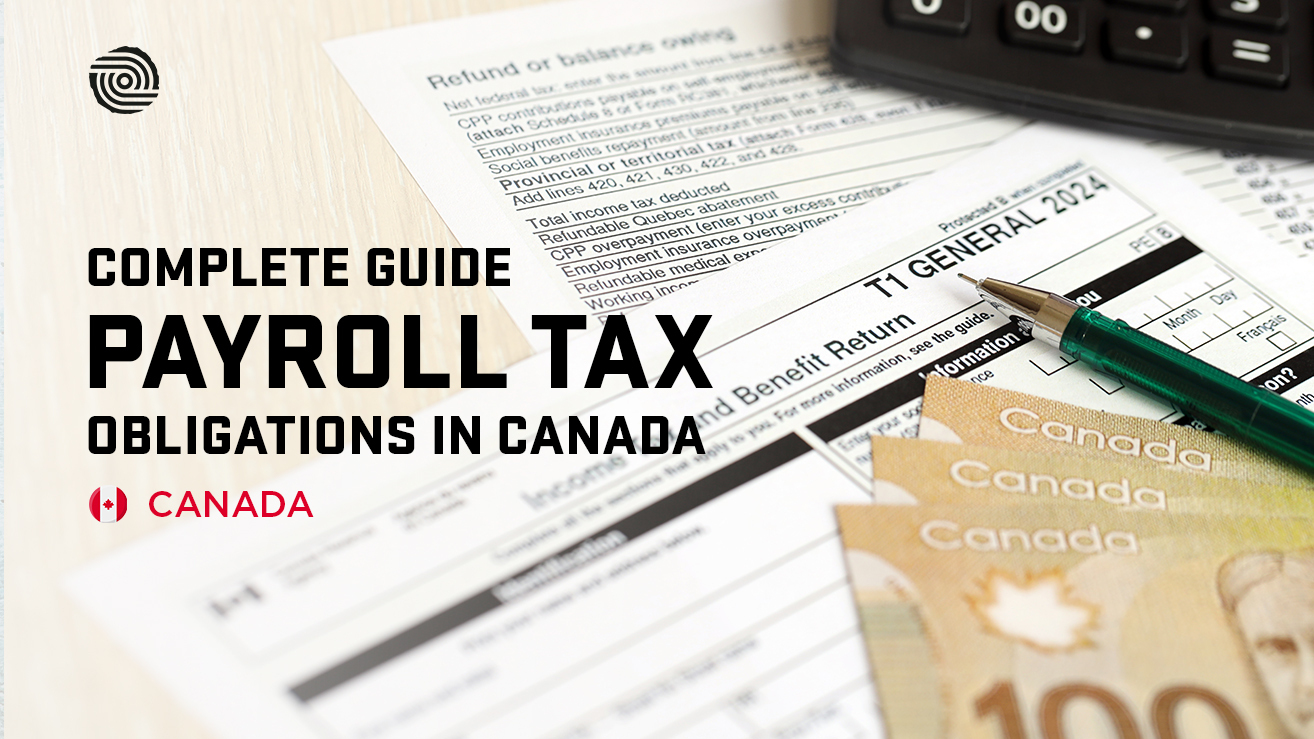
A Complete Guide to Payroll Tax Obligations in Construction



A framing crew shows up on a Monday in Alberta and finishes the same job in Saskatchewan two weeks later. The foreman is on the Ontario head office payroll. A labour supply company technically employs the apprentice. Nobody adjusted the source deductions for any of it.
This is how construction companies end up owing the Canada Revenue Agency (CRA) money they did not know they owed. Payroll tax obligations aren't a back-office footnote in this industry. They shift with every jobsite, every subcontractor arrangement, and every province a crew crosses into.
For general contractors, specialty trades, payroll administrators, and construction accountants, understanding payroll tax obligations means knowing exactly what to withhold, remit, report, and what happens when any of it is missed.
This guide walks through payroll tax obligations in construction, how they differ from a standard office payroll, and how to calculate payroll deductions correctly so a CRA review doesn't become a cash flow problem.
Key Takeaways
- Payroll tax obligations in construction include CPP, CPP2, EI, and federal and provincial income tax withholding, plus Workers' Compensation Board (WCB) or WSIB premiums and construction-specific CRA reporting.
- Construction adds obligations most other industries don't carry, including T5018 subcontractor reporting and worker-classification risk tied to frequent subcontracting.
- Correct worker classification, whether a person is an employee or a genuine subcontractor, is one of the most audited areas in construction payroll.
- Multi-provincial crews mean payroll deductions can change depending on where the work is actually performed, not just where head office is located.
- The CRA uses a graduated penalty structure for late remittances, starting at 3 percent and rising to 10 percent, with steeper penalties for repeated or deliberate non-compliance.
- Canadian payroll tax brackets and CPP, CPP2, and EI maximums are updated every year, so 2026 figures are different from 2025 and must be applied from January 1.
- Record-keeping is not optional. The CRA expects you to retain payroll records and keep them available for at least six years.
- Payroll deduction errors are rarely intentional. It is usually a rate that wasn't updated, or a worker who wasn't reclassified after the scope of work changed.
What Are Payroll Tax Obligations in Construction?
Payroll tax obligations are the legal requirements an employer must withhold, remit, and report from employee pay. In Canada, this covers four core pieces for every employee:
- Canada Pension Plan (CPP) contributions, including the CPP2 enhancement on higher earnings
- Employment Insurance (EI) premiums
- Federal and provincial income tax withholding, sometimes called tax withholding Canada or federal withholding tax Canada.
- Reporting, primarily through T4 slips issued to employees and summaries filed with the CRA
In construction, payroll tax obligations extend further. Employers must also account for:
- Workers' Compensation Board or WSIB premiums, which are mandatory in every province for construction work and are rated by classification unit, not a flat percentage
- T5018 subcontractor reporting, unique to the construction industry
- Union dues and fringe remittances, where a collective agreement applies
- Multi-provincial payroll rules, since crews frequently work across provincial lines within the same pay period
The CRA enforces payroll tax obligations, while Revenu Québec handles the equivalent role for Quebec-based employers and employees. Provincial WCB and WSIB authorities enforce compensation premium obligations separately from the CRA.
General vs. Construction-Specific Payroll Tax Obligations
A retail business and a construction company both owe CPP, EI, and income tax withholding. What changes in construction is scale, mobility, and the sheer number of parties on a single jobsite.
The T5018 requirement is the clearest example of a construction-specific obligation. If more than 50 percent of a business's income comes from construction activities, and the business pays a Canadian resident subcontractor more than $500 in a calendar year, the CRA requires either a T5018 slip or an equivalent listing of payments. This exists specifically because construction has historically had high rates of unreported subcontractor income, and the CRA uses T5018 data to cross-check what subcontractors report on their own returns.
Compliance with Payroll Tax Regulations
Meeting payroll tax obligations in construction comes down to three pillars: correct classification, timely remittance, and disciplined record-keeping.
Employee Classification
The CRA looks at the real working relationship, not the label on a contract. Key factors include:
- Who controls how, when, and where the work is done
- Who supplies tools and equipment
- Whether the worker can subcontract the work to someone else
- Whether the worker bears financial risk or is paid a set wage regardless of outcome
Misclassifying an employee as a subcontractor to avoid CPP, EI, and withholding obligations is one of the most common triggers for a CRA payroll audit in construction, precisely because subcontracting is so routine on a jobsite.
Remittance Requirements
Every employer with a payroll account must remit CPP, EI, and income tax withholding to the CRA on a schedule based on their average monthly withholding amount (AMWA) from two calendar years prior:
- Regular remitters (AMWA under $15,000) remit by the 15th of the month following the pay period.
- Threshold 1 accelerated remitters (AMWA of $15,000 to $49,999.99) remit twice a month.
- Threshold 2 accelerated remitters (AMWA of $50,000 or more) remit up to four times a month.
WCB and WSIB premiums follow their own remittance schedule, set independently by the provincial board, and are not combined with CRA remittances.
Record-Keeping Responsibilities
Construction employers must retain payroll records, including time records, wage rates, deduction calculations, T4 and T5018 filings, and WCB/WSIB assessments, for at least six years. Because construction payroll is often reviewed for classification and multi-provincial issues, keeping organized, jobsite-level records makes a CRA or WCB review straightforward instead of a scramble.
Payroll Compliance and Employer Obligations in Construction
Running compliant payroll in construction means keeping several moving parts aligned at once.
Registering the right accounts. A construction employer needs a CRA payroll (RP) account, WCB or WSIB coverage in every province where work is performed, and Revenu Québec registration if Quebec crews are involved.
Applying the right rates by location. Provincial income tax rates, WCB/WSIB premium rates, and even minimum wage differ by province. A crew working a project in another province may need deductions recalculated for the period they are there.
Handling union payroll correctly. Where a collective bargaining agreement applies, payroll must account for negotiated wage rates, fringe benefit contributions, and union dues remittance, in addition to standard statutory deductions.
Tracking apprentices separately. Apprentice wages are often tied to a percentage of the certified journeyperson rate based on the apprentice's registered level, which affects both gross pay and how deductions are calculated.
Reconciling subcontractor payments for T5018. This means tracking payments to every subcontractor throughout the year, not compiling them after the fact at tax time.
Issuing T4s and T5018s on time. Both are due by the last day of February following the calendar year they cover.
This is where many construction companies feel the strain of running payroll on spreadsheets. Multiple job sites, multiple provinces, and multiple subcontractors mean multiple places for a rate or classification to slip through.
Lumber's payroll platform is built for exactly this kind of complexity, applying the right CPP, CPP2, EI, and provincial tax rates automatically by jobsite, while tracking subcontractor payments for T5018 as they happen rather than at year-end.
Penalties for Non-Compliance
The CRA applies a graduated penalty structure for late remittances:
- 1 to 3 days late: 3 percent of the amount due
- 4 to 5 days late: 5 percent of the amount due
- 6 to 7 days late: 7 percent of the amount due
- More than 7 days late: 10 percent of the amount due
For a second late remittance in the same calendar year where the CRA determines the failure was knowing or due to gross negligence, the penalty can rise to 20 percent. Separately, failing to deduct CPP or EI at all carries a minimum penalty of 10 percent of the amount that should have been deducted, rising to 20 percent for repeated or deliberate failures. Interest is charged on top of any penalty, compounding daily from the date the amount was due.
Beyond the CRA, non-compliance carries other real costs in construction:
- WCB/WSIB penalties and surcharges for unpaid or underreported premiums, plus potential loss of clearance certificate status, which can stop a contractor from being awarded new work
- Retroactive reclassification costs if a subcontractor is later deemed an employee, including back CPP, EI, and withholding plus penalties and interest
- T5018 non-filing penalties, assessed per slip not filed on time
None of these penalties require intent. Most come from a rate that was not updated for the new year, a worker whose role changed without payroll being notified, or a subcontractor payment that never made it into the T5018 tracking sheet.
Calculate the Payroll Deductions
Payroll deductions in Canada follow the same basic sequence for every employee, with 2026 rates applied from January 1.
Step 1: Determine gross pay.
Total wages for the pay period before any deductions.
Step 2: Calculate CPP contributions.
For 2026, employees contribute 5.95 percent on earnings between the $3,500 basic exemption and the Year's Maximum Pensionable Earnings (YMPE) of $74,600, to a maximum contribution of $4,230.45.
On earnings between $74,600 and the Year's Additional Maximum Pensionable Earnings (YAMPE) of $85,000, an additional CPP2 contribution of 4 percent applies, to a maximum of $416. Quebec employees contribute to the Quebec Pension Plan (QPP) instead, at a different rate.
Step 3: Calculate EI premiums.
For 2026, employees pay EI premiums on insurable earnings up to a maximum insurable earnings amount of $68,900, with no basic exemption. Quebec has a separate, reduced EI rate paired with the Quebec Parental Insurance Plan (QPIP).
Step 4: Calculate income tax withholding.
Apply both federal and provincial or territorial tax tables to the employee's taxable income for the pay period, using the CRA's payroll deduction tables or certified payroll software. For 2026, the federal rate is 14 percent on income up to $58,523, rising through 20.5, 26, and 29 percent, to a top federal rate of 33 percent above $258,482.
Provincial tax brackets are set independently and vary by province; for example, Ontario payroll deductions use Ontario's own bracket structure layered on top of the federal calculation.
Step 5: Apply any additional deductions.
This includes union dues, pension contributions, and any other authorized deductions specific to the employee or the collective agreement.
Step 6: Subtract all deductions from gross pay to arrive at net pay.
Once an employee reaches the CPP or EI maximum for the year, that specific deduction stops for the remainder of the year, which is why take-home pay typically increases slightly for higher earners late in the calendar year.
Because CPP, CPP2, EI, and tax bracket thresholds are indexed and updated annually, payroll teams need to confirm the current year's figures before running the first payroll of January, rather than carrying forward the prior year's numbers.
Final Thoughts on Canadian Payroll Taxes
Payroll tax obligations in construction are not fundamentally different from payroll tax obligations anywhere else in Canada. CPP, EI, and income tax withholding apply the same way. What changes is the volume of moving parts: multiple job sites, multiple provinces, frequent subcontracting, union agreements, and apprentice wage scales all layered on top of the same statutory base.
Getting it right comes down to three habits: classify workers correctly from day one, apply the current year's rates without exception, and keep records organized by jobsite throughout the year, not at tax time. Contractors who build these habits into their payroll process spend far less time explaining themselves to the CRA or a WCB auditor.
For contractors managing crews across multiple provinces, subcontractor relationships, and union agreements, a payroll system built specifically for construction removes most of the manual tracking that leads to these errors in the first place. | Get a Personalized Quote for Canadian Payroll Services
Frequently Asked Questions
1. Do I have to withhold deductions if I pay myself a salary?
Yes, if you pay yourself a salary as an employee of your incorporated business, the same CPP, EI, and income tax withholding rules apply to you as they do to any other employee, and your corporation must remit those deductions to the CRA on the same schedule.
If you are self-employed as a sole proprietor and draw money from the business rather than a salary, there is no source withholding. Still, you are responsible for paying both the employer and employee portions of CPP contributions when you file your personal income tax return. EI is generally optional for self-employed individuals unless you have opted into the EI special benefits program for self-employed people. Speak with a payroll or tax professional to confirm the right structure for your situation.
2. What payroll deductions are mandatory in Canada?
Mandatory payroll deductions in Canada are Canada Pension Plan (CPP) contributions, including CPP2 for higher earners, Employment Insurance (EI) premiums, and federal and provincial or territorial income tax withholding. Quebec employers and employees use the Quebec Pension Plan (QPP) and Quebec Parental Insurance Plan (QPIP) instead of CPP and standard EI rates. In construction, Workers' Compensation Board (WSIB) premiums are also mandatory, though they are remitted to the provincial board rather than the CRA. Union dues and pension contributions may also be mandatory where a collective agreement or employment contract requires them. Still, these are not statutory payroll taxes in the same sense as CPP, EI, and income tax.
3. Do contractors charge tax on labour in Canada?
Yes. Construction labour is generally a taxable supply under Canada's GST/HST system. Contractors registered for GST/HST must charge GST, or HST in participating provinces, on both labour and materials for most construction services, then remit that tax to the CRA. Some provinces also apply provincial sales tax separately on materials.
Certain residential construction activities may qualify for rebates, such as the GST/HST New Housing Rebate, but the rebate applies after tax is charged; it does not exempt the labour from tax in the first place. Businesses with total taxable revenue under $30,000 in a calendar quarter and the prior four quarters combined are generally not required to register for GST/HST, though many choose to register voluntarily. This is separate from payroll tax obligations, which apply to employee wages rather than the value of contracted work.
4. What is a payroll tax obligation?
A payroll tax obligation is a legal requirement for an employer to withhold specific amounts from an employee's pay and remit them to the appropriate government body, along with related reporting requirements. In Canada, this means withholding CPP, EI, and income tax from every paycheque, remitting those amounts to the CRA on a schedule based on payroll size, and issuing T4 slips summarizing the year's pay and deductions. Employers also carry a matching obligation, since they must contribute their own share of CPP and EI on top of what is withheld from the employee. In construction, payroll tax obligations also include WCB or WSIB premiums and T5018 subcontractor reporting.
Note: Payroll tax rates, thresholds, and brackets are updated annually by the CRA and provincial authorities. Confirm current-year figures before applying any calculation in this guide, and consult a payroll or tax professional for advice specific to your business.
Lorem ipsum dolor sit amet, consectetur adipiscing elit. Donec ullamcorper mattis lorem non. Ultrices praesent amet ipsum justo massa. Eu dolor aliquet risus gravida nunc at feugiat consequat purus. Non massa enim vitae duis mattis. Vel in ultricies vel fringilla.
Introduction
Mi tincidunt elit, id quisque ligula ac diam, amet. Vel etiam suspendisse morbi eleifend faucibus eget vestibulum felis. Dictum quis montes, sit sit. Tellus aliquam enim urna, etiam. Mauris posuere vulputate arcu amet, vitae nisi, tellus tincidunt. At feugiat sapien varius id.
Eget quis mi enim, leo lacinia pharetra, semper. Eget in volutpat mollis at volutpat lectus velit, sed auctor. Porttitor fames arcu quis fusce augue enim. Quis at habitant diam at. Suscipit tristique risus, at donec. In turpis vel et quam imperdiet. Ipsum molestie aliquet sodales id est ac volutpat.


Ipsum sit mattis nulla quam nulla. Gravida id gravida ac enim mauris id. Non pellentesque congue eget consectetur turpis. Sapien, dictum molestie sem tempor. Diam elit, orci, tincidunt aenean tempus. Quis velit eget ut tortor tellus. Sed vel, congue felis elit erat nam nibh orci.

Dolor enim eu tortor urna sed duis nulla. Aliquam vestibulum, nulla odio nisl vitae. In aliquet pellentesque aenean hac vestibulum turpis mi bibendum diam. Tempor integer aliquam in vitae malesuada fringilla.
Elit nisi in eleifend sed nisi. Pulvinar at orci, proin imperdiet commodo consectetur convallis risus. Sed condimentum enim dignissim adipiscing faucibus consequat, urna. Viverra purus et erat auctor aliquam. Risus, volutpat vulputate posuere purus sit congue convallis aliquet. Arcu id augue ut feugiat donec porttitor neque. Mauris, neque ultricies eu vestibulum, bibendum quam lorem id. Dolor lacus, eget nunc lectus in tellus, pharetra, porttitor.
Ipsum sit mattis nulla quam nulla. Gravida id gravida ac enim mauris id. Non pellentesque congue eget consectetur turpis. Sapien, dictum molestie sem tempor. Diam elit, orci, tincidunt aenean tempus. Quis velit eget ut tortor tellus. Sed vel, congue felis elit erat nam nibh orci.
Mi tincidunt elit, id quisque ligula ac diam, amet. Vel etiam suspendisse morbi eleifend faucibus eget vestibulum felis. Dictum quis montes, sit sit. Tellus aliquam enim urna, etiam. Mauris posuere vulputate arcu amet, vitae nisi, tellus tincidunt. At feugiat sapien varius id.
Eget quis mi enim, leo lacinia pharetra, semper. Eget in volutpat mollis at volutpat lectus velit, sed auctor. Porttitor fames arcu quis fusce augue enim. Quis at habitant diam at. Suscipit tristique risus, at donec. In turpis vel et quam imperdiet. Ipsum molestie aliquet sodales id est ac volutpat.
Mi tincidunt elit, id quisque ligula ac diam, amet. Vel etiam suspendisse morbi eleifend faucibus eget vestibulum felis. Dictum quis montes, sit sit. Tellus aliquam enim urna, etiam. Mauris posuere vulputate arcu amet, vitae nisi, tellus tincidunt. At feugiat sapien varius id.
Eget quis mi enim, leo lacinia pharetra, semper. Eget in volutpat mollis at volutpat lectus velit, sed auctor. Porttitor fames arcu quis fusce augue enim. Quis at habitant diam at. Suscipit tristique risus, at donec. In turpis vel et quam imperdiet. Ipsum molestie aliquet sodales id est ac volutpat.
- Lectus id duis vitae porttitor enim gravida morbi.
- Eu turpis posuere semper feugiat volutpat elit, ultrices suspendisse. Auctor vel in vitae placerat.
- Suspendisse maecenas ac donec scelerisque diam sed est duis purus.
Lectus leo massa amet posuere. Malesuada mattis non convallis quisque. Libero sit et imperdiet bibendum quisque dictum vestibulum in non. Pretium ultricies tempor non est diam. Enim ut enim amet amet integer cursus. Sit ac commodo pretium sed etiam turpis suspendisse at.
Tristique odio senectus nam posuere ornare leo metus, ultricies. Blandit duis ultricies vulputate morbi feugiat cras placerat elit. Aliquam tellus lorem sed ac. Montes, sed mattis pellentesque suscipit accumsan. Cursus viverra aenean magna risus elementum faucibus molestie pellentesque. Arcu ultricies sed mauris vestibulum.

Critical Construction Compliance | Awareness Week
Mar 16, 2026
Apr 15, 2026
Nov 30, 2026
Dec 15, 2026
Essential resources for contractors