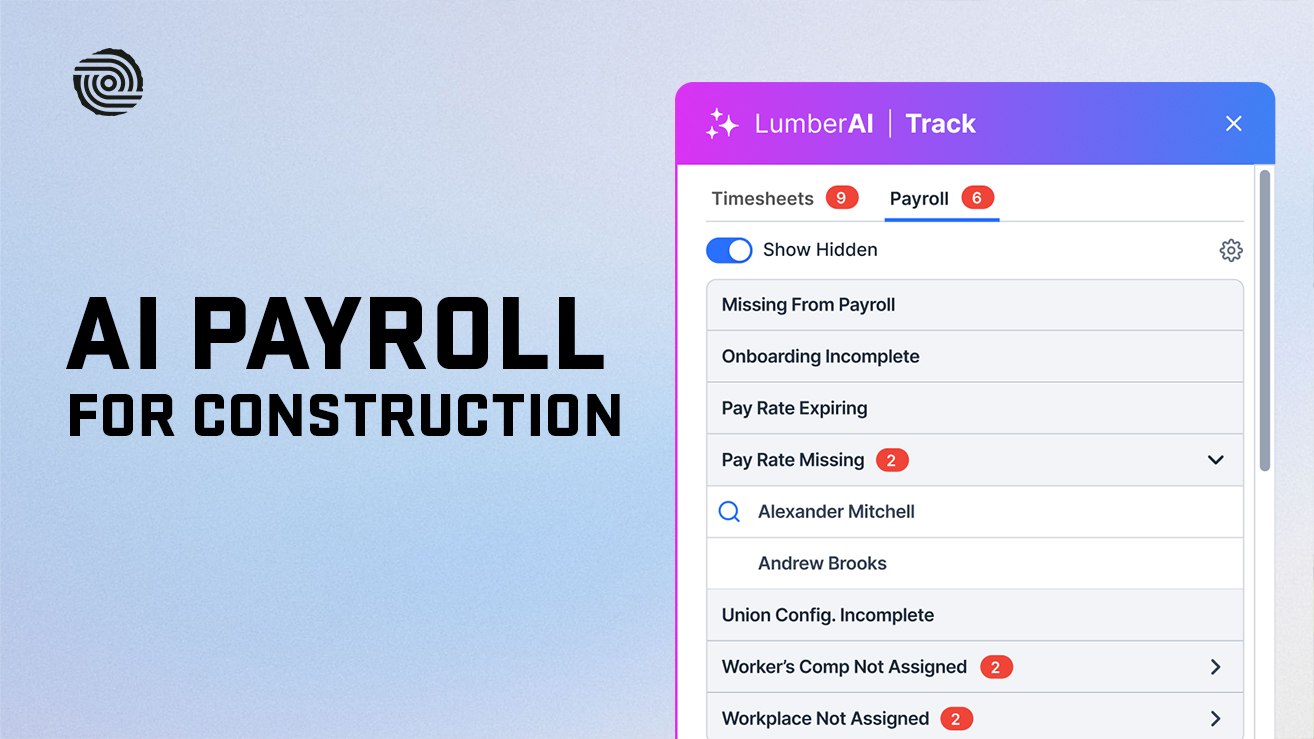
How the AI Action Plan Will Trigger a Surge in Data Center Construction

.avif)


Highlights
- AI infrastructure policy is expected to accelerate data center construction nationwide.
- Faster permitting means shorter timelines and greater workforce mobilization pressure.
- Federal projects bring prevailing wage and certified payroll compliance requirements.
- Labor shortages in key trades will become more pronounced as project volume increases.
- Multi-state builds create complex payroll and compliance challenges.
- Contractors with automated workforce and compliance systems will have a significant advantage.
On July 23, 2025, the White House released Winning the Race: America’s AI Action Plan, a sweeping federal initiative to secure US dominance in artificial intelligence.
Most of the coverage focused on chips, models, and export controls. The tech press zeroed in on semiconductor manufacturing. The AI policy community debated ideological neutrality provisions and open-source frameworks.
Contractors should be reading the infrastructure section.
Because buried inside this policy document is a set of directives that will directly accelerate data center construction across the country and, with it, a wave of operational complexity that most construction companies aren’t ready for.
Here’s what it means on the ground.
What the AI Action Plan Actually Says About Construction
The plan’s second pillar, Building American AI Infrastructure, is where the construction implications live. It calls explicitly for streamlined permitting for data centers, semiconductor manufacturing facilities, and supporting energy infrastructure. It recommends using federal lands for data center construction. It pushes for expedited environmental reviews. It directs agencies to examine grid capacity constraints and clear the path for faster development of power infrastructure.
This isn’t aspirational language. These are specific policy directives assigned to specific federal agencies with a clear intent: to remove the friction that slows down infrastructure builds.
For contractors, that’s not an abstract policy shift. It’s a change to the operating environment that will show up in project timelines, bid volumes, and workforce demands over the next 12 to 36 months.
Faster Permitting = Compressed Timelines
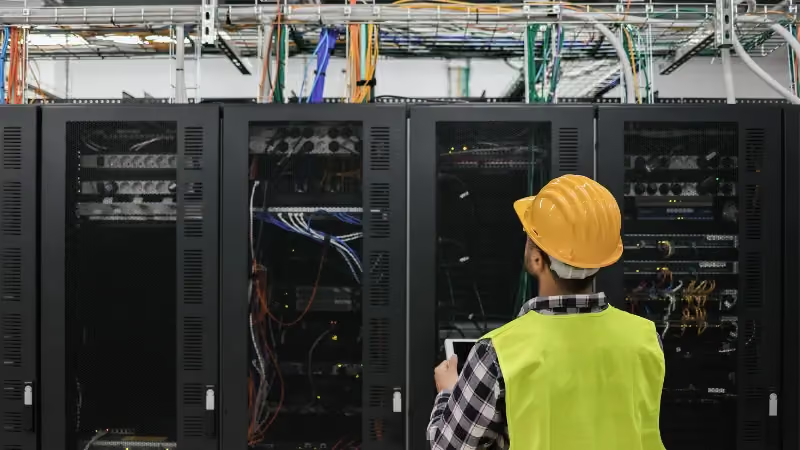
The AI Action Plan explicitly directs the establishment of a new categorical exclusion under the National Environmental Policy Act (NEPA) to cover data center-related construction. It also calls for expediting environmental permits under the Clean Air Act, Clean Water Act, and other regulatory frameworks that have historically added months to project preconstruction timelines.
For contractors, this is not a minor procedural change. NEPA review has been one of the primary timeline risks on large infrastructure projects. A standard environmental review process can add six to eighteen months to preconstruction. Removing or fast-tracking that review compresses the window between project announcement and groundbreaking, which is good news for pipeline visibility, and puts pressure on mobilization timelines.
When a project that used to have an 18-month preconstruction phase now has a 10- or 12-month preconstruction phase, every downstream milestone tightens. Procurement, subcontractor selection, crew scheduling, and onboarding. The assumptions your estimating team built into labor mobilization schedules will need to be revisited for any project moving under the new framework.
The contractors who benefit most from faster permitting will be those who can execute quickly once the green light comes on. That means workforce management has to be a strength, not a constraint. If your onboarding process takes three weeks and your mobilization window is four, you’ve already lost a week.
Federal Land + Federal Funding = Prevailing Wage Requirements
The AI Action Plan recommends making federal lands available for data center construction. That’s a meaningful expansion of viable build sites, particularly in regions where private land costs are high, zoning is restrictive, or grid access is limited to federally managed corridors.
But construction on federal land, or with federal assistance, comes with a well-understood implication for contractors: prevailing wage requirements under the Davis-Bacon Act.
Davis-Bacon means you’re not just paying workers - you’re paying the right workers the right wage rates for the right classifications in the right jurisdiction, and you’re documenting it every week. It means certified payroll. It means WH-347 submissions. It means fringe benefit compliance for every covered worker in every pay period (health and welfare contributions, vacation accruals, pension contributions), all calculated correctly and reported accurately.
This is table stakes for contractors who already work on public projects. But data center developers new to federally assisted construction, and the specialty contractors they bring in, would encounter this compliance framework for the first time on projects where the schedule is already aggressive, and the owner has zero tolerance for compliance issues.
The learning curve for Davis-Bacon compliance is steep. The penalties for getting it wrong are steeper. Back pay liability, debarment proceedings, and the reputational damage of a compliance failure on a high-visibility federal project can follow a contractor for years. Getting the systems right before the first bid is the only strategy that makes sense.
More Projects, Same Labor Pool = Real Strain on Specialty Trades

The AI Action Plan is designed to accelerate investment. That means more projects, moving faster, competing for the same skilled trades.
Electricians. HVAC technicians. Low-voltage specialists. Fire suppression crews. The specialty trades that data centers need in large quantities are already operating in a tight labor market. The construction industry as a whole is short hundreds of thousands of workers. The AI infrastructure push doesn’t create more workers; instead, it adds more projects chasing the workers that already exist.
For contractors, that dynamic has a direct operational implication: the ability to attract, onboard, and retain workers quickly becomes a competitive differentiator, not just a nice-to-have.
Slow onboarding causes workers to leave for the next contractor who can credential them and bill faster. Poor time tracking and payroll errors lose workers to competitors who pay right, pay on time, and don’t make people chase their hours. Reputation in the trades spreads. If your company is known for Friday payroll anxiety (missed deductions, wrong classifications, late checks), your best workers will find somewhere else to be.
Conversely, contractors who run clean payroll, onboard smoothly, and treat worker compliance seriously become preferred employers in a market where workers have options. That’s not a soft benefit. It shows up in bid competitiveness when you can credibly promise an owner that you can staff and retain the crew.
Multi-State Builds = Compliance Chaos Without the Right Systems
Data center programs aren’t single-site projects. Amazon, Microsoft, and Google don’t build one facility—they build campuses, regions, portfolios. A single capital program might involve construction across Virginia, Texas, Nevada, Ohio, and Arizona simultaneously, with phased starts over 18 to 24 months.
Each state has its own worker classification rules. Its own employer tax requirements. Its own union jurisdiction landscape. If federal funds or federal land are involved, Davis-Bacon requirements layer on top and the wage determinations are jurisdiction-specific, meaning the prevailing wage rates in Loudoun County, Virginia are different from the rates in Maricopa County, Arizona.
Running payroll for a crew in Virginia looks different from running payroll for a crew in Nevada. Running union payroll for an IBEW Local in Dallas looks different from running it for a Local in Phoenix. Managing both simultaneously while also submitting certified payroll for the federally assisted components, tracking fringe contributions across multiple CBAs, and keeping job costing accurate by project requires a compliance engine, not a spreadsheet.
Most contractors doing this work today are managing it through hard-won expertise and significant manual effort. A payroll specialist who knows the rules. An office manager who has done Davis-Bacon before. A binder of wage determinations that someone has to remember to update.
That works when you have two projects. It starts breaking at four. It fails at six. And the AI infrastructure wave isn’t going to stop at six.
What Contractors Should Be Doing Right Now
The permitting changes in the AI Action Plan are being implemented at the agency level. Some of them take time to flow through. But the capital commitments that are driving data center construction are already in place—billions of dollars of investment that doesn’t need a new NEPA rule to start moving, and that will accelerate further as regulatory friction reduces.
Which means the right time to get your operations ready for this wave is before the volume hits, not during it.
A few things worth pressure-testing in your current setup:
Certified payroll readiness. If your team is manually assembling WH-347 submissions from timesheet data, it’s worth understanding how that process scales when your project count doubles. What’s the per-project labor cost for certified payroll preparation? What’s the error rate? How long does a correction take?
Multi-state payroll capability. If you operate in more than two or three states today, how does your payroll system handle the jurisdictional differences? Are tax configurations and wage determinations managed manually, or does the system handle them automatically?
Onboarding throughput. How many new workers can you onboard in a week without a process breakdown? On a large data center mobilization, that number needs to be significant. If your current process relies on physical paperwork and manual data entry, it’s worth understanding the ceiling.
Union CBA management. If data center work brings you into new union jurisdictions, new locals, new CBAs - how long does it take your team to configure the correct fringe structures in your payroll system? Days are too long when the project is already moving.
The Policy Is Designed to Remove Barriers to Construction. Your Operations Should Be Too.
The AI Action Plan creates urgency that wasn’t there before. Faster permitting means faster groundbreakings. Federal land availability means more sites in the pipeline. The administration’s stated goal is to move as quickly as possible on AI infrastructure and the private sector capital backing that goal is measured in the hundreds of billions.
That urgency flows downstream. Developers will pressure GCs on schedule. GCs will pressure subs on mobilization. Everyone will be moving faster than they’re used to.
Lumber’s platform was built for exactly this operating environment. Multi-state payroll without manual configuration. Union CBA management with an AI-powered setup. Prevailing wage and certified payroll compliance that runs automatically. Time tracking that works in the field, not just on a desktop. Real-time job costing across every active project.
When the AI Action Plan’s permitting reforms unlock a new wave of starts, Lumber is the platform that lets contractors execute without the compliance bottleneck slowing them down.
The compliance engine doesn’t guess. It calculates. Certified payroll is generated automatically. The right fringe rates apply to the right workers on the right projects. So when your project schedule compresses, and your crew count doubles, your back office doesn’t buckle.
The policy is removing barriers on their end. Make sure you’ve done the same on yours.
Next in this series: “Scaling Crews for Data Center Builds Without Breaking Payroll” — the operational playbook for executing at scale.
Lorem ipsum dolor sit amet, consectetur adipiscing elit. Donec ullamcorper mattis lorem non. Ultrices praesent amet ipsum justo massa. Eu dolor aliquet risus gravida nunc at feugiat consequat purus. Non massa enim vitae duis mattis. Vel in ultricies vel fringilla.
Introduction
Mi tincidunt elit, id quisque ligula ac diam, amet. Vel etiam suspendisse morbi eleifend faucibus eget vestibulum felis. Dictum quis montes, sit sit. Tellus aliquam enim urna, etiam. Mauris posuere vulputate arcu amet, vitae nisi, tellus tincidunt. At feugiat sapien varius id.
Eget quis mi enim, leo lacinia pharetra, semper. Eget in volutpat mollis at volutpat lectus velit, sed auctor. Porttitor fames arcu quis fusce augue enim. Quis at habitant diam at. Suscipit tristique risus, at donec. In turpis vel et quam imperdiet. Ipsum molestie aliquet sodales id est ac volutpat.


Ipsum sit mattis nulla quam nulla. Gravida id gravida ac enim mauris id. Non pellentesque congue eget consectetur turpis. Sapien, dictum molestie sem tempor. Diam elit, orci, tincidunt aenean tempus. Quis velit eget ut tortor tellus. Sed vel, congue felis elit erat nam nibh orci.

Dolor enim eu tortor urna sed duis nulla. Aliquam vestibulum, nulla odio nisl vitae. In aliquet pellentesque aenean hac vestibulum turpis mi bibendum diam. Tempor integer aliquam in vitae malesuada fringilla.
Elit nisi in eleifend sed nisi. Pulvinar at orci, proin imperdiet commodo consectetur convallis risus. Sed condimentum enim dignissim adipiscing faucibus consequat, urna. Viverra purus et erat auctor aliquam. Risus, volutpat vulputate posuere purus sit congue convallis aliquet. Arcu id augue ut feugiat donec porttitor neque. Mauris, neque ultricies eu vestibulum, bibendum quam lorem id. Dolor lacus, eget nunc lectus in tellus, pharetra, porttitor.
Ipsum sit mattis nulla quam nulla. Gravida id gravida ac enim mauris id. Non pellentesque congue eget consectetur turpis. Sapien, dictum molestie sem tempor. Diam elit, orci, tincidunt aenean tempus. Quis velit eget ut tortor tellus. Sed vel, congue felis elit erat nam nibh orci.
Mi tincidunt elit, id quisque ligula ac diam, amet. Vel etiam suspendisse morbi eleifend faucibus eget vestibulum felis. Dictum quis montes, sit sit. Tellus aliquam enim urna, etiam. Mauris posuere vulputate arcu amet, vitae nisi, tellus tincidunt. At feugiat sapien varius id.
Eget quis mi enim, leo lacinia pharetra, semper. Eget in volutpat mollis at volutpat lectus velit, sed auctor. Porttitor fames arcu quis fusce augue enim. Quis at habitant diam at. Suscipit tristique risus, at donec. In turpis vel et quam imperdiet. Ipsum molestie aliquet sodales id est ac volutpat.
Mi tincidunt elit, id quisque ligula ac diam, amet. Vel etiam suspendisse morbi eleifend faucibus eget vestibulum felis. Dictum quis montes, sit sit. Tellus aliquam enim urna, etiam. Mauris posuere vulputate arcu amet, vitae nisi, tellus tincidunt. At feugiat sapien varius id.
Eget quis mi enim, leo lacinia pharetra, semper. Eget in volutpat mollis at volutpat lectus velit, sed auctor. Porttitor fames arcu quis fusce augue enim. Quis at habitant diam at. Suscipit tristique risus, at donec. In turpis vel et quam imperdiet. Ipsum molestie aliquet sodales id est ac volutpat.
- Lectus id duis vitae porttitor enim gravida morbi.
- Eu turpis posuere semper feugiat volutpat elit, ultrices suspendisse. Auctor vel in vitae placerat.
- Suspendisse maecenas ac donec scelerisque diam sed est duis purus.
Lectus leo massa amet posuere. Malesuada mattis non convallis quisque. Libero sit et imperdiet bibendum quisque dictum vestibulum in non. Pretium ultricies tempor non est diam. Enim ut enim amet amet integer cursus. Sit ac commodo pretium sed etiam turpis suspendisse at.
Tristique odio senectus nam posuere ornare leo metus, ultricies. Blandit duis ultricies vulputate morbi feugiat cras placerat elit. Aliquam tellus lorem sed ac. Montes, sed mattis pellentesque suscipit accumsan. Cursus viverra aenean magna risus elementum faucibus molestie pellentesque. Arcu ultricies sed mauris vestibulum.

Critical Construction Compliance | Awareness Week
Mar 16, 2026
Apr 15, 2026
Nov 30, 2026
Dec 15, 2026
Essential resources for contractors