The Real Bottleneck in AI Growth Isn't Chips - It's Construction Labor



Highlights
- AI companies have committed more than $500 billion to data center infrastructure, creating one of the largest construction opportunities of the decade.
- The biggest constraint to AI growth may not be semiconductor production—it may be the availability of skilled construction labor needed to build data centers.
- Data center projects require specialized trades including electricians, HVAC technicians, low-voltage specialists, and structured cabling crews that are already in short supply.
- Contractors face growing challenges around workforce mobilization, multi-state payroll, union agreements, prevailing wage requirements, and certified payroll compliance.
- Data center builds scale rapidly, often requiring contractors to onboard and manage hundreds of workers across multiple projects and jurisdictions simultaneously.
- Manual payroll, spreadsheet-based compliance tracking, and paper onboarding processes become major operational risks as project volume increases.
- Contractors that invest in workforce automation, compliance management, and scalable payroll operations will be best positioned to capitalize on the AI infrastructure boom.
Everyone is watching the chip race.
NVIDIA's order books. TSMC's fabs. The semiconductor supply chain. These are the conversations dominating boardrooms, earnings calls, and policy briefings. The assumption built into most AI coverage is that the constraint is silicon and if you can manufacture enough high-end GPUs, the rest of the infrastructure will follow naturally.
But there's a quieter bottleneck, one that doesn't show up in tech headlines but will nonetheless determine whether America's AI infrastructure actually gets built on time.
It's not silicon. It's the 200,000-square-foot hyperscale facility that Silicon needs to live in. And more specifically, it's the crews that have to build it.
The Build Is Bigger Than Most People Realize
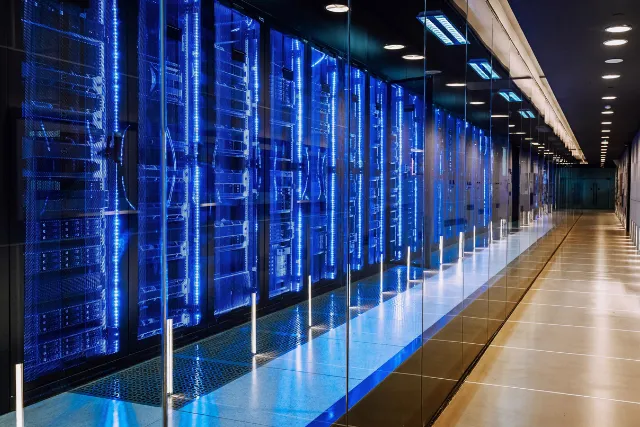
The numbers are staggering. Microsoft, Google, Amazon, Meta, and a wave of new entrants have collectively announced plans to invest over $500 billion in data centers over the next several years. The White House's AI Action Plan, released in July 2025, added federal momentum by streamlining NEPA permitting, opening federal lands for data center construction, and pushing grid infrastructure expansion to match AI's insatiable power demand.
What does half a trillion dollars in announced infrastructure actually look like on the ground?
It looks like hundreds of individual construction projects. Hyperscale campuses spanning multiple buildings across multiple phases. Electrical systems are engineered to absorb hundreds of megawatts per facility. Mechanical systems running 24/7 to keep server rooms from overheating. Specialized structural work, fire suppression, security infrastructure, and low-voltage systems that don't exist on a typical commercial build.
It looks like projects in northern Virginia, central Texas, central Ohio, the Arizona desert, and the Pacific Northwest are running simultaneously because hyperscale operators are building portfolios rather than single sites.
And each one of these projects needs crews. Skilled, specialized crews. Lots of them. The contractors who win these bids are about to find out that the hardest part isn't landing the job, it's staffing it and keeping the back office from breaking under the weight.
The Labor Shortage No One in AI Is Talking About
Construction has been operating under a persistent labor shortage for years. The Associated General Contractors of America estimates the industry needs roughly half a million more workers than are currently available. Retirements are outpacing new entries into the trades. Apprenticeship pipelines, while growing, haven't come close to meeting demand.
Data center construction pulls from the deepest end of that scarcity. These projects require licensed electricians (sometimes hundreds per project) at a moment when the electrical trade is already stretched thin on EV charging infrastructure, utility-scale solar, semiconductor fab construction, and conventional commercial work. They require HVAC and mechanical technicians with experience in precision cooling systems that don't exist in most commercial buildings. They require specialists in low-voltage and structured cabling, security system installers, and structural steel workers familiar with the load requirements of raised-floor server environments.
These aren't trades you can backfill with general laborers. The certifications, apprenticeships, and on-the-job experience required to work in these specialties take years to develop. The supply of qualified workers has grown over the decades, and the demand for them has grown in recent months.
This creates a straightforward competitive dynamic for specialty contractors: the companies that can attract workers, onboard them fast, and retain them through project completion will capture more work. The companies that can't are those that would lose workers to competitors with better pay, accuracy, faster onboarding, or cleaner compliance records will find themselves under-resourced on projects they already won.
What Makes Data Center Uniquely Complex for Staff
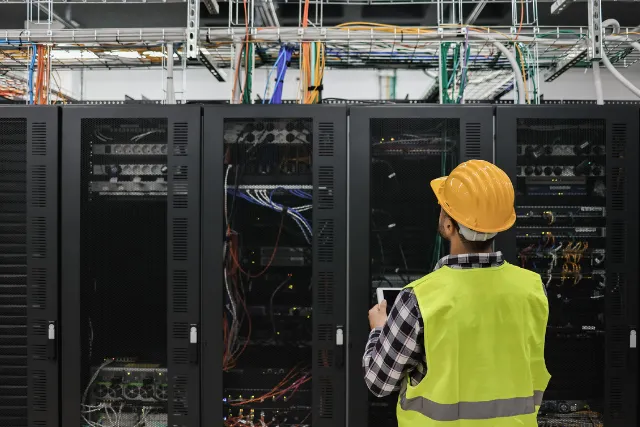
Not all large construction projects are equally difficult to manage from a workforce perspective. Data center builds sit at the hard end of the spectrum for several compounding reasons.
Multiple trades, multiple contracts, simultaneous. A data center build isn't a single-trade job. You have structural, electrical, mechanical, plumbing, fire suppression, security, and IT infrastructure all running in coordinated sequences. Each trade may have its own collective bargaining agreement, wage determination, and fringe benefit structure. Managing payroll across all of them in parallel and correctly requires a system that can handle that complexity, not a spreadsheet that must be manually reconciled every week.
Federally influenced projects come with compliance overhead. As the AI Action Plan opens federal lands and accelerates federally assisted infrastructure, more data center projects will fall under the Davis-Bacon Act. That means prevailing wage rates for every classification, certified payroll submissions every week, and fringe benefit compliance across every covered worker. Contractors new to public-sector work will encounter this framework for the first time on a project with an already aggressive schedule.
Compressed timelines leave no margin for errors. Data center owners are building on compressed schedules because their businesses depend on getting compute capacity online. When permitting accelerates (as the AI Action Plan is designed to make happen) those schedules compress further. A payroll error that costs your team two days to research and correct on a 24-month project is annoying. On a 14-month data center build, it's a material problem.
Scale up and scale down fast. Data center projects ramp crew counts rapidly (sometimes going from 50 workers to 200 workers) in a matter of weeks as construction phases hit full stride. Then they ramp back down as work completes. Onboarding, time tracking, payroll processing, and offboarding all have to function smoothly at changing volumes. Systems that work fine for a 40-person crew start showing cracks at 180 people across two shifts.
Multi-Project Scaling Is Where Payroll Goes Wrong
Picture this: your company wins data center contracts in Texas, Virginia, and Nevada simultaneously. You're deploying crews from across your network. Some workers are in a union. Some are prevailing wage. Some are both. Different states, different CBAs, different wage determinations, different fringe benefit structures. You have a project manager on each site and an overworked payroll team back at the office trying to hold everything together.
This is what data center growth looks like for specialty contractors right now. And this is exactly where payroll complexity compounds fast.
A single payroll error on a prevailing wage project doesn't just create an accounting problem. It creates a compliance problem (potential debarment, back pay liability, certified payroll resubmissions) and an audit process that pulls your best people off productive work and into a conference room with outside counsel. The kind of problem that starts with a missed fringe calculation on week three and ends with a very uncomfortable conversation with your bonding company.
For most contractors, this complexity is managed through heroic spreadsheet effort and institutional knowledge. Someone in the office knows the rules for each jurisdiction. They work late on Fridays. The certified payroll goes out on Monday. Everyone prays that the wage determination doesn't change mid-project.
That's not a system. That's a dependency on individuals. And individuals leave, get sick, make mistakes, and eventually burn out.
What Operations Need to Look Like at This Scale
Running a data center correctly, from a workforce management standpoint, requires a few core capabilities that not every contractor has built yet.
You need onboarding that doesn't create a bottleneck at mobilization. When you're bringing 80 workers onto a project in two weeks, the paperwork process can't be a two-day-per-person exercise. Workers need to be correctly classified, credentialed, and have their time tracked accurately from day one.
You need time tracking that works in the field, not just at a desktop. Data center sites are large. Crews move between areas. Shift changes happen. The time data that flows into payroll has to be accurate and real-time and not manually entered from paper at the end of the week.
You need a compliance engine that handles prevailing wage and union payroll without requiring a specialist to manually configure every rule. The right fringe rates, applied to the right workers, on the right projects, automatically. Not because someone remembered to update the spreadsheet.
You need certified payroll submissions that generate without a two-day reconciliation effort. Your project owner wants WH-347s on time, every week, without amendments. That's not possible when your system requires manual data assembly.
And you need visibility across every project simultaneously, with labor costs being tracked in real time against cost codes, so you know where you stand on margin before the project owner asks. When you're running three jobs in three states, "I'll get that report to you by Thursday" isn't a viable answer.
How Does Lumber Solve These Problems?
Lumber was built by people who've been on the operations side of exactly this kind of growth. We didn't build payroll software and then try to understand construction. We built from the jobsite up, right from the foreman's truck to the back office.
That means Lumber handles what data center builds actually throw at you.
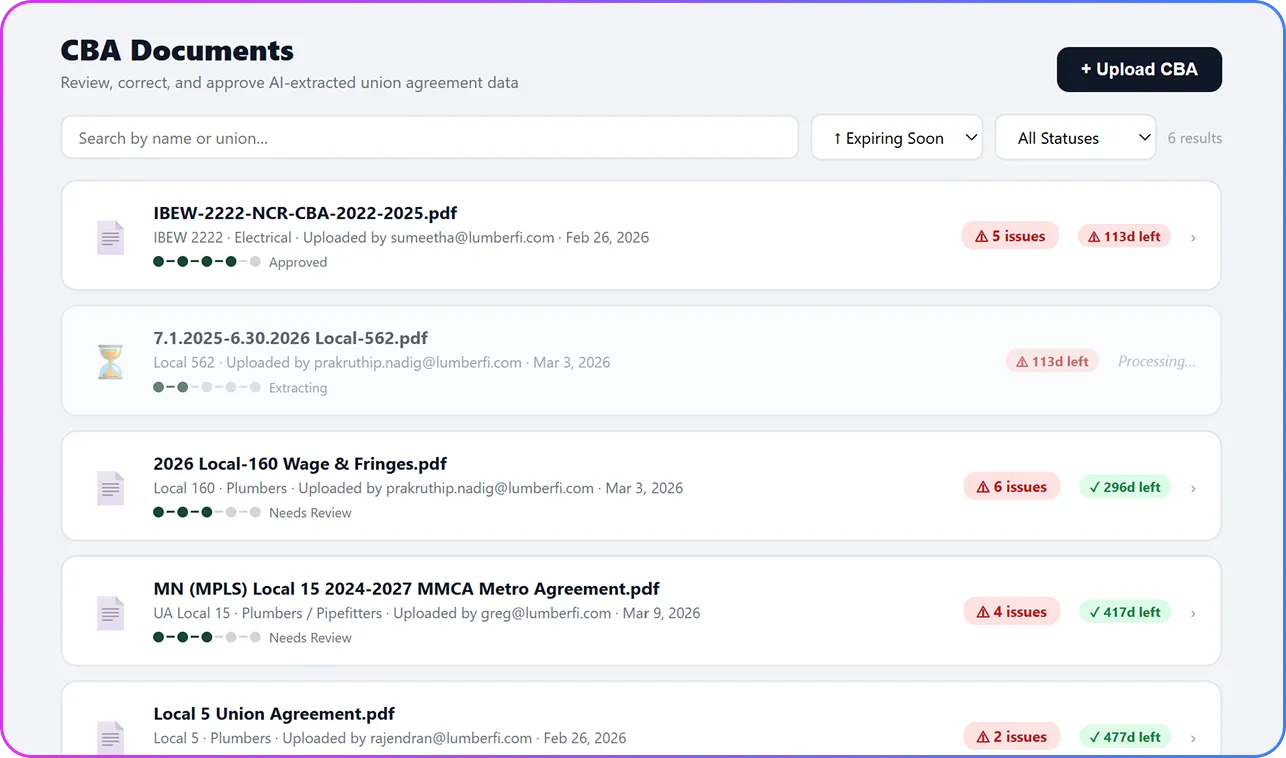
Multi-state compliance, without manual tracking. Lumber's compliance engine automatically handles prevailing wage requirements across jurisdictions. No lookup tables. No manual wage determination updates. The right rates, applied correctly, every time.
Union and multi-CBA payroll, at scale. Whether you're running one CBA or ten, Lumber processes union payroll with fringe calculations handled end-to-end. Our Union Agent AI ingests CBAs and configures the relevant deductions and contributions, cutting setup from days to hours.
Crew onboarding that doesn't slow down mobilization. New workers are in the system, credentialed, and tracking time before their first shift. No paperwork sitting in someone's inbox. No compliance gap on day one.
Time tracking built for the jobsite. Mobile app, paper timecard photo, or on-site kiosk are some of the options crews use to clock in, whichever works best for the project. Many construction companies and contractors still use paper timecards to track time. Our Paper Timecard Agent converts handwritten cards to digital records. Time flows directly into payroll without a manual entry step.
Funding visibility built for large-scale projects. Lumber’s Funding Agent helps contractors track certified payroll, compliance status, and workforce documentation required for draws, audits, and lender reporting across complex data center builds. Instead of chasing paperwork across jobsites and back offices, contractors get a centralized system that keeps funding workflows moving and reduces delays tied to missing labor or compliance records.
Real-time visibility across every project. Labor costs, crew hours, and job costing are synced from the field to the back office in real time. When you're running three projects in three states, you know what's happening on all three. And your CFO can pull a consolidated labor report without asking someone to spend a day in Excel.
LumberCare for when the stakes are highest. For complex situations that need a human expert, such as a mid-project wage determination change, a compliance audit, or a CBA interpretation question, our team of CPAs and prevailing wage specialists are always available as your support crew.
The Contractors Who Win the Data Center Decade Will Be the Ones Who Can Scale
The AI infrastructure boom isn't a one-year spike. It's a structural shift in where construction dollars are going for the foreseeable future. The federal policy is designed to accelerate it. The private capital is committed to sustaining it. And the demand for compute, which drives the demand for the buildings that house it, shows no signs of plateauing.
The contractors who position themselves to handle the operational complexity of large, multi-state, compliance-heavy builds will build a durable competitive advantage. They'll win more work, retain better workers, and protect their margins where others lose them to payroll errors and compliance firefighting.
The ones who can't are the ones who stumble on certified payroll submissions, who fall behind on onboarding because the paperwork process hasn't scaled, who can't mobilize fast enough when a project accelerates, and will watch that work go to someone who was ready.
The bottleneck in AI growth isn't chips. It's labor. And the contractors who manage that labor well are about to have a very good decade.
Next in this series: "From Policy to Projects: How the AI Action Plan Will Trigger a Surge in Data Center Construction" — what the White House announcement means for contractors on the ground.
Lorem ipsum dolor sit amet, consectetur adipiscing elit. Donec ullamcorper mattis lorem non. Ultrices praesent amet ipsum justo massa. Eu dolor aliquet risus gravida nunc at feugiat consequat purus. Non massa enim vitae duis mattis. Vel in ultricies vel fringilla.
Introduction
Mi tincidunt elit, id quisque ligula ac diam, amet. Vel etiam suspendisse morbi eleifend faucibus eget vestibulum felis. Dictum quis montes, sit sit. Tellus aliquam enim urna, etiam. Mauris posuere vulputate arcu amet, vitae nisi, tellus tincidunt. At feugiat sapien varius id.
Eget quis mi enim, leo lacinia pharetra, semper. Eget in volutpat mollis at volutpat lectus velit, sed auctor. Porttitor fames arcu quis fusce augue enim. Quis at habitant diam at. Suscipit tristique risus, at donec. In turpis vel et quam imperdiet. Ipsum molestie aliquet sodales id est ac volutpat.


Ipsum sit mattis nulla quam nulla. Gravida id gravida ac enim mauris id. Non pellentesque congue eget consectetur turpis. Sapien, dictum molestie sem tempor. Diam elit, orci, tincidunt aenean tempus. Quis velit eget ut tortor tellus. Sed vel, congue felis elit erat nam nibh orci.

Dolor enim eu tortor urna sed duis nulla. Aliquam vestibulum, nulla odio nisl vitae. In aliquet pellentesque aenean hac vestibulum turpis mi bibendum diam. Tempor integer aliquam in vitae malesuada fringilla.
Elit nisi in eleifend sed nisi. Pulvinar at orci, proin imperdiet commodo consectetur convallis risus. Sed condimentum enim dignissim adipiscing faucibus consequat, urna. Viverra purus et erat auctor aliquam. Risus, volutpat vulputate posuere purus sit congue convallis aliquet. Arcu id augue ut feugiat donec porttitor neque. Mauris, neque ultricies eu vestibulum, bibendum quam lorem id. Dolor lacus, eget nunc lectus in tellus, pharetra, porttitor.
Ipsum sit mattis nulla quam nulla. Gravida id gravida ac enim mauris id. Non pellentesque congue eget consectetur turpis. Sapien, dictum molestie sem tempor. Diam elit, orci, tincidunt aenean tempus. Quis velit eget ut tortor tellus. Sed vel, congue felis elit erat nam nibh orci.
Mi tincidunt elit, id quisque ligula ac diam, amet. Vel etiam suspendisse morbi eleifend faucibus eget vestibulum felis. Dictum quis montes, sit sit. Tellus aliquam enim urna, etiam. Mauris posuere vulputate arcu amet, vitae nisi, tellus tincidunt. At feugiat sapien varius id.
Eget quis mi enim, leo lacinia pharetra, semper. Eget in volutpat mollis at volutpat lectus velit, sed auctor. Porttitor fames arcu quis fusce augue enim. Quis at habitant diam at. Suscipit tristique risus, at donec. In turpis vel et quam imperdiet. Ipsum molestie aliquet sodales id est ac volutpat.
Mi tincidunt elit, id quisque ligula ac diam, amet. Vel etiam suspendisse morbi eleifend faucibus eget vestibulum felis. Dictum quis montes, sit sit. Tellus aliquam enim urna, etiam. Mauris posuere vulputate arcu amet, vitae nisi, tellus tincidunt. At feugiat sapien varius id.
Eget quis mi enim, leo lacinia pharetra, semper. Eget in volutpat mollis at volutpat lectus velit, sed auctor. Porttitor fames arcu quis fusce augue enim. Quis at habitant diam at. Suscipit tristique risus, at donec. In turpis vel et quam imperdiet. Ipsum molestie aliquet sodales id est ac volutpat.
- Lectus id duis vitae porttitor enim gravida morbi.
- Eu turpis posuere semper feugiat volutpat elit, ultrices suspendisse. Auctor vel in vitae placerat.
- Suspendisse maecenas ac donec scelerisque diam sed est duis purus.
Lectus leo massa amet posuere. Malesuada mattis non convallis quisque. Libero sit et imperdiet bibendum quisque dictum vestibulum in non. Pretium ultricies tempor non est diam. Enim ut enim amet amet integer cursus. Sit ac commodo pretium sed etiam turpis suspendisse at.
Tristique odio senectus nam posuere ornare leo metus, ultricies. Blandit duis ultricies vulputate morbi feugiat cras placerat elit. Aliquam tellus lorem sed ac. Montes, sed mattis pellentesque suscipit accumsan. Cursus viverra aenean magna risus elementum faucibus molestie pellentesque. Arcu ultricies sed mauris vestibulum.

Critical Construction Compliance | Awareness Week
Mar 16, 2026
Apr 15, 2026
Nov 30, 2026
Dec 15, 2026
Essential resources for contractors