




How to Read a Construction Pay Stub: Deductions, Union Dues, and Fringe Benefits Explained



Introduction
In July 2025, the U.S. Department of Labor recovered $155,066 in back wages and fringe benefits for 19 workers on a HUD-funded project in Denver. The contractor had classified 16 employees as apprentices without registered programs and skipped required fringe benefits. Those mistakes did not start in a courtroom. They started on the pay stub, where the wrong rate and the missing contributions were printed every single week.
A construction pay stub carries more than most. A single check can show regular hours, overtime, and double time across two or three trade classifications, plus federal and state taxes, pre-tax benefit deductions, union dues, court-ordered deductions, and a list of employer fringe contributions that never touch the worker's net pay. When any of those lines is wrong, the worker loses money, the contractor takes on compliance risk, or both.
This guide is for the people who have to explain the stub: owners, payroll managers, HR and accounting teams, and compliance leads at union and prevailing wage contractors. You will learn what each section of a construction pay stub means, how pre-tax and after-tax deductions differ, how union dues are handled, how fringe benefits are taxed depending on how they are paid, and what to check before payroll goes out the door.
Key Takeaways
- Federal law does not require pay stubs, but the FLSA requires accurate records of hours and wages, and most states set their own pay stub content rules. California, for example, lists nine required items.
- Read every construction pay stub in the same order: header, hours and earnings, taxes, pre-tax deductions, after-tax deductions, employer contributions, and year-to-date totals.
- "Pre-tax" does not mean the same thing for every deduction. Section 125 health premiums generally reduce both income tax and FICA wages, while traditional 401(k) or annuity deferrals reduce income tax wages but still count for Social Security and Medicare.
- Union dues are after-tax deductions. They require a written dues checkoff authorization, and W-2 employees can no longer deduct them on their federal return.
- Employer fringe contributions paid to a bona fide plan or trust usually appear as memo lines and do not change net pay. A cash fringe paid on the check is taxable wages.
- Some employer contributions are taxable to the worker and show up as imputed income. The collective bargaining agreement (CBA) or plan documents, not the payroll system, decide that tax treatment.
- On prevailing wage jobs, the stub should support what you report on certified payroll: the right trade classification, base rate, and fringe amount for every hour.
- Wrong tax treatment repeats on every paycheck for every worker in that union, so set it up right before the first payroll and audit it each time a CBA changes.
What Is on a Construction Pay Stub?
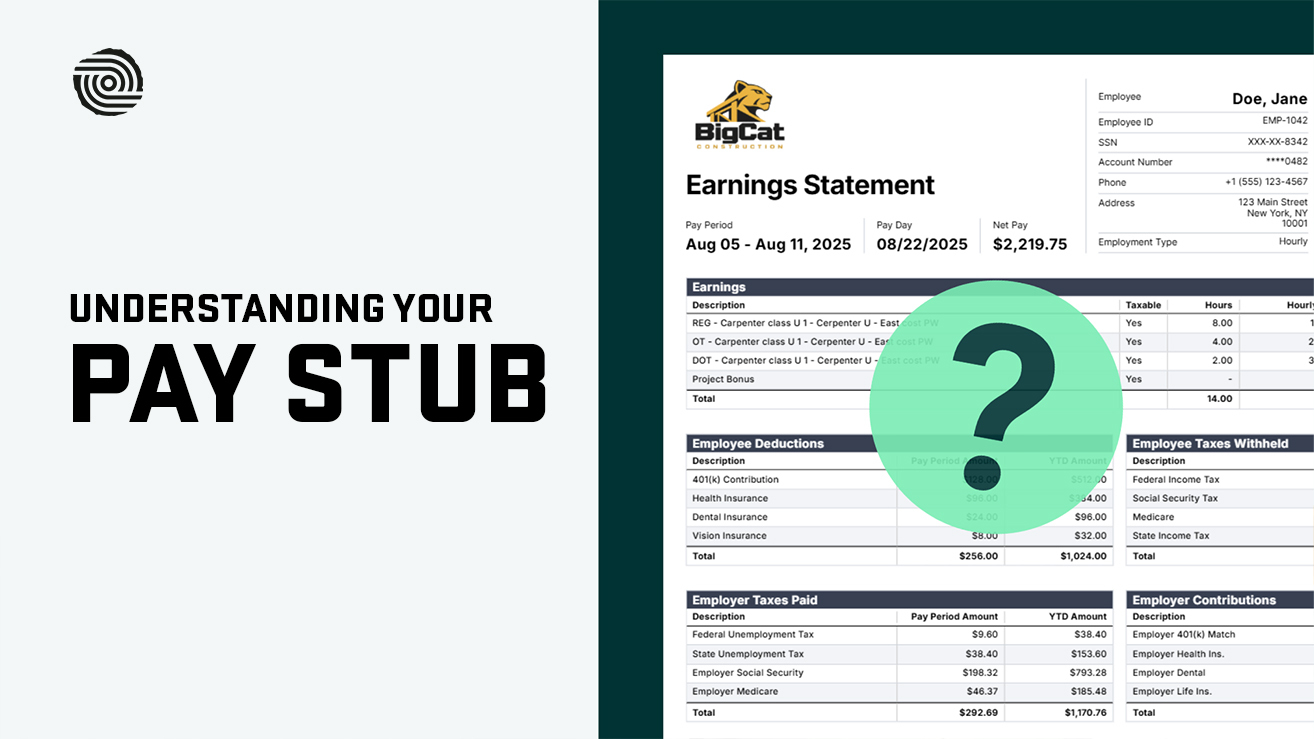
A pay stub, also called a pay statement or wage statement, is the itemized record of how an employee's gross pay became net pay for one pay period. Construction stubs follow the same basic flow as pay stubs in any other industry. They carry more lines because crews change jobs, trades, and pay rates during the week.
Do employers have to provide a pay stub?
Not under federal law. The U.S. Department of Labor states that the Fair Labor Standards Act (FLSA) requires employers to keep accurate records of hours worked and wages paid, but does not require them to give employees pay stubs.
States fill that gap, and the rules vary widely. California Labor Code Section 226 requires an accurate itemized statement with each wage payment that includes gross wages, total hours worked, all deductions, net wages, the pay period dates, the employee's name and identifier, the employer's legal name and address, and every applicable hourly rate with the hours worked at each rate. Other states have shorter lists, and some have none. Check your state labor department's current rules before you design or change a stub.
The eight sections to read, in order
The table below breaks a typical construction pay stub into its sections and lists what to verify in each one.
If you read the stub top to bottom in this order, every number on it should trace back to a timesheet, a rate table, a tax rule, or a signed authorization.
Hours and earnings: where construction stubs get complicated
The earnings section shows each pay type (also called an earning code) on its own line. On a construction stub, expect to see some combination of:
- Regular hours at the base rate, up to the overtime threshold set by federal law, state law, or the CBA.
- Overtime, typically paid at 1.5 times the regular rate. The FLSA requires time and one-half for hours over 40 in a workweek, and some states and CBAs add daily overtime rules.
- Double time, usually required by a CBA or by state law.
- Shift differentials, show-up pay, travel pay, and per diem, each driven by the CBA or company policy.
- Multiple rates in one week. A worker who runs conduit as an electrician on Monday and works as a laborer on Thursday may have two trade classifications on the same stub, each with its own rate. Overtime that week is calculated on a weighted-average regular rate.
When a company reimburses travel, meals, lodging, or mileage under an IRS accountable plan, those payments are not taxable wages, as long as the expense is work-related, documented, and any unused advance is returned. For per diem, the benchmark is the federal per diem rate the General Services Administration (GSA) publishes for each location. Payments up to that rate count as documented without receipts. Anything paid above the federal rate is taxable wages unless the worker documents the higher cost or returns the difference. Mileage works the same way against the IRS standard mileage rate.
Where union pay rates come from
On a union job, the rate on each earnings line should trace back to the wage table in the CBA. Union payroll systems typically store a separate rate for every combination of job level, trade, and classification, with regular, overtime, and double-time rates and start and expiration dates that match the agreement period. When a new CBA takes effect, the new rates apply from their effective date, so a stub that straddles a rate change may show two rates for the same work.
Some rates are not fixed dollar amounts. An apprentice rate is often a percentage of the journeyman rate, and in union reciprocity situations, a rate may be tied to another union's rate. If an apprentice's rate looks wrong, check the percentage and the base rate it is calculated from.
Shift rules add another layer. A CBA may define first and second shifts with set start and end times, and apply a shift differential, often a percentage premium, to regular, overtime, and double-time pay for the off shift. When a night-shift worker's rate does not match the wage table, check whether the differential was applied, and whether it was stacked on top of the overtime multiplier the way the agreement requires.
One more check: payroll systems often keep expired rates on file for history. The most recent rate in a list isn't always the active one, so confirm the pay period falls within the rate's start and expiration dates, with no gap between one rate period and the next.
Time off balances
Many construction stubs now include a time off section alongside earnings. The FLSA does not require paid vacation, sick leave, or holidays, so these balances come from company policy, the CBA, or state and local leave laws. A clear time off section usually shows four columns:
- Earned this pay period: leave accrued during this pay period only.
- Used this pay period: leave actually taken in this pay period. Future-dated requests do not appear until that date falls within a pay period.
- Adjusted this pay period: manual adjustments or carryover applied within the pay period.
- Total remaining: the available balance as of the end of the pay period.
For hourly accrual policies, also confirm when accruals post. Some systems credit hours as soon as timesheets move into payroll processing, while others wait until payday. If a worker says their balance is behind, the accrual timing setting is often the answer.
Taxes Withheld on a Construction Pay Stub
Once gross pay is set, the tax section shows what was withheld and sent to government agencies. These amounts are required by law, so workers cannot opt out of them the way they can with voluntary deductions.
Federal income tax
Federal income tax withholding is based on the employee's Form W-4 and IRS withholding tables. It is calculated on taxable wages, which means gross pay minus any deductions that qualify as pre-tax for income tax purposes. If a worker says their federal withholding looks wrong, start with their W-4, then check which deductions are reducing federal taxable wages.
Social Security and Medicare (FICA)
FICA covers two separate taxes, and both appear as their own lines on most stubs:
- Social Security: 6.2% withheld from the employee, matched by 6.2% from the employer. It applies only up to an annual wage base, which the Social Security Administration set at $184,500 for 2026. Once a worker's wages pass that amount with one employer, Social Security withholding stops for the rest of the calendar year.
- Medicare: 1.45% is withheld from the employee and matched by 1.45% from the employer on all wages, with no cap.
- Additional Medicare Tax: an extra 0.9% the employer must withhold once an employee's wages exceed $200,000 in a calendar year. The employer does not match it.
Foremen and superintendents on heavy overtime schedules can cross the Social Security wage base before December. A smaller Social Security line late in the year is often correct, not an error.
State and local taxes
State and local taxes are where multi-state and multi-site crews create the most questions. Some states have no income tax at all, while others layer on city, county, or school district taxes, as in Pennsylvania and Ohio. A handful of states also withhold employee contributions for unemployment insurance, state disability insurance, or paid family and medical leave programs.
For a crew that crosses state lines, the stub should reflect the right work location and residence location for the period. State tax reciprocity agreements between certain states can change which state withholds. Because these rules vary by state and change often, confirm current requirements with each state revenue and labor agency.
Employer-paid taxes that do not appear as deductions
Employers also pay their matching FICA share, federal unemployment tax (FUTA), and state unemployment tax (SUTA). These are employer costs, so they usually do not appear as deductions on the employee's stub. Some payroll systems list them as informational lines. Either way, they should never reduce net pay.
Pre-Tax vs. After-Tax Deductions on a Construction Pay Stub
With taxes covered, the next lines are deductions the worker either elected or is legally required to have taken out. The key question for each one is simple: does it come out before or after taxes are calculated?
- A pre-tax deduction is subtracted from gross pay before certain taxes are calculated, which lowers the wages those taxes apply to.
- An after-tax deduction (often labeled post-tax) is subtracted after taxes are calculated. It lowers take-home pay but does not change taxable wages.
Not all pre-tax deductions are equal
This is the most common point of confusion on any pay stub. "Pre-tax" can mean pre-income-tax only, or pre-income-tax and pre-FICA. The IRS states that elective deferrals to a 401(k) plan are generally not subject to income tax withholding at the time of deferral. However, they are still included as wages subject to Social Security and Medicare taxes. Health premiums paid through a Section 125 cafeteria plan generally avoid both.
The table below compares how common deductions on a construction pay stub affect taxable wages.
If a traditional retirement deferral is reducing Social Security and Medicare wages on your stubs, payroll is under-withholding FICA. That error compounds every pay period until someone catches it, so plan documents should drive the setup.
Where health benefit deductions come from
For non-union plans, medical, dental, vision, life, and disability deductions often come from a separate benefits administration platform. Employees enroll there, and the calculated deduction syncs into payroll. When a worker disputes one of those amounts, the fix usually belongs in the benefits platform, not in payroll, so the correction carries through on the next sync. Items such as 401(k) and Roth 401(k) elections, 401(k) loan repayments, child support, and other garnishments are typically maintained directly in payroll.
Union dues: how they work on the stub
Union dues are after-tax deductions. Taxes are calculated on full gross pay, then the dues come out of what is left. A union stub may show several dues lines:
- Membership dues: a periodic fee, often monthly or quarterly.
- Working dues: an amount per hour worked or a percentage of gross pay, set by the local.
- Initiation fees: a one-time fee for new members, often collected in installments.
- Supplemental deductions: voluntary contributions such as political action funds, which must stay voluntary.
Authorization comes first. Federal labor law generally prohibits employers from paying money to a union. Section 302(c)(4) of the Labor Management Relations Act creates an exception for dues checkoff, but only when the employee has signed a written assignment. That assignment cannot be irrevocable for more than one year or past the end of the CBA, whichever comes first. Keep the signed checkoff form on file before the first dues line hits a stub.
Dues are not deductible on the federal return for W-2 employees. The Tax Cuts and Jobs Act suspended miscellaneous itemized deductions, including unreimbursed employee expenses like union dues, for 2018 through 2025. Section 70110 of the One Big Beautiful Bill Act, signed July 4, 2025, made that suspension permanent. Some states set their own rules, so workers should check with a tax professional about state returns.
Court-ordered deductions
Court-ordered deductions, commonly called wage garnishments, are taken from disposable earnings: the pay left after legally required deductions such as taxes. Title III of the Consumer Credit Protection Act limits most creditor garnishments to the lesser of 25% of disposable earnings or the amount by which weekly disposable earnings exceed 30 times the federal minimum wage.
Child support orders can take more, and that cap does not limit federal or state tax levies. When a worker has more than one order, child support generally takes priority. State laws may set lower limits, so check the rules where the employee works.
Fringe Benefits on a Construction Pay Stub
Deductions come out of the worker's pay. Fringe benefits are different: they are employer-paid contributions made on the worker's behalf, usually calculated per hour worked or as a percentage of gross pay. On a union stub, they are often the biggest numbers on the page that the worker never takes home.
Common union fringe funds
Most CBAs spell out a fringe package that includes some combination of these funds:
- Health & Welfare: funds medical, dental, vision, life, and disability coverage through a trust.
- Pension: employer contributions to a defined benefit plan, often a multiemployer (Taft-Hartley) plan.
- Annuity: contributions to an individual account-style retirement plan.
- Apprenticeship and Training Fund: pays for apprenticeship and journey-level training programs.
- Vacation or Holiday Fund: contributions to a trust that pays members vacation money.
The CBA is the source of truth for each one: the rate, the calculation method, which hours count, and how it is taxed. Payroll should configure only what the agreement states.
Three ways a fringe can show up, and why the tax treatment matters
The same dollar of fringe can land on the stub in three different ways. Each one changes taxable wages differently.
If a worker asks why their taxes went up when their take-home did not, an imputed contribution is one of the first places to look.
Bona fide plan fringe. When the employer contributes to a qualifying trust or plan, the money goes to the fund, not the worker. Employer contributions to health plans and qualified retirement plans are generally excluded from the worker's taxable wages. The stub typically lists them in an employer contributions section so the worker can see what was paid on their behalf.
Cash fringe. On prevailing wage jobs, some contractors pay all or part of the required fringe directly to the worker as extra cash on the check. A cash fringe is wages. It is subject to income tax withholding, Social Security, Medicare, FUTA, and state unemployment tax, and it counts toward the unemployment wage base. Labeling it clearly on the stub matters, because it also needs to be reported correctly on certified payroll.
Imputed contributions. Some CBAs treat a specific employer contribution as taxable compensation to the worker. Payroll handles this as imputed income: it adds the contribution to gross pay so taxes are calculated on the higher amount, then deducts the same amount from net pay because the money actually goes to the fund. For example, on a $2,000 gross check with a $200 imputed employer contribution, taxes are calculated on $2,200, and $200 is then deducted after tax. The worker's net pay does not include the $200, but their withholding reflects it.
Which hours earn fringes?
The CBA also decides which hours generate fringe contributions, and agreements differ. Points to confirm for each fund:
- Hour types: Regular, overtime, and double-time hours usually generate fringes. Travel, holiday, leave, meal break penalty, and PTO payout hours depend on the agreement.
- Multipliers: Some CBAs pay fringes per hour worked regardless of overtime. Others apply the overtime multiplier to certain funds.
- Calculation method: A fixed dollar amount per hour, a fixed amount based on gross pay, or a percentage of a defined base.
- Caps: Some agreements cap a fringe at the rate for a specific job level, such as journeyman.
- Travelers: When a member works outside their home local's jurisdiction, union reciprocity agreements may route their fringe contributions back to the home local's funds.
When fringe totals on a stub look off, compare the hours that generated each contribution against the CBA's eligibility rules before assuming the rate is wrong.
Why every worker in a classification sees the same fringe lines
On a non-union stub, benefit deductions are usually set employee by employee, so amounts vary. Union stubs work differently. Fringes, benefits, and dues are typically set once in the union's configuration and attached to the pay rate for each classification. When payroll runs, the worker's classification selects the pay rate, and the pay rate carries the fringes. Two journeymen in the same local and classification should see identical hourly fringe rates.
A few items are still set per person, even for union workers: 401(k) and Roth 401(k) elections, 401(k) loan repayments, child support orders, and other garnishments. If one worker's fringe line differs from the rest of the crew, check their classification and the pay rate's effective dates before editing anything on the individual employee record. Fix an incorrect union setup at the union level, so the fix carries to every affected worker.
Travelers and union reciprocity
Union reciprocity can change a traveler's stub in ways that confuse both the worker and the office. When a member from one local (the home union) works in another local's jurisdiction (the work union), the reciprocity agreement between the two decides whose rules apply to each part of the paycheck.
Things to look for on a traveler's stub:
- Base rate: some agreements pay the higher of the home and work union rates; others specify one union.
- Fringes and deductions can split: the agreement may send dues to the work union while Health & Welfare and pension contributions go back to the home union's funds.
- Travel and subsistence, shift premiums, and equipment rates may follow either union.
- Excess employer fringes paid as cash: when one union's employer fringe package is richer than the amount remitted, some agreements pay the difference to the worker as cash. That amount is a taxable cash line in earnings, not a fund contribution.
When a traveler questions a fringe or dues line, confirm which union each line follows under the reciprocity agreement before treating it as an error.
Reading a Prevailing Wage Pay Stub
Prevailing wage work adds one more test to every stub: does it prove the worker received at least the full rate required for their trade classification?
How the prevailing wage is built
The Department of Labor defines the Davis-Bacon prevailing wage as the basic hourly rate plus any fringe benefit rate listed for a classification in the applicable wage determination. Contractors can meet that obligation by paying the full amount as cash wages, or by combining cash wages with employer-provided bona fide fringe benefits.
That flexibility shows up directly on the stub. Consider a classification with a required base rate and a required fringe rate:
- If the contractor pays the full fringe into bona fide plans, the stub shows the base rate as earnings and the contributions in the employer section.
- If the contractor has no qualifying plans, the full fringe rate appears as a taxable cash fringe line.
- If plan contributions cover only part of the required fringe, the stub shows both: plan contributions in the employer section and the shortfall paid as cash fringe.
Only contributions to bona fide plans count toward the fringe obligation, and the DOL's Wage and Hour Division decides questions about what qualifies. Credit for plans that also cover private work generally has to be calculated on an annualized basis, which can reduce the creditable amount per prevailing wage hour.
Pay stubs and certified payroll must agree
On federally funded construction covered by the Davis-Bacon and Related Acts, contractors submit weekly certified payroll reports, commonly on Form WH-347 or an equivalent, signed with a statement of compliance. Many states require their own forms for state prevailing wage work.
The pay stub shows the same data from the worker's perspective. Before certifying, confirm that for every worker:
- The trade classification on the stub matches the work actually performed and the classification on the wage determination.
- The base rate and fringe rate meet or exceed the wage determination for that classification.
- Hours on the stub match the approved timesheet and the hours on the certified payroll report.
- The certified payroll report reports cash fringes and fringes paid to plans in the right place.
- Any worker paid an apprentice rate is registered in an approved apprenticeship program.
That last point is exactly what tripped up the Colorado contractor from the introduction. The DOL's district director in Denver noted that employers cannot simply label workers as apprentices to pay them a lower rate. A stub that shows an apprentice rate without registration behind it is a back-wage finding waiting to happen.
Putting It Together: A Sample Union Pay Stub, Line by Line
To see how the pieces connect, walk through one week for a union journeyman. These numbers are illustrative only. They are not taken from any real CBA, and actual rates, dues, and fringe amounts come from the applicable agreement. Assume 40 regular hours and 4 overtime hours, a $45.00 base rate, and a CBA that pays fringes per hour worked without an overtime multiplier.
The table below shows the main lines on that stub and how each one is calculated.
Here is how to read it:
- Gross pay is $2,070.00. The overtime line uses 1.5 times the base rate.
- Federal income tax wages are $1,970.00 because the traditional annuity deferral reduces income tax wages. Federal and state income tax amounts depend on the worker's W-4, state forms, and work location, so they are not shown here.
- Social Security and Medicare are calculated on the full $2,070.00. The deferral does not reduce FICA wages.
- Working dues come out after taxes and reduce net pay without changing taxable wages.
- The $946.00 in employer contributions does not change net pay. Fringes are paid on all 44 hours worked, but not at the overtime premium, because this example CBA does not apply the multiplier to fringes.
If the same contractor ran this worker on a Davis-Bacon job with no bona fide plans, the fringe value would appear instead as a taxable cash fringe line in the earnings section, and FICA and income tax would rise with it.
Common Construction Pay Stub Mistakes to Catch Before Payroll Runs
Most pay stub errors in construction trace back to setup, not math. Use this checklist when you onboard a new union, sign a new CBA, or start a prevailing wage job.
- Wrong tax treatment on a fund. A fringe or deduction set as pre-tax when the plan says after-tax, or the reverse, miscalculates taxes for every worker under that union. Tax treatment should come from the CBA or plan documents and be confirmed in writing, never assumed. Fixing it later can mean voiding and reissuing paychecks and amending tax filings.
- Retirement deferrals reducing FICA wages. Traditional 401(k) and similar deferrals reduce income tax wages only.
- Dues without authorization. No signed checkoff form, no dues deduction.
- Fringes on the wrong hours. Travel, holiday, leave, and PTO payout hours are included or excluded per the CBA, fund by fund.
- Wrong trade classification or unregistered apprentices. Rates must match the work performed and the wage determination.
- Cash fringe treated as non-taxable. Cash fringe is wages and must be taxed.
- Wage base and threshold misses. Social Security should stop at the annual wage base, and Additional Medicare Tax should start at $200,000.
- Wrong work location. Crews that move between jobs can trigger different state and local taxes in the same pay period.
- Stub and certified payroll out of sync. Hours, rates, and fringes should match line for line.
How to Audit a Union Setup When a Stub Looks Wrong
When a union stub doesn't match what the worker expects, the cause is usually upstream in the union's configuration, not in that single paycheck. Review the setup against the signed CBA before changing anything. A review-only pass lets you find the problem without accidentally altering live payroll settings for every worker in the union.
The table below lists the four areas to compare against the CBA and the red flags to look for in each.
A quick sanity check helps here. Add up the active fringe amounts per hour for a classification and add the base rate. That total is the all-in hourly rate, and it should match the wage package in the CBA or, on prevailing wage work, meet the wage determination.
If you find a discrepancy:
- Document the field, its current value, and the value the CBA calls for.
- Notify the person who owns union configuration, such as the payroll manager or union specialist.
- If the error affects an open pay period, hold payroll until you confirm the fix.
- Correct the setup at the union level so the fix applies to every affected worker, then decide whether to void and reissue past checks.
Frequently Asked Questions
Why do fringe benefits appear on a pay stub if the worker never receives that money?
The employer pays fringe contributions to union or benefit funds on the worker's behalf, such as Health & Welfare, pension, annuity, and training funds. They are listed on the stub so the worker can see the full value of their compensation and confirm the employer is contributing for the right hours at the right rate. When contributions go to a bona fide plan or trust, they generally don't count as the worker's taxable wages and don't change net pay. The exception is a cash fringe, which is paid directly on the check and taxed like regular wages. If you are unsure which type a line represents, check whether it sits in the earnings section or the employer contributions section.
Are union dues deducted before or after taxes?
Union dues are after-tax deductions. Federal, state, and FICA taxes are calculated on full gross pay first, and dues are subtracted from the remaining amount. A stub may show several dues lines: monthly membership dues, working dues calculated per hour or as a percentage of gross, and installment payments on an initiation fee. Before deducting any dues, the employer needs a signed written checkoff authorization from the employee under Section 302(c)(4) of the Labor Management Relations Act. W-2 employees also cannot deduct union dues on their federal income tax return. The Tax Cuts and Jobs Act suspended that deduction for 2018 through 2025, and the One Big Beautiful Bill Act made the suspension permanent. State rules may differ.
Is a cash fringe taxable?
Yes. A cash fringe is a fringe benefit value paid directly to the worker as part of their paycheck instead of being contributed to a bona fide plan. Because the worker receives it as cash, it is wages. It is subject to federal and state income tax withholding, Social Security, Medicare, FUTA, and state unemployment tax, and it counts toward the unemployment wage base. Cash fringes are most common on prevailing wage jobs where the contractor does not have qualifying benefit plans, or where plan contributions cover only part of the required fringe rate. The stub should show the cash fringe as its own earnings line, and certified payroll reports should reflect that the fringe was paid in cash rather than to a plan.
Why did Social Security tax stop coming out of a worker's paycheck?
Social Security tax applies only up to an annual wage base. For 2026, the Social Security Administration set that limit at $184,500. Once a worker's wages with one employer pass that amount, the employer stops withholding the 6.2% Social Security tax for the rest of the calendar year, and it restarts on January 1. The Medicare tax has no cap and applies to all wages. Separately, once a worker's wages exceed $200,000 in a calendar year, the employer must begin withholding an additional 0.9% Medicare tax, which the employer does not match. Foremen, superintendents, and crew members with heavy overtime are the most likely to see this change late in the year.
What does imputed income mean on a construction pay stub?
Imputed income is the value of a benefit that counts as taxable compensation even though the worker does not receive it as cash. In union payroll, some CBAs treat a specific employer contribution as taxable to the employee. Payroll adds the contribution to gross pay so taxes are calculated on the higher amount, then deducts the same amount from net pay because the money goes to the fund. For example, a $200 imputed contribution on a $2,000 check means taxes are calculated on $2,200, and $200 is deducted after tax. Net pay is lower only by the extra tax. Whether a contribution is imputed should come from the CBA or plan documents, not an assumption.
Does federal law require employers to give construction workers pay stubs?
No. The Fair Labor Standards Act requires employers to keep accurate records of hours worked and wages paid, but the DOL states it does not require employers to provide pay stubs. Most states do have their own requirements, and the details vary by state. Some require a written or printed statement, some allow electronic access, and some specify exactly what must appear. California's Labor Code Section 226, for example, requires an itemized statement listing gross wages, total hours, all deductions, net wages, pay period dates, employee and employer identifiers, and each hourly rate with the hours worked at that rate. Because these rules change, contractors working in multiple states should verify current requirements with each state labor agency.
How can a contractor confirm prevailing wage pay is correct on a stub?
Start with the wage determination for the project. For each worker, confirm the trade classification matches the work they actually performed, then compare the base rate and fringe rate on the stub against the rates listed for that classification. Check that hours match the approved timesheet. Next, confirm how the fringe was paid: contributions to bona fide plans in the employer section, any shortfall as a taxable cash fringe in earnings. Verify that anyone paid an apprentice rate is registered in an approved program. Finally, make sure every one of those numbers matches the weekly certified payroll report, such as Form WH-347. If the stub and the certified payroll report disagree, fix the source data before certifying.
Why do a traveling union member's fringes go to a different local?
When a union member works outside their home local's jurisdiction, a union reciprocity agreement between the home union and the work union decides where each part of the compensation goes. Often, the work union's rates govern pay on the project, while fringe contributions such as Health & Welfare and pension are routed back to the home local's funds so the member keeps building credit toward coverage and retirement. Dues may follow a different rule than fringes, for example going to the work union while benefits stay with the home union. Some agreements also pay the worker any excess employer fringe as taxable cash. The stub should make clear which union each fringe and dues line belongs to. If it does not, compare it line by line with the reciprocity agreement on file.
Final Thoughts
A construction pay stub tells the whole story of a paycheck: hours by trade and pay type, taxes withheld, deductions the worker chose or a court required, and contributions the employer made on the worker's behalf. Reading it well comes down to a few habits. Know whether each deduction is pre-tax or after-tax, and for which taxes. Treat union dues as after-tax and keep signed authorizations on file. Separate bona fide plan fringes from cash fringes and imputed contributions, because each one changes taxable wages differently. On prevailing wage jobs, make sure every stub supports what you certify.
Practical next steps for contractors:
- Pull one recent stub for each union and each prevailing wage job, and walk it line by line against the CBA or wage determination.
- Confirm the tax treatment of every fund and deduction in writing from the CBA or plan documents.
- Verify which hour types earn each fringe and whether overtime multipliers apply.
- Audit dues checkoff authorizations and apprentice registrations.
- Reconcile stubs to certified payroll reports before each submission.
- Recheck state pay stub, tax, and prevailing wage rules wherever your crews work, since they change often.
Much of that work gets easier when union rules live in payroll instead of in someone's head. In Lumber, payroll teams set each union benefit's tax treatment once, attach fringes to specific pay rates with fixed or percentage calculations, and control which hour types (such as travel, leave, meal break penalty, and PTO payout) generate fringe contributions. Caps by job level and overtime multipliers are set per fringe, so the stub, the fund remittance, and the certified payroll report all come from the same rules.
Union reciprocity settings control whether each rate, benefit, and deduction follows the home or work union, and pay stubs show a time off section with earned, used, adjusted, and remaining balances. Admins can also review a union's shifts, pay rates, fringes, and benefits against the signed CBA in a read-only pass before deciding whether anything needs to change.
Lorem ipsum dolor sit amet, consectetur adipiscing elit. Donec ullamcorper mattis lorem non. Ultrices praesent amet ipsum justo massa. Eu dolor aliquet risus gravida nunc at feugiat consequat purus. Non massa enim vitae duis mattis. Vel in ultricies vel fringilla.
Introduction
Mi tincidunt elit, id quisque ligula ac diam, amet. Vel etiam suspendisse morbi eleifend faucibus eget vestibulum felis. Dictum quis montes, sit sit. Tellus aliquam enim urna, etiam. Mauris posuere vulputate arcu amet, vitae nisi, tellus tincidunt. At feugiat sapien varius id.
Eget quis mi enim, leo lacinia pharetra, semper. Eget in volutpat mollis at volutpat lectus velit, sed auctor. Porttitor fames arcu quis fusce augue enim. Quis at habitant diam at. Suscipit tristique risus, at donec. In turpis vel et quam imperdiet. Ipsum molestie aliquet sodales id est ac volutpat.


Ipsum sit mattis nulla quam nulla. Gravida id gravida ac enim mauris id. Non pellentesque congue eget consectetur turpis. Sapien, dictum molestie sem tempor. Diam elit, orci, tincidunt aenean tempus. Quis velit eget ut tortor tellus. Sed vel, congue felis elit erat nam nibh orci.

Dolor enim eu tortor urna sed duis nulla. Aliquam vestibulum, nulla odio nisl vitae. In aliquet pellentesque aenean hac vestibulum turpis mi bibendum diam. Tempor integer aliquam in vitae malesuada fringilla.
Elit nisi in eleifend sed nisi. Pulvinar at orci, proin imperdiet commodo consectetur convallis risus. Sed condimentum enim dignissim adipiscing faucibus consequat, urna. Viverra purus et erat auctor aliquam. Risus, volutpat vulputate posuere purus sit congue convallis aliquet. Arcu id augue ut feugiat donec porttitor neque. Mauris, neque ultricies eu vestibulum, bibendum quam lorem id. Dolor lacus, eget nunc lectus in tellus, pharetra, porttitor.
Ipsum sit mattis nulla quam nulla. Gravida id gravida ac enim mauris id. Non pellentesque congue eget consectetur turpis. Sapien, dictum molestie sem tempor. Diam elit, orci, tincidunt aenean tempus. Quis velit eget ut tortor tellus. Sed vel, congue felis elit erat nam nibh orci.
Mi tincidunt elit, id quisque ligula ac diam, amet. Vel etiam suspendisse morbi eleifend faucibus eget vestibulum felis. Dictum quis montes, sit sit. Tellus aliquam enim urna, etiam. Mauris posuere vulputate arcu amet, vitae nisi, tellus tincidunt. At feugiat sapien varius id.
Eget quis mi enim, leo lacinia pharetra, semper. Eget in volutpat mollis at volutpat lectus velit, sed auctor. Porttitor fames arcu quis fusce augue enim. Quis at habitant diam at. Suscipit tristique risus, at donec. In turpis vel et quam imperdiet. Ipsum molestie aliquet sodales id est ac volutpat.
- Lectus id duis vitae porttitor enim gravida morbi.
- Eu turpis posuere semper feugiat volutpat elit, ultrices suspendisse. Auctor vel in vitae placerat.
- Suspendisse maecenas ac donec scelerisque diam sed est duis purus.
Lectus leo massa amet posuere. Malesuada mattis non convallis quisque. Libero sit et imperdiet bibendum quisque dictum vestibulum in non. Pretium ultricies tempor non est diam. Enim ut enim amet amet integer cursus. Sit ac commodo pretium sed etiam turpis suspendisse at.
Tristique odio senectus nam posuere ornare leo metus, ultricies. Blandit duis ultricies vulputate morbi feugiat cras placerat elit. Aliquam tellus lorem sed ac. Montes, sed mattis pellentesque suscipit accumsan. Cursus viverra aenean magna risus elementum faucibus molestie pellentesque. Arcu ultricies sed mauris vestibulum.

Critical Construction Compliance | Awareness Week
Mar 16, 2026
Apr 15, 2026
Nov 30, 2026
Dec 15, 2026
Essential resources for contractors